How to Stop Confusing Frantic Activity with Strategic Momentum
30 March 2026
Why senior leaders get trapped in 'heroic execution' and how to build a rhythm that prioritises outcome over activity.
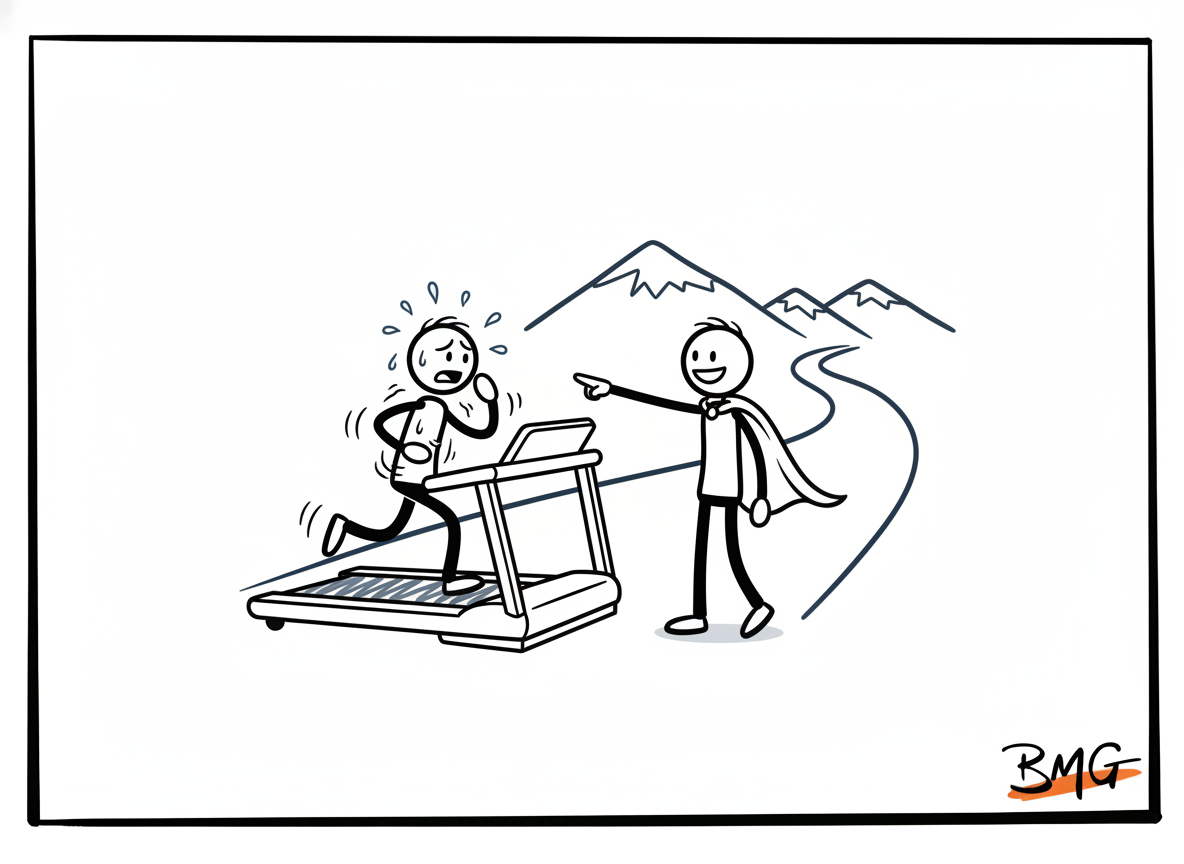
The Problem
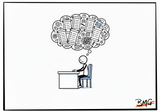
You are exhausted. Your calendar is a mosaic of thirty-minute blocks, back-to-back, from 8:00 AM until 6:00 PM. Your Slack, or Teams, notifications are a relentless drumbeat of ‘quick questions’ and ‘urgent updates’. You spend your lunch break (if you get one) triaging emails, and your evenings are dedicated to the ‘real work’ that you couldn't get to during the day.
If someone asked you how you are doing, your default answer is ‘Busy. Really busy.’
In many corporate cultures, this busy-ness is a badge of honour. It is seen as proof of your value, your dedication, and your importance to the organisation. You are the one who keeps the wheels turning. You are the one who bridges the gaps and fixes the fires.
But here is the hard truth: Busy-ness is often just a socially acceptable form of drift.
When you are frantically busy, you are usually operating in a state of ‘Heroic Execution’. You are relying on your own stamina, your own expertise, and your own caffeine levels to push things across the line. But heroic execution is not scalable, and it is certainly not sustainable. More importantly, it is a barrier to strategic momentum. While you are busy being the hero of today’s crisis, you are losing the ability to be the Guide for tomorrow’s growth.
You aren't moving faster. You are just vibrating in place.
The Reframe
We confuse activity with progress.
Activity is about the effort you put in. Progress is about the distance you travel toward your strategic goals. Frantic activity is often an immune response to a lack of clarity. When people don't know exactly what they own (Decision Rights) or what the standard is (High Fidelity), they default to doing more of everything in the hope that something will work.
The Busy-ness Barrier is the ceiling placed on your leadership by your own inability to stop doing.
High-fidelity leadership requires a shift from Activity to Outcome, and from Heroic to Normal Execution.
Normal execution is what happens when the operating cadence of the team is so clear, and the standards are so well-held, that results happen predictably without anyone having to be a hero. It is the transition from a leader who is the ‘Engine’ of the team to a leader who is the ‘Architect’ of the team’s rhythm.
Strategic momentum is quiet. It is measured. It looks, from the outside, almost like you aren't working that hard. But the distance you are covering is far greater than the leader who is sprinting on a treadmill.
The Operating Rhythm
A high-fidelity culture is built on a predictable Operating Cadence.
Most leaders treat meetings and check-ins as ‘interruptions’ to their work. In a high-fidelity system, the cadence is the work. It is the ritualised space where clarity is maintained, standards are reviewed, and decisions are made.
When your cadence is broken, busy-ness fills the vacuum. If there isn't a trusted time and place for a specific decision to be made, it will bleed into your Slack, your emails, and your ‘quick chats’ in the corridor. You are busy because you have allowed the work to become unstructured.
The Ghost in your team (the person who is incredibly busy but delivers nothing) is a master of the unstructured environment. They love the ‘urgent’ because it allows them to avoid the ‘important’. They can spend all day responding to pings and attending ‘alignment meetings’ without ever having to produce a high-fidelity outcome.
Your job is to build a barrier against the busy-ness by enforcing a rhythm that demands outcome over activity.
A quick pause
If this is helpful, the free guide goes deeper, and the newsletter brings ideas like this twice a week.
Personal Reflection
I used to pride myself on being the person who could handle the most. I thought my value was my capacity. If a project was failing, I would jump in, roll up my sleeves, and work harder than anyone else. I called this ‘Leading from the front’.
I remember one specific Friday afternoon. I was leading a critical launch. I had been working fourteen-hour days for three weeks. I was reviewsing a technical document for the third time, finding typos, correcting tone, and redrawing diagrams. I was tired, irritable, and feeling very proud of my ‘dedication’.
My mentor at the time stopped by my office. He looked at the screen, then at me, and asked one question: ‘Barry, if you are doing the Lead Architect’s job, who is doing your job?’
I started to explain how busy I was, how urgent the launch was, and how I was the only one who could ensure the quality.
He cut me off. ‘You aren't ensuring quality,’ he said. ‘You are insuring against their incompetence. And as long as you provide the insurance, they will never have to be competent. You are the busiest person here, and you are the reason the team is standing still.’
He was right. My busy-ness wasn't a sign of my leadership; it was a sign of my failure to build a high-fidelity system.
I was the Busy-ness Barrier.
Reflection Prompts
If I removed all the meetings from my calendar today, what strategic work would I actually have the capacity to do?
How much of my current ‘busy-ness’ is actually a Rescue Reflex triggered by my own anxiety?
Does my team’s operating rhythm eliminate noise, or does it create it?
What would 'Normal Execution' look like for my most important project?
Am I confusing my own heroic effort with the team’s strategic progress?
Final Thought
Busy-ness is the favourite disguise of the leader who is avoiding the hard work of clarity and standards.
It is easier to be busy than it is to be clear. It is easier to attend five meetings than it is to have one difficult conversation about a standard slip. It is easier to fix a problem yourself than it is to define the decision rights that would prevent the problem from recurring.
But the cost of that ease is your future.
To break through the Busy-ness Barrier, you must be willing to sit in the silence of a clear calendar. You must be willing to let go of the dopamine hit of ‘fixing’ and replace it with the steady, quiet work of building a system that doesn't need a hero. High-fidelity leadership is not about doing more; it is about ensuring that the things you do carry the weight of authority and the momentum of intent.
The path to extraordinary is walked with a thousand small steps, you’re doing great!
Your Small Steps
How do I start clearing the busy-ness?
Audit your week. Look at every meeting and ask: ‘What is the outcome of this meeting?’ and ‘Could this outcome be achieved through a clear decision right or a standard operating procedure?’
Small Step: Cancel or decline one meeting this week that does not have a clear, documented outcome.
What if everything feels urgent?
Urgency is usually a symptom of a lack of cadence. If people don't know when the next decision window is, everything feels like a crisis.
Small Step: Define a fixed ‘Decision Window’ (e.g., 2:00 PM to 3:00 PM on Thursdays) and tell your team that non-critical tactical calls will be handled then, and only then.
How do I handle the ‘Quick Question’ pings?
Every time you answer a ‘quick question’, you are training your people that your time is less valuable than their curiosity.
Small Step: Next time you get a Slack ping with a tactical question, wait thirty minutes before responding. Often, they will find the answer themselves if you don't provide the Rescue Reflex immediately.
Won't the team think I'm being distant or unreachable?
There is a difference between being unreachable and being structured. You aren't avoiding them; you are respecting the work.
Small Step: Set an ‘Out of Office’ or a Status on Slack for two hours a day that says ‘Deep Work: No pings. If the building is on fire, call me.’
My boss still expects me to be in every meeting.
This is a Standard Slip in your relationship with your manager. You need to reframe the conversation. ‘I’m reducing my attendance at X meetings so I can ensure 100% fidelity on Y strategic project.’
Small Step: Identify the one project your boss cares about most and use it as the ‘shield’ to protect your strategic time.
How do I know I’m moving toward ‘Normal Execution’?
Watch the energy of the team. In heroic execution, everyone is frazzled and red-faced. In normal execution, the team feels calm, focused, and steady. Results start arriving without the drama.
Small Step: Measure your week not by the tasks you completed, but by the number of times you didn't have to intervene to make things happen.

Barry Marshall-Graham
Executive coach and leadership advisor
Get the Difficult Conversations Guide
A practical resource for leaders who want to say the thing that needs saying, without burning bridges or avoiding the moment.
Keep reading
6 April 2026
The Soft Ending Trap
Hard conversations rarely fail at the opening. They fail when leaders soften the close, leave the standard vague, and walk away without a real commitment.
23 March 2026
Why ‘Empowerment’ Fails Without the Clarity of Decision Rights
Why telling your team they are ‘empowered’ often leads to paralysis, and how to fix it with clear decision ownership.
16 March 2026
How Your Desire to be Liked is Creating a Low-Fidelity Culture
Why being a ‘nice’ leader is often a form of standard-avoidance, and how to transition to supportive candour.
13 March 2026
The Weight of Unshared Doubt
Why senior leadership feels lonelier as you rise, and why confidence is often just unshared doubt.
9 March 2026
Why Your Best Advice is the Problem
Why the rush to fix others is actually a specific insecurity, and how to stop.
6 March 2026
The Weight in Your Voice
Your words carry more weight than you realise. Calm authority is often a matter of pace, tone, and the courage to name what matters.

2 March 2026
The Quiet Drift You Inherit
Inherited teams rarely collapse in a moment. They drift. Resetting standards isn't about being harsh, it's about clarity, dignity, and trust.
27 February 2026
When Everyone Owns It
Shared ownership sounds healthy, but when everyone owns a decision, nobody owns the decision. Clarity needs a single accountable owner.
23 February 2026
The Private Ledger of Leadership
Senior leaders carry a private ledger of risks, promises, and people. Naming that inner load isn't weakness, it's how you lead without breaking.
20 February 2026
The Avoided Conversation Is a Decision
The conversation you're avoiding isn't neutral. It's a decision to let the current pattern continue, and that decision shapes the culture.
