Why ‘Empowerment’ Fails Without the Clarity of Decision Rights
23 March 2026
Why telling your team they are ‘empowered’ often leads to paralysis, and how to fix it with clear decision ownership.
The Problem
You have walked into the room, or jumped on the Zoom call, and delivered the speech.
You’ve told your team that you want them to take the lead.
You’ve said, ‘I want you to feel empowered. I’m stepping back so you can step up. You have my full support.’
You wait for the surge of initiative. You wait for the decisions to start flowing and the momentum to build.
But instead, you get silence. Or worse, you get a series of emails asking for your ‘thoughts’ on minor tactical points. You get meetings that end with everyone looking at you, waiting for the final nod. You feel like you are still the bottleneck, despite your best intentions to get out of the way.
You think you have an ‘initiative’ problem or a ‘capability’ problem in your team.
You don't.
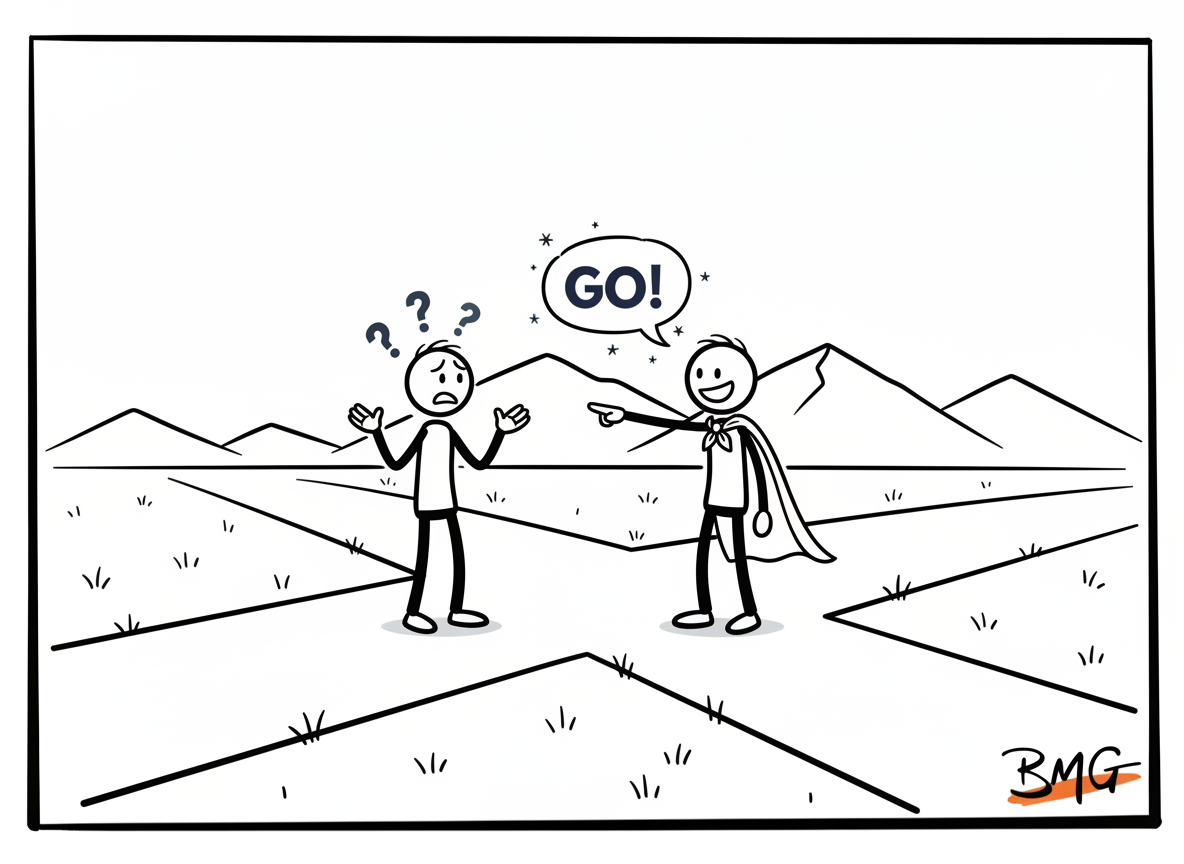
You have a clarity problem. You have trapped your team in the Permission Paradox. By telling them they are ‘empowered’ without defining exactly where their authority starts and yours ends, you have actually made it more dangerous for them to act. They are not empowered; they are exposed.
In the absence of clear decision rights, every action feels like a risk. Every decision feels like a potential overstep. And so, because they respect you and don't want to get it wrong, they default to the safest possible path: they ask for permission.
The Reframe
Empowerment is not a feeling. It is a contract.
When you use the word ‘empowered’ without specifying the boundaries, you are using a hollow term. It’s leadership fluff. It sounds good in a Town Hall, but it is functionally useless on a Tuesday morning when a director has to decide whether to sign off on a five-thousand-pound spend or wait for your approval.
The Permission Paradox is the gap between your intent to delegate and their ability to execute.
Real empowerment is the result of Decision Rights. It is the explicit agreement on who owns the final call in specific domains. It is moving from ‘I want you to take the lead’ to ‘You own the budget for X up to £10k, and you own the final sign-off on the hiring for Y. I don't need to see those decisions until they are made.’
Clarity is the fuel for initiative. When a team member knows exactly where they have the right to fail or succeed without your intervention, they stop asking for permission and start asking for help. And those are two very different conversations.
The Decision Vacuum
In most organisations, decision-making is not a process; it is a drift.
Political tension often arises not because people want power, but because they are terrified of being blamed for things they didn't know they owned. This is the ‘Decision Vacuum’. When ownership is unclear, the vacuum is filled by either the most aggressive person in the room or, more commonly, by a collective paralysis where nothing moves until a senior leader enters the space.
This creates a high-friction environment. Communication becomes a game of ‘Who needs to know about this?’ rather than ‘Who is deciding this?’.
The Ghost in your team (the person who is incredibly busy but delivers nothing)thrives in a decision vacuum. They can spend weeks ‘collaborating’ and ‘aligning’ without ever having to make a call. They are playing the game of activity because the game of outcome has no clear referee.
High-fidelity leadership requires you to be the referee. Your job is not to make the decisions; it is to ensure everyone knows who is making them.
A quick pause
If this is helpful, the free guide goes deeper, and the newsletter brings ideas like this twice a week.
Personal Reflection
I remember a time when I was leading a large-scale IT transformation. I had a brilliant team of leads, and I told them constantly that I trusted them to run their workstreams. I thought I was a model of empowering leadership.
Then I noticed that even the simplest architectural decisions were landing in my inbox.
I’d get these long, ‘FYI’ emails that were clearly looking for me to say, ‘Looks good, go ahead.’ I was frustrated. I thought, ‘Why can’t they just decide?’
One day, I sat down with my Lead Architect, a man with twenty years of experience who was still asking me for permission on server configurations. I asked him why. He looked at me and said, ‘Barry, last time a decision like this went wrong, you spent two hours in a post-mortem asking why I didn't consult you. I’m not asking for permission because I don't know the answer. I’m asking because I don't know if I’m allowed to be wrong.’
I realised that my ‘empowerment’ was conditional. I was happy for them to decide, as long as they decided what I would have decided.
Once I explicitly mapped out the decision rights - identifying what was a ‘Type 1’ decision (irreversible, I need to be involved) versus a ‘Type 2’ decision (reversible, you own it entirely)... the emails stopped. The momentum returned. But first, I had to admit that the bottleneck wasn't their lack of confidence; it was my lack of clarity.
Reflection Prompts
What decisions am I still making that my team should have the authority to make?
Have I explicitly defined the ‘Type 2’ decisions that my team can make without my approval?
Does my team know exactly where they have the right to be wrong?
Am I confusing ‘keeping me informed’ with ‘asking for my permission’?
What is the specific cost (to my time and to their growth) of my current decision-making involvement?
Final Thought
Empowerment fails when it is delivered as a gift rather than a specification.
If you want your team to stop asking for permission, you must stop being the person who gives it. You must do the hard work of defining the boundaries of their authority. It feels like more work upfront, and it is. It requires you to be precise about what matters and what doesn't.
But the reward is a team that moves with momentum and a leader who finally has the capacity to focus on the future. High-fidelity leadership is not about maintaining control; it is about scaling clarity so that control becomes unnecessary.
The path to extraordinary is walked with a thousand small steps, you’re doing great!
Your Small Steps
How do I start defining decision rights?
Start small. Don't try to map every decision in the company. Choose one repeated process or one upcoming project and list the top five decisions involved. Explicitly assign an ‘Owner’ for each.
Small Step: Take fifteen minutes today to list three decisions you’ve made this week that someone else on your team should have the right to make.
What if they make a bad decision?
They will. That is the price of empowerment. Your job is to ensure the ‘blast radius’ of their decision is manageable. If it’s a Type 2 decision (reversible), let them make it and then coach them through the post-mortem if it fails.
Small Step: Identify a low-risk decision today and explicitly tell the owner, ‘I trust your call on this. Even if it goes wrong, we will learn from it.’
My team says they want me involved. What then?
Sometimes teams use the leader’s approval as a shield against accountability. If they won't decide, ask them why. Is it a lack of information, or a lack of safety?
Small Step: Next time someone asks for your ‘thoughts’ on a decision they own, take a sip of water and ask: ‘What would you decide if I wasn't in the room?’
How do I communicate this to the team?
Be transparent. Tell them you’ve realised you are a bottleneck and you want to fix it. Use a simple framework like ‘Aware, Consult, Decide’.
Small Step: Draft a simple table with three columns: Decision, Owner, and Barry’s Role (e.g., ‘Informed only’). Share it in your next team meeting.
Won't I lose track of what’s happening?
Clarity on decision rights is not a licence to go dark. You still need an operating cadence that keeps you informed. The difference is that you are being informed of outcomes, not asked for inputs.
Small Step: Set up a weekly five-minute ‘Decision Log’ where your team listed the key calls they made that week.
What if my boss still expects me to make all the calls?
This is a standard-drift issue at the layer above you. You need to manage up. Show them the decision rights map you’ve created and explain how it is increasing your capacity to focus on the strategic goals they value.
Small Step: Identify one strategic project you could spend more time on if you delegated three tactical decision-making areas.

Barry Marshall-Graham
Executive coach and leadership advisor
Get the Difficult Conversations Guide
A practical resource for leaders who want to say the thing that needs saying, without burning bridges or avoiding the moment.
Keep reading
6 April 2026
The Soft Ending Trap
Hard conversations rarely fail at the opening. They fail when leaders soften the close, leave the standard vague, and walk away without a real commitment.
30 March 2026
How to Stop Confusing Frantic Activity with Strategic Momentum
Why senior leaders get trapped in 'heroic execution' and how to build a rhythm that prioritises outcome over activity.
16 March 2026
How Your Desire to be Liked is Creating a Low-Fidelity Culture
Why being a ‘nice’ leader is often a form of standard-avoidance, and how to transition to supportive candour.
13 March 2026
The Weight of Unshared Doubt
Why senior leadership feels lonelier as you rise, and why confidence is often just unshared doubt.
9 March 2026
Why Your Best Advice is the Problem
Why the rush to fix others is actually a specific insecurity, and how to stop.
6 March 2026
The Weight in Your Voice
Your words carry more weight than you realise. Calm authority is often a matter of pace, tone, and the courage to name what matters.

2 March 2026
The Quiet Drift You Inherit
Inherited teams rarely collapse in a moment. They drift. Resetting standards isn't about being harsh, it's about clarity, dignity, and trust.
27 February 2026
When Everyone Owns It
Shared ownership sounds healthy, but when everyone owns a decision, nobody owns the decision. Clarity needs a single accountable owner.
23 February 2026
The Private Ledger of Leadership
Senior leaders carry a private ledger of risks, promises, and people. Naming that inner load isn't weakness, it's how you lead without breaking.
20 February 2026
The Avoided Conversation Is a Decision
The conversation you're avoiding isn't neutral. It's a decision to let the current pattern continue, and that decision shapes the culture.
