The Soft Ending Trap
6 April 2026
Hard conversations rarely fail at the opening. They fail when leaders soften the close, leave the standard vague, and walk away without a real commitment.
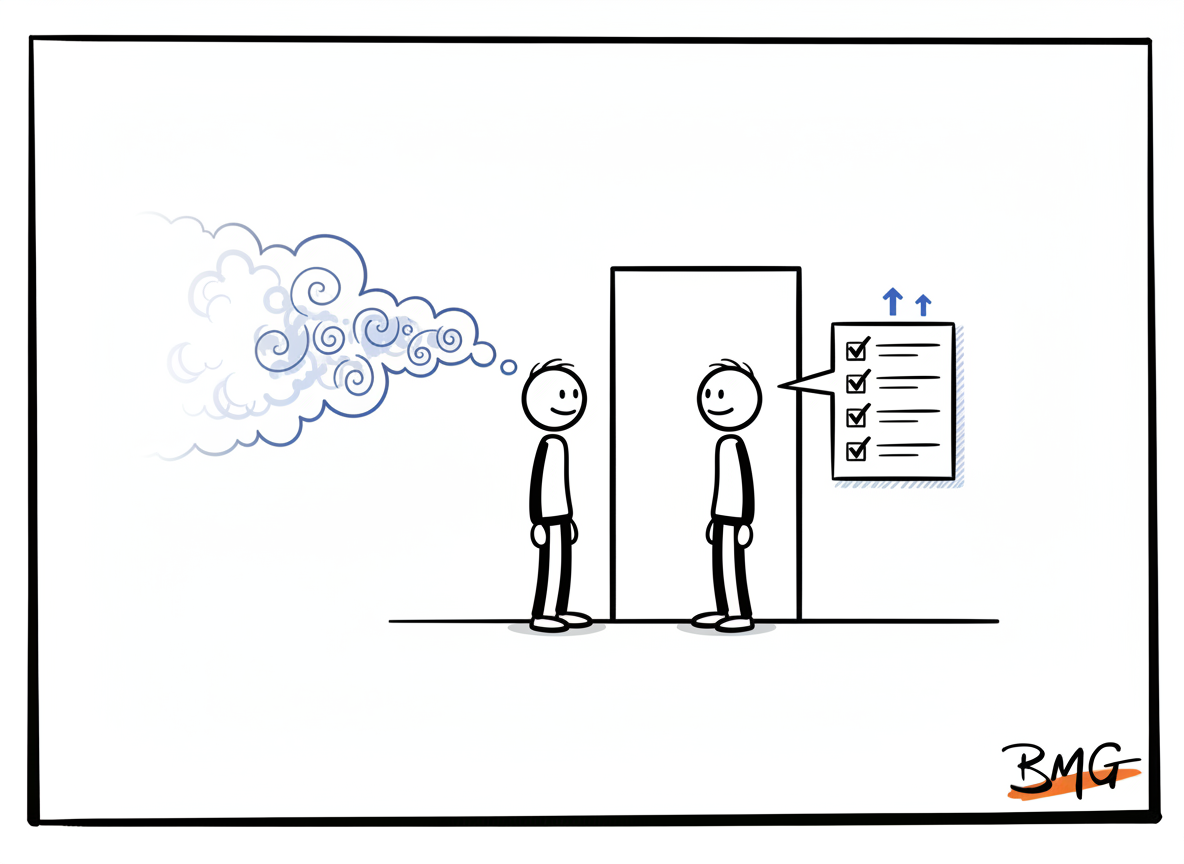
Why Difficult Conversations Fail in the Last Thirty Seconds
Most difficult conversations do not fail at the beginning.
They fail in the final thirty seconds.
You prepare yourself to say the hard thing. You choose your words carefully. You stay calm. You name the issue more directly than you usually would. For a moment, it feels like you have done the brave part.
Then you feel the tension in the room.
You see the other person’s face tighten. You hear your own pulse in your ears. You notice the instinct to rescue, smooth, reassure, and make sure they do not leave thinking badly of you.
So you soften the ending.
You say things like, ‘No rush, just have a think about it.’ Or, ‘Let’s keep talking and see how it goes.’ Or, ‘I’m sure this will settle down naturally.’
The conversation sounds mature. It sounds humane. It sounds as if you have preserved the relationship.
But in reality, you have just removed the line.
The problem is not that you lacked honesty. The problem is that you failed to convert honesty into clarity. You named the issue, then left the standard blurred, the ownership vague, and the next step unwritten. The emotional discomfort was visible, so you tried to reduce it. In doing so, you also reduced the usefulness of the conversation.
This is the Soft Ending Trap.
It is what happens when a leader has the courage to start the hard conversation, but not the steadiness to finish it cleanly. The issue gets aired, but not resolved. The emotional release creates the illusion of progress, while the actual operating conditions remain untouched.
That is why so many leaders leave a difficult conversation thinking, ‘Well, I said it.’ Then two weeks later they are carrying the same frustration, having the same internal monologue, and preparing for the same conversation all over again.
The Reframe
A difficult conversation is not complete when the truth has been spoken.
It is complete when the contract has changed.
That is the distinction many capable leaders miss. They think the point of the conversation is expression. It is not. Expression matters, because silence creates drift, but expression on its own does not change behaviour. A conversation only starts to matter when both people leave with a shared understanding of what will happen next.
In other words, the quality of the ending determines the value of the conversation.
If the close is vague, the conversation becomes a moment of emotional processing. That may feel relieving, but it will not reliably alter standards, behaviour, ownership, or trust. If the close is clear, the conversation becomes an operating event. Something has been reset. A line has been named. A follow-up exists. Responsibility now has shape.
Leaders often focus heavily on openers. They ask how to begin, how to phrase it, how not to trigger defensiveness, how to sound kind. Those things matter. A bad opener can make a conversation harder than it needs to be.
But weak endings create a more expensive problem than weak openings.
A clumsy opening can be recovered if the substance is real. A soft ending creates ambiguity that follows both people back into the work. It leaks into meetings, Slack threads, document reviews, and private resentment. Everyone senses the issue is still alive, but nobody can point to the exact standard that now applies.
The clean close is not the harsh close. It is not about dominance, nor is it about winning. It is the part where leadership becomes precise. It is the moment you move from naming a tension to defining the reality that now sits around it.
The Cost of the Polite Exit
The damage caused by a soft ending rarely looks dramatic. That is one reason it survives so easily.
It looks like a manager telling someone their updates need to be sharper, then ending with, ‘Let’s just keep an eye on it.’ Nothing explodes. There is no formal complaint. The next status report still arrives in the same vague shape, and now the manager feels even more irritated because they have technically already said something.
It looks like a founder finally addressing a senior hire whose meetings drift and overrun. The founder says the right words about focus and pace, sees the hire nod sympathetically, then closes with, ‘I know there is a lot going on right now, so let’s do our best.’ Everyone leaves with dignity intact, and no behavioural line has actually been set.
It looks like a director confronting tension between two team leads. They facilitate a careful conversation, everyone shares their side, there is visible relief in the room, and the director ends with, ‘I’m glad we’ve surfaced it. Let’s keep communicating openly.’ That sounds sensible. It also means nobody knows what changes tomorrow morning.
The cost is cumulative.
First, the leader loses credibility with themselves. They know, privately, that they did not actually hold the line. That creates a subtle form of internal friction. You start rehearsing the conversation again in your head, editing the parts you wish you had landed more clearly. You feel the residue of unfinished leadership.
Second, the other person receives mixed data. They heard concern, but not consequence. They heard discomfort, but not a reset. If they are reflective, they may guess what you meant. If they are anxious, they may overcorrect in the wrong direction. If they are avoidant, they may simply wait and see whether you really meant it.
Third, the team learns from the pattern. Teams study endings. They may not say this out loud, but they notice whether standards are stated cleanly or dissolved under emotional pressure. They notice whether accountability survives the last minute of tension. Over time, that pattern teaches people how seriously to take difficult conversations in your culture.
If the ending is habitually soft, the culture becomes politely unclear.
That is a terrible environment for good people.
High performers do not need a lot of drama, but they do need a reliable line. They need to know that when something matters, it will be named clearly enough for action to follow. When leaders repeatedly soften the close, high performers start carrying more interpretation work than they should. They become translators of vague leadership. They spend energy inferring what the standard probably is.
Meanwhile, lower-fidelity performers learn the opposite lesson. They learn that if they can absorb a difficult moment without openly resisting, the pressure will probably pass. The conversation becomes something to survive, not something to respond to.
That is how drift spreads after a conversation that looked, on the surface, successful.
A quick pause
If this is helpful, the free guide goes deeper, and the newsletter brings ideas like this twice a week.
What a Clean Close Sounds Like
Most leaders imagine clarity has to sound cold. It does not.
Clarity usually sounds quieter than that.
A clean close is specific, bounded, and human. It tells the other person what matters now, what will happen next, and how you will both know the issue is improving. It removes guessing without removing dignity.
That might sound like this:
‘I want to be clear about the shift I need. From next week, your project updates need to include decision, risk, owner, and date. If those four elements are missing, I will treat the update as incomplete.’
Or this:
‘I’m not asking for a general improvement. I’m asking for client meetings to start on time and finish with explicit actions. Let’s review that in our 1:1 next Thursday.’
Or this:
‘I appreciate you hearing this. I also want to be direct that this is now a standard, not a suggestion. We’ll revisit it in two weeks and look at the evidence together.’
Notice what these endings do.
They do not multiply words. They reduce escape routes.
They answer the questions people are usually left carrying after a vague conversation:
What exactly needs to change?
By when?
How will it be observed?
When will we review it?
What status does this now hold, suggestion or standard?
That is the architecture of a clean close.
It is not always possible to answer every question in the room, especially in emotionally charged situations. But you should be able to leave with enough specificity that both people could independently write down the next step in almost identical language. If that is not true, the ending is probably too soft.
One practical test helps here. At the end of the conversation, ask yourself: if I vanished for two weeks, would the other person know what to do next without another translation meeting? If the honest answer is no, the close is not done yet.
Another useful discipline is to separate empathy from dilution.
You can say, ‘I know this is uncomfortable.’ You can say, ‘I appreciate that this may be hard to hear.’ You can say, ‘I’m raising it because I care about the standard and your success.’
What you cannot do, if you want the conversation to matter, is let empathy replace precision.
The kind ending is not the one that makes the room feel instantly lighter. The kind ending is the one that gives the other person a fair chance to succeed because the standard has finally been made visible.
The Emotional Reason We Leave It Vague
If you are intelligent and experienced, you probably already know most of this.
The real issue is not knowledge. It is self-protection.
Leaders soften endings because clarity creates exposure.
Once you define the line, you have to hold it. Once you set the follow-up, you have to return to it. Once you say, ‘This needs to change by next Thursday,’ you lose the comforting flexibility of pretending the matter is still open-textured and contextual. You now have to be the person who notices, follows through, and stays steady if the response is awkward.
That is why vague endings can feel so appealing. They preserve optionality for you.
If the behaviour improves, you can tell yourself the conversation worked. If it does not, you can have another conversation and still claim you were being supportive. Vagueness keeps your image clean. You can feel caring without yet having to bear the full weight of clarity.
There is another layer too. Many leaders are not actually afraid of the difficult conversation. They are afraid of what a clean ending reveals about the relationship.
If you close clearly and the other person still does not respond, you have learned something more definitive. You can no longer hide in the soothing belief that they simply ‘didn’t quite get it’. You may have to confront a deeper problem of fit, willingness, maturity, or trust.
Soft endings delay that reckoning.
They buy emotional time.
But the time is expensive. While you are buying time for yourself, the team is paying for it through confusion, duplicated effort, uneven standards, and avoidable resentment.
I have seen leaders spend months in this loop. They keep having articulate conversations with a person whose behaviour never really changes. Every conversation feels substantial. There are thoughtful sentences, visible care, and mutual understanding. Yet the operating reality stays stuck because none of the endings ever redraw the line.
This is one of the hidden ways nice leadership becomes low-fidelity leadership.
The leader is not silent. The leader is not aggressive. The leader is simply unwilling to let the final minute become concrete.
Reflection Prompts
Which conversation in my world has already happened once, but not actually finished?
Where am I using warmth to blur a line that needs definition?
If I named the next step and the review point clearly, what discomfort would that create for me?
What standard does the other person think applies right now, and how sure am I of that?
Am I trying to preserve the relationship by avoiding clarity, or strengthen it through clarity?
Final Thought
Most people assume the courage in difficult conversations lives in the opening line.
Sometimes it does.
But very often the real courage is in the last thirty seconds, when the emotional temperature has shifted and you have a choice. You can reach for relief, or you can provide clarity. You can end with something that sounds caring, or with something that is useful enough to carry the standard forward.
Leadership is not only the willingness to say the difficult thing. It is the willingness to leave behind a cleaner reality once you have said it.
The path to extraordinary is walked with a thousand small steps, you’re doing great!
Your Small Steps
How do I know if a previous conversation ended too softly?
Look for repetition. If you have already raised the issue once and you are still privately translating what you meant, the close was probably too vague.
Small Step: Write down the last difficult conversation you had and complete this sentence: ‘The concrete change I asked for was…’ If that sentence is hard to finish, the ending needs another pass.
What should I include in every clean close?
You need four elements: the change required, the evidence that will show it, the timing, and the follow-up point. You do not need a script, but you do need those anchors.
Small Step: Before your next hard conversation, put these four prompts on a note in front of you: Change, Evidence, Timing, Review.
What if I worry that clarity will sound too harsh?
Usually that fear means you are equating precision with aggression. They are not the same. Precision is simply the removal of guesswork.
Small Step: Practise one closing line aloud: ‘I’m being direct here because I want the expectation to be fair and visible.’
What if the other person gets emotional at the end?
Emotion does not mean the close was wrong. Stay regulated. Acknowledge the emotion without retreating from the standard.
Small Step: If the room gets tense, use one steady sentence: ‘I can see this matters, and I still want to be clear about what changes next.’
How do I avoid over-explaining the ending?
When we feel anxious, we add words. More words usually means more loopholes. Say the line, state the follow-up, then stop.
Small Step: After you state the expectation, pause for three seconds before speaking again.
What if I am not sure what the exact standard should be?
Then the work is not to delay the conversation forever. The work is to think more clearly before you have it. Ambiguous leaders often generate ambiguous endings because they have not fully defined the line for themselves.
Small Step: Spend ten minutes before the conversation writing the sentence: ‘Good looks like…’ Keep refining it until it is concrete.
How do I stop myself from rescuing the feeling in the room?
Notice the moment you start trying to make everyone feel better. That is often where the line starts dissolving. Your job is not to rescue the mood. Your job is to hold the standard and the relationship at the same time.
Small Step: When you feel the urge to soften, take a sip of water instead of adding another reassuring sentence.

Barry Marshall-Graham
Executive coach and leadership advisor
Get the Difficult Conversations Guide
A practical resource for leaders who want to say the thing that needs saying, without burning bridges or avoiding the moment.
Keep reading
30 March 2026
How to Stop Confusing Frantic Activity with Strategic Momentum
Why senior leaders get trapped in 'heroic execution' and how to build a rhythm that prioritises outcome over activity.
23 March 2026
Why ‘Empowerment’ Fails Without the Clarity of Decision Rights
Why telling your team they are ‘empowered’ often leads to paralysis, and how to fix it with clear decision ownership.

16 March 2026
How Your Desire to be Liked is Creating a Low-Fidelity Culture
Why being a ‘nice’ leader is often a form of standard-avoidance, and how to transition to supportive candour.

13 March 2026
The Weight of Unshared Doubt
Why senior leadership feels lonelier as you rise, and why confidence is often just unshared doubt.

9 March 2026
Why Your Best Advice is the Problem
Why the rush to fix others is actually a specific insecurity, and how to stop.

6 March 2026
The Weight in Your Voice
Your words carry more weight than you realise. Calm authority is often a matter of pace, tone, and the courage to name what matters.

2 March 2026
The Quiet Drift You Inherit
Inherited teams rarely collapse in a moment. They drift. Resetting standards isn't about being harsh, it's about clarity, dignity, and trust.

27 February 2026
When Everyone Owns It
Shared ownership sounds healthy, but when everyone owns a decision, nobody owns the decision. Clarity needs a single accountable owner.
23 February 2026
The Private Ledger of Leadership
Senior leaders carry a private ledger of risks, promises, and people. Naming that inner load isn't weakness, it's how you lead without breaking.

20 February 2026
The Avoided Conversation Is a Decision
The conversation you're avoiding isn't neutral. It's a decision to let the current pattern continue, and that decision shapes the culture.
