Action is the Antidote to Anxiety
3 November 2025
Turning movement into mindful progress in a world that stirs worry
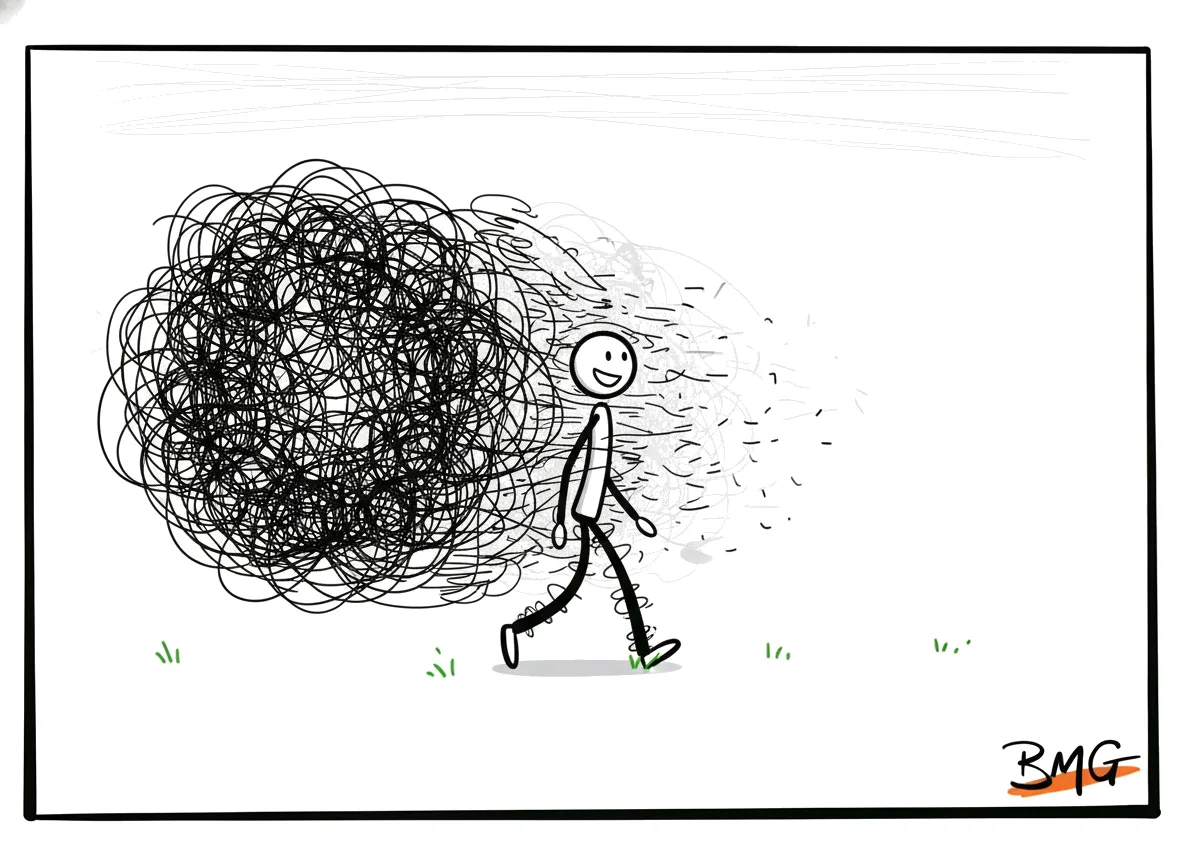
In our hyper-connected, always-on world, it is little wonder that anxiety has become the background hum of our daily existence.
We are exposed to more information, more choice and more complexity than any previous generation, and all of it seems to demand a response.
Usually, an immediate response!
Yet the reflexive response to anxious feelings (to retreat, hesitate, overanalyse) often makes the feeling worse. We churn scenarios in our minds, ruminate on what might go wrong, and freeze ourselves into inertia.
Monday mornings can highlight this tension: the week stretches ahead, and every decision seems weighty.
As leaders, we are expected to anticipate change, to manage risk and to keep the people around us calm. It is easy to assume that more thought and more planning will bring us peace but the paradox is that peace seldom arrives through thought alone.
The philosopher William James wrote that “Action seems to follow feeling, but really action and feeling go together.”
The Spiral of Anxiety
Anxiety is a natural biological response to perceived threats. Our ancestors relied on these responses to survive!
In more modern times however, many of the “threats” that trigger this response are intangible: looming deadlines, ambiguous messages and the fear of making the wrong move.
Think about those … there is no immediate outlet - no wild animal to flee or fire to extinguish - the energy has nowhere to go. We end up fighting our own thoughts or fleeing into distraction and procrastination.
Anxiety thrives in the space between knowing we need to do something and actually doing it.
The longer we delay, the larger the task looms.
Analysis Paralysis
Modern organisations celebrate strategic thinking, and rightly so … but there is a tipping point where reflection becomes rumination. Psychologists call this “analysis paralysis”: the state where practical approaches fail to move from anxiety to action.
It’s not laziness that keeps us stuck; it’s the illusion that more information will make the choice clear.
However the irony is that when we linger too long in preparation, our minds fill the unknown future with imagined pitfalls and our opportunities quietly expire while we ponder them.
I believe that the solution is not to eradicate planning altogether, but to pair your thinking with doing.
A rough draft is better than a perfect idea stuck in your head; a prototype teaches you much more than another hour of analysis.
Leaders who break free from analysis paralysis accept that imperfect action, followed by reflection, is what leads to progress.
A quick pause
If this is helpful, the free guide goes deeper, and the newsletter brings ideas like this twice a week.
Recommended Practice
This week, choose one area of your work or life where anxiety often holds you back.
Commit to a single, daily action in that area.
Keep the action deliberately small so that it is impossible to ignore: two minutes of research, one paragraph of writing, one phone call.
Track how your feelings change before and after you complete the action.
Notice how, over time, the dread diminishes and your confidence grows.
You might be surprised by how quickly momentum builds.
It’s like pushing a heavy flywheel, the first turns are the hardest, but once it is spinning, it requires far less effort to keep it moving.
Reflective questions
What recurring task or decision do you tend to postpone, and how does that postponement affect your anxiety levels?
If you could take one small action today that would reduce your worry about the week ahead, what would it be?
How might your leadership style change if you focused more on initiating experiments than on achieving perfect outcomes?
Whose support could you enlist to hold you accountable for taking the actions that matter?
Take a few minutes to journal or think on these prompts.
They are not here to add more items to your to‑do list; they are intended to help you unearth the patterns that keep you stuck.
Awareness is the first step toward movement.
Closing thoughts
Anxiety is not an enemy to be vanquished; it is a messenger telling us something needs our attention. When we respond with purposeful action, we honour the message without allowing it to control us. We transform restless energy into forward motion.
As you move through this week, remember that leadership is not measured by how little you feel, but by what you do in the presence of feeling.
Take the small step that is in front of you.
Then take the next.
In time, those small steps become giant leaps.
(See what I did there :) )
Remember, the path to extraordinary is walked with a thousand small steps, and you’re doing great!
Your Small Steps
Why do I still feel anxious even after I begin taking action?
Because momentum builds gradually, and your mind may revisit unresolved worries.
Action: Notice how your anxiety changes after each small step; write down your progress and remind yourself that progress takes time.
How can I choose the right small action?
Use the smallest possible step that moves you closer to resolution; it doesn’t have to be perfect, just actionable.
Action: Ask yourself, ‘What five‑minute task could shift this?’ and start there.
What if I don’t know where to start?
When overwhelmed, choose any step that feels intuitive rather than overthinking the entire path.
Action: Flip a coin or let chance decide the first micro‑action and commit to it to break inertia.
How do I keep going when I feel stuck again?
Build accountability and momentum with routines and check‑ins.
What if my first action doesn’t work?
Not all actions produce immediate results, but each teaches you something.
Action: Treat every outcome as feedback; adjust your next step accordingly rather than abandoning the process.

Barry Marshall-Graham
Executive coach and leadership advisor
Get the Difficult Conversations Guide
A practical resource for leaders who want to say the thing that needs saying, without burning bridges or avoiding the moment.
Keep reading
13 March 2026
The Weight of Unshared Doubt
Why senior leadership feels lonelier as you rise, and why confidence is often just unshared doubt.
9 March 2026
Why Your Best Advice is the Problem
Why the rush to fix others is actually a specific insecurity, and how to stop.
6 March 2026
The Weight in Your Voice
Your words carry more weight than you realise. Calm authority is often a matter of pace, tone, and the courage to name what matters.

2 March 2026
The Quiet Drift You Inherit
Inherited teams rarely collapse in a moment. They drift. Resetting standards isn't about being harsh, it's about clarity, dignity, and trust.
27 February 2026
When Everyone Owns It
Shared ownership sounds healthy, but when everyone owns a decision, nobody owns the decision. Clarity needs a single accountable owner.
23 February 2026
The Private Ledger of Leadership
Senior leaders carry a private ledger of risks, promises, and people. Naming that inner load isn't weakness, it's how you lead without breaking.
20 February 2026
The Avoided Conversation Is a Decision
The conversation you're avoiding isn't neutral. It's a decision to let the current pattern continue, and that decision shapes the culture.

16 February 2026
Calm Authority in Tense Rooms
Authority isn't volume or force. It's the ability to hold a tense room steady, name what matters, and set a clear boundary without heat.

13 February 2026
The First Small Tolerance
Standards rarely collapse in a moment. They slip through the first small tolerance you let pass, then the next one feels easier.
9 February 2026
The Decision Vacuum
When decision rights are unclear, every meeting becomes a referendum. Clarity is less about answers and more about who owns the call.
