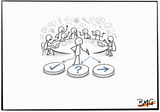
Calm Authority in Tense Rooms
16 February 2026
Authority isn't volume or force. It's the ability to hold a tense room steady, name what matters, and set a clear boundary without heat.

The Problem
In tense rooms, senior leaders often feel a quiet dilemma.
If they push hard, they risk being seen as heavy handed.
If they soften, they risk being ignored. The pressure to land the meeting can turn a calm leader into someone who speaks too much, or not at all.
You can see the ripple effect. People speak around the issue instead of naming it, and he conversation becomes indirect. A confident team starts to look cautious. The room feels busy, but the centre is missing.
I've watched a senior team debate a customer exit decision for over an hour.
Sales wanted to keep the account, operations wanted to walk away, and finance wanted to reduce the exposure. The leader kept trying to balance every view, hoping to keep the room calm.
The result was a polite loop.
Nobody left clear on the call, and the leader left carrying the tension alone.
This is where authority is tested. Right here in in moments of tension. The challenge isn't a lack of knowledge, it's how you hold the room when the temperature rises.
The Reframe
Authority isn't force.
It's clarity with gravity.
It's the ability to hold a boundary without raising your voice, and to name the reality of a situation without making it personal.
When you show calm authority, people relax. They mightn't agree, but they trust that someone is holding the line. That trust is what turns a tense room into a room that can decide.
It's the keel that stops the ship from rolling in rough water.
The Signals People Read
People read authority in the small signals before they hear the content. The pace of your words. The way you pause. The willingness to let a question land instead of rushing to fill the space.
If you speak too quickly, the room hears anxiety. If you over explain, the room hears uncertainty. If you soften every statement with extra context, the room begins to think there's more room for negotiation than there really is.
Your physical presence matters too. If you keep looking down at your notes or your screen, the room reads distance. If you keep scanning for approval, the room reads doubt.
Calm authority shouldn't need to be a performance, but it's observable. People notice when you sit forward, hold eye contact, and stay present when the tension rises.
People also read your consistency outside the tense moment. If you say you'll decide by Friday and you do, authority grows. If you delay without naming why, authority erodes. Calm authority is built in follow through as much as in the moment itself.
It also shows up in your boundaries. A boundary isn't a threat. It's the clean edge of a decision. When you say, this is the decision, and this is the reason, you aren't shutting the room down.
You're stopping it from circling.
Finally, think about the signal of what you don't say. The moment you refuse to take the bait, or avoid a side argument, tells the room you aren't here to win a debate.
You're here to lead the decision.
A quick pause
If this is helpful, my free guide goes deeper, and the newsletter brings ideas like this twice a week.
My book, High-Fidelity Leadership, explores these same themes in more depth, with practical frameworks for standards, clarity, and the conversations that leaders avoid for too long.
The Moment That Tests It
I remember a leadership offsite where the temperature changed in a single sentence.
The CFO said, this plan won't stand up to the board. The room went quiet. The entire room looked to the CEO, waiting for the response.
The CEO could have reacted defensively, pushed back or tried to convince the room with more detail. Instead, they paused and said... "the risk is real, and we aren't pretending it isn't". Then they named the decision the team needed to make, and set a clear time frame for it.
Almost immediately, the room softened, because the tension was acknowledged and contained. The conversation moved from posturing to problem solving. The authority in that moment came from calm clarity, not from argument.
After the meeting, people referenced that pause more than the decision itself. It gave them a signal about how future tension would be held.
That's the hidden function of authority. It teaches the room what to expect when things are hard.
This is why authority in tense rooms is a skill that shows up in your posture and your timing. It's the ability to hold the heat long enough for the decision to be made.
Personal Reflection
I used to mistake volume for presence. When the room felt tense, I'd speak more, faster, and with more detail. Fill the gaps.
It felt like care, but in hindsight, it was also a way of avoiding the discomfort of holding a boundary.
The change for me came when I noticed how little of my "extra explanations" actually helped. People were not looking for more detail. They were looking for a clear stance they could work with.
I also noticed how much the tension was affecting my body. I'd leave a meeting and feel the adrenaline hours later. That was a signal that I was carrying more of the room than I needed to.
Calm authority isn't just a communication skill, it's a way of sharing the load back to the room. Where is belongs!
Now, when a room tightens, I focus on two things.
I slow down, and I name the core issue.
It doesn't always make the moment easy, but it makes the decision possible.
Reflection Prompts
Where do I confuse being calm with being quiet?
What boundary am I softening to reduce tension in the room?
Where do I over explain because I want to be liked?
What short sentence would give the room clarity right now?
How can I use silence as a leadership signal, not an absence?
Final Thought
Authority in tense rooms isn't about winning.
It's about steadying the space so a decision can be made.
People can tolerate hard choices when they feel the leader is calm and clear.
If you want the room to trust you, hold the line without heat.
That's what calm authority looks like.
The path to extraordinary is walked with a thousand small steps, you’re doing great!
Your Small Steps
How do I avoid coming across as heavy handed?
Start with clarity. If the decision and the reason are clean, you can state them without force. People rarely resist clarity, they resist uncertainty.
Small Step: Write the decision and the one sentence reason before the meeting, and stick to it.
What if the room keeps arguing anyway?
Don't chase every point. Name the pattern, then return to the decision. You can acknowledge the concern without reopening the decision every time.
Small Step: Use a simple line like, I hear the concern, and the decision stands. Let that be enough.
How do I handle a direct challenge from a peer?
Pause, acknowledge, and respond to the substance, not the heat. A calm response signals you aren't threatened and keeps the conversation professional.
Small Step: Take one full breath before you respond to a challenge, then answer in one sentence.
What if I'm not fully sure about the decision?
If you're still unsure, name what's missing and set a clear path to a decision. Uncertainty is acceptable when it's owned.
Small Step: Say, I'm not decided yet, and name the two criteria that will settle it.
How do I build authority with a new team?
Consistency builds credibility. Do what you say you'll do, and hold the line on small standards. Authority grows in the small moments.
Small Step: Choose one small standard to enforce this week and follow through calmly.
How do I stop over explaining?
Notice the impulse to add extra context. If the decision is clear, extra detail can sound like doubt. Keep it short and clean.
Small Step: Limit yourself to one paragraph when explaining a decision, then stop.

Barry Marshall-Graham
Executive coach and leadership advisor
Get the Difficult Conversations Guide
A practical resource for leaders who want to say the thing that needs saying, without burning bridges or avoiding the moment.
Keep reading
31 August 2026
The Sentence They Nearly Said
A pause or changed expression may lead to the useful part of a conversation, but noticing it doesn't give the coach permission to decode it.
24 August 2026
You Cannot Coach Someone You Are Secretly Judging
Second-hand information may be useful, but once it becomes a character verdict it changes the leader’s listening, questions and tone.
17 August 2026
A Good Question Can Be Badly Timed
The wording may be excellent, but a coaching question can still arrive before the relationship or the moment is ready to carry it.
10 August 2026
Whose Goal Is It Anyway?
A goal can be strategically sensible and still feel unowned. The answer is honest internalisation, not coaching somebody into believing it was their idea.
3 August 2026
The Leader Who Uses Coaching to Avoid Leading
Coaching can create room for another person to think, but it can also help a leader postpone the feedback, standard or decision that belongs to them.
27 July 2026
Advice Wearing a Hat
A coaching question can sound wonderfully curious while quietly steering somebody towards the answer their leader already prefers.
20 July 2026
The Emotional Cost of Being the Reliable One
Reliability earns trust, but it can also turn one capable leader into the place where unfinished work, uncertainty, and organisational risk accumulate.
13 July 2026
The Relief of Finally Saying the Thing
An overdue conversation occupies far more space than the words themselves. Relief begins when reality is finally allowed back into the room.
6 July 2026
The Sideways Shove
Peer conflict cannot be solved with the Manager Card. Influence begins when leaders stop pushing across borders and repair the working relationship.
29 June 2026
Clarity Under Pressure
Authority is tested when the room tightens. Clear leaders make reality, uncertainty, and the next decision visible without adding drama.