The Meeting After the Meeting
22 January 2026
Why real alignment only happens when truth can survive the room.
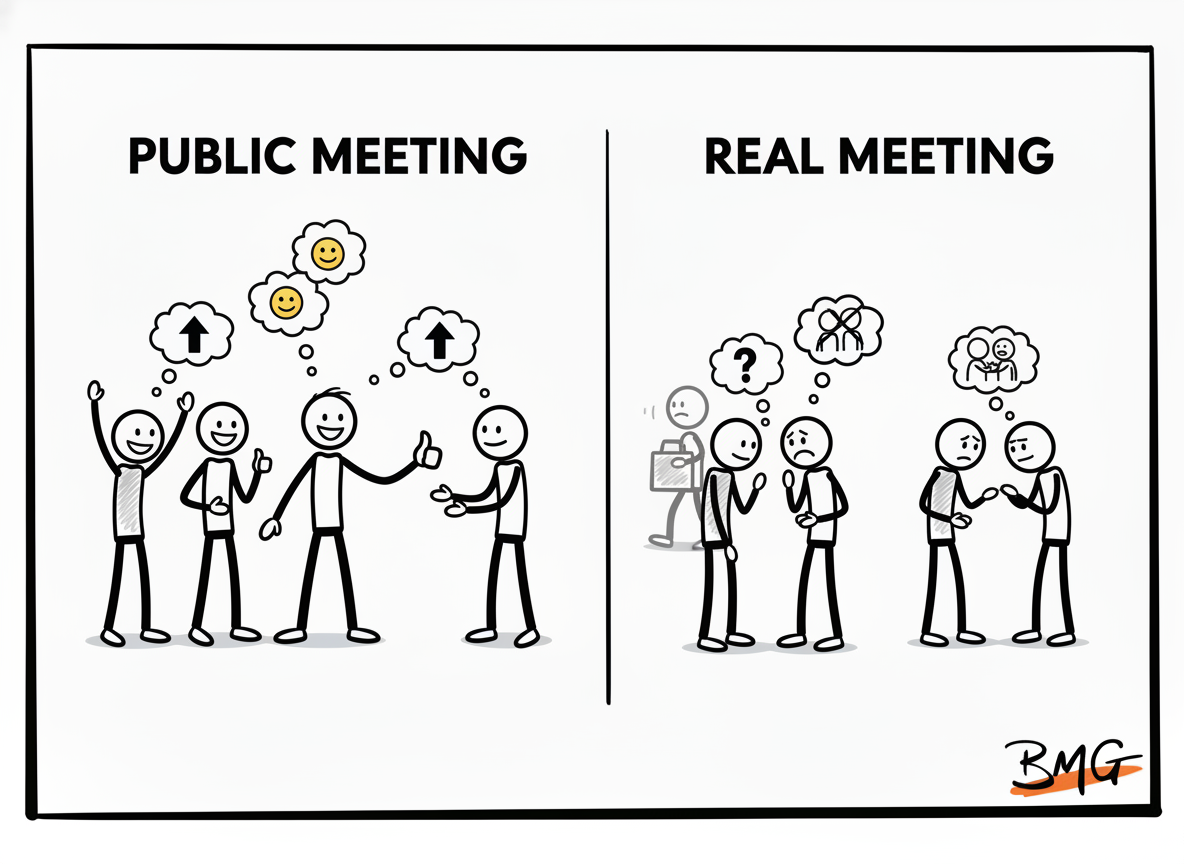
There's a particular moment most senior people recognise.
The meeting ends. Everyone says, "Sounds good." Cameras go off, notebooks close, and the room empties.
Then the real meeting begins.
It happens in side chats, corridor conversations, quiet DMs, and that one follow-up call where the tone suddenly changes. Concerns appear that somehow could not be spoken when everyone was present. Doubts surface that were apparently not worth naming five minutes earlier. Decisions get softened, delayed, or quietly re-litigated.
And if you're the leader, you feel it as a kind of hidden drag.
Not because people are bad, or political, or trying to undermine you. Often it's because truth has a social cost, and people are managing that cost in real time. They are protecting relationships, reputations, status, and sometimes their own sense of safety. The safest place to be honest can feel like the place where the fewest people are watching.
But ... here's the problem.
When the truth only shows up after the meeting, you do not have alignment. You have compliance, followed by correction. You have a decision that looks clean on paper and messy in reality. You have momentum that seems to exist until it doesn't.
Over time, it becomes normal. The public room becomes a performance. The private room becomes where leadership actually happens.
If this is showing up around you, it's worth asking a few gentle questions.
What do people believe happens to them if they speak plainly in the room?
What kinds of truth are welcomed, and what kinds of truth are quietly punished?
What have you been rewarding without meaning to, agreement over honesty, smoothness over clarity, harmony over reality?
And if you're honest, where do you do it too?
Where do you save your real view for later because it feels safer?
A thought to land the week.
The goal is not to force people to speak. It's to make it safer to be real than to be polite. The more senior you become, the more your work is not just making decisions, it's creating conditions where the truth can survive in public.
If you'd like these reflections in your inbox twice a week, please consider subscribing to my newsltter below (Twice-weekly reflections on leadership, clarity, and the inner load of senior roles.)
The path to extraordinary is walked with a thousand small steps, you're doing great!

Barry Marshall-Graham
Executive coach and leadership advisor
Get the Difficult Conversations Guide
A practical resource for leaders who want to say the thing that needs saying, without burning bridges or avoiding the moment.
Keep reading
13 March 2026
The Weight of Unshared Doubt
Why senior leadership feels lonelier as you rise, and why confidence is often just unshared doubt.
9 March 2026
Why Your Best Advice is the Problem
Why the rush to fix others is actually a specific insecurity, and how to stop.
6 March 2026
The Weight in Your Voice
Your words carry more weight than you realise. Calm authority is often a matter of pace, tone, and the courage to name what matters.

2 March 2026
The Quiet Drift You Inherit
Inherited teams rarely collapse in a moment. They drift. Resetting standards isn't about being harsh, it's about clarity, dignity, and trust.
27 February 2026
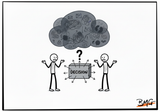
When Everyone Owns It
Shared ownership sounds healthy, but when everyone owns a decision, nobody owns the decision. Clarity needs a single accountable owner.
23 February 2026
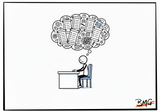
The Private Ledger of Leadership
Senior leaders carry a private ledger of risks, promises, and people. Naming that inner load isn't weakness, it's how you lead without breaking.
20 February 2026
The Avoided Conversation Is a Decision
The conversation you're avoiding isn't neutral. It's a decision to let the current pattern continue, and that decision shapes the culture.

16 February 2026
Calm Authority in Tense Rooms
Authority isn't volume or force. It's the ability to hold a tense room steady, name what matters, and set a clear boundary without heat.

13 February 2026
The First Small Tolerance
Standards rarely collapse in a moment. They slip through the first small tolerance you let pass, then the next one feels easier.
9 February 2026
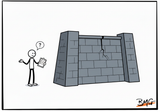
The Decision Vacuum
When decision rights are unclear, every meeting becomes a referendum. Clarity is less about answers and more about who owns the call.
