From Insight to Execution: The Principles of ‘Good to Great’ (Part One)
8 September 2024
Crafting a Winning Team Strategy
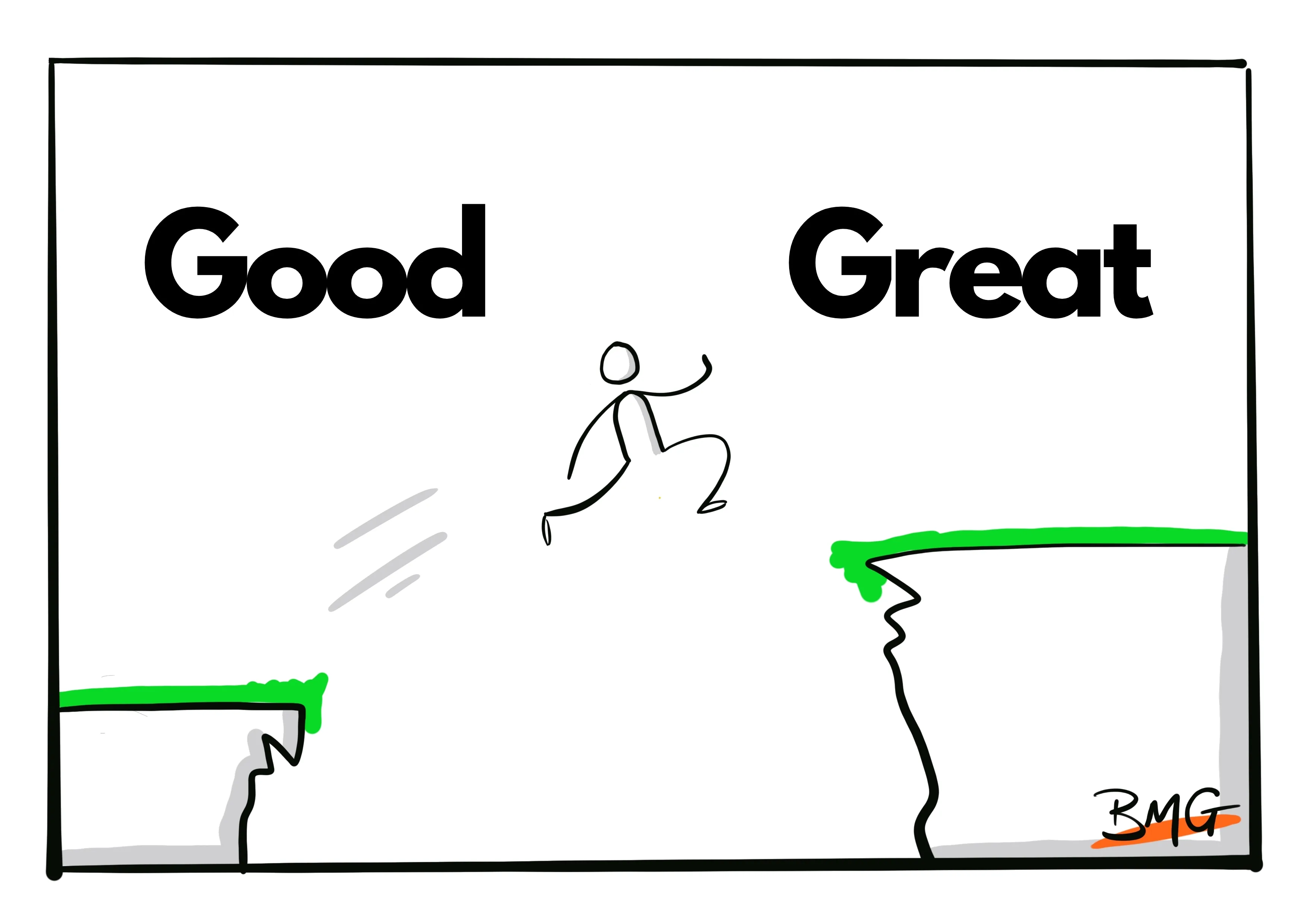
Turning a good team into a great one requires more than just ambition. It calls for a well-thought-out strategy and effective execution.
I took on a challenge recently where the remit was a simple one … take a good, established and well-rounded team, to a great one. Fortunately, I have some experience here.
I don’t just build good teams, I build great, high-performing teams.
The following article explores how to build a winning team strategy using principles from Jim Collins' book 'Good to Great'.
We will delve into leadership, talent management, facing hard truths, and more, all aimed at helping you and your team achieve lasting success.
Key Takeaways
Strong leadership is essential for building a solid foundation in any organisation.
Having the right people in the right roles is crucial for long-term success.
Facing harsh realities with a balanced mindset can lead to better decision-making.
Simplicity in strategy, focusing on core strengths, can drive exceptional results.
A disciplined culture can help maintain focus and achieve goals consistently.
Building momentum is key to sustaining long-term success and avoiding pitfalls.
Leveraging technology can accelerate growth and innovation.
Continuous improvement and adaptability are essential for enduring success.
Building a Foundation with Level 5 Leadership
Understanding Level 5 Leadership
Level 5 Leadership is about building greatness for the company or team, not for oneself. It is leadership style characterised by a blend of personal humility and professional will.
These leaders are modest, self-effacing, and focused on the success of the organisation rather than personal accolades.
They are fiercely determined to do what is best for the company, displaying a strong resolve to achieve long-term goals, while also empowering and supporting their teams.
This unique combination of traits enables them to drive their companies from good to great.
Level 5 leaders channel their ego needs away from themselves and into the larger goal of building a great company. It’s not that Level 5 leaders have no ego or self-interest. Indeed, they are incredibly ambitious, but their ambition is first and foremost for the institution, not themselves.
Characteristics of Level 5 Leaders
Level 5 Leaders are:
Humble
Driven to do the right thing for the company or team
Highly capable
Contributing team members
Competent managers
Effective leaders with a clear vision
Impact on Organisational Culture
Level 5 Leadership create and maintain a cultures of humility and ambition.
It encourages teams to focus on the company's success rather than seek personal gain.
This leadership style can transform a company's culture, making it more collaborative and goal-oriented.
Developing Level 5 Leaders
To develop Level 5 Leaders, organisations should:
Identify potential leaders with humility and determination.
Provide training and development opportunities.
Encourage a culture of continuous improvement.
Offer mentorship and coaching.
Challenges in Cultivating Level 5 Leadership
Cultivating Level 5 Leadership can be challenging.
It requires a long-term commitment to developing leaders who prioritise the company's success over personal ambition.
Additionally, it can be very difficult to identify individuals with the right mix of humility and determination, which leads us very nicely to our next section.
First Who, Then What: The Right People on the Bus
Once you have the right people, they will figure out how to take the bus somewhere great
Importance of Talent Acquisition
Getting the right people on the bus is the most crucial step for any organisation aiming for greatness.
Before setting a direction or strategy, it's essential to ensure that the team is composed of individuals who are aligned with your company's vision and values.
This approach allows for greater adaptability and resilience the type of fast-changing environment that is the keystone to the success of any great team.
Identifying Key Roles
Identifying the key roles within your organisation is vital.
Each position should be filled by someone who not only has the necessary skills but also fits well with the company culture.
This ensures that everyone is working towards the same goals and can collaborate effectively.
Strategies for Effective Recruitment
Effective recruitment strategies are essential for attracting top talent.
This includes having a clear understanding of the qualities and skills needed for each role, as well as using the many various channels available to reach potential candidates.
It's also important to have a rigorous selection process to ensure that only the best candidates make it into your team.
Aligning Talent with Company Vision
Once the right people are on the bus, it's important to fully align their talents with the company's vision.
This involves clear communication of the company's goals and values, as well as providing opportunities for team members to contribute to the overall company success.
When employees understand and intrinsically believe in the company's vision, they are more likely to be motivated and engaged.
Retaining Top Performers
Never forget that retaining your top performers is just as important as attracting them.
This can be achieved through various means, such as offering competitive compensation, providing opportunities for growth and development, and creating a positive work environment.
When team members feel valued and appreciated, they are more likely to stay with the team and continue to contribute to its success.
Case Studies of Successful Talent Management
Several companies have successfully implemented the principle of first who, then what.
For example, when David Maxwell became CEO of Fannie Mae, he focused on getting the right people on the bus before addressing the company's financial issues.
This approach led to a remarkable turnaround, with the company going from losing $1 million a day and having $54bn of bad mortgage loans to earning $4 million a day.
This case study highlights the importance of having the right team in place before tackling strategic challenges.
Confronting the Brutal Facts: The Stockdale Paradox
Understanding the Stockdale Paradox
The Stockdale Paradox, named after Admiral James Stockdale who survived years of captivity during the Vietnam War, highlights the need to confront brutal facts while maintaining unwavering faith in eventual success.
You must never confuse faith that you will prevail in the end,which you can never afford to lose,with the discipline to confront the most brutal facts of your current reality, whatever they might be.
Stockdale, a prisoner of war for over eight years, accepted his harsh reality but never lost hope that he would prevail, balancing optimism with a clear-eyed assessment of his challenges.
Importance of Facing Reality
Facing reality is crucial for any organisation aiming to move from good to great.
Ignoring or denying the truth hinders progress.
Leaders must engage in dialogue and debate, asking questions rather than giving answers.
Balancing Optimism and Realism
The Stockdale Paradox teaches us to balance optimism with realism.
While it's essential to stay hopeful, one must also acknowledge and address the challenges at hand.
This balance helps in crafting strategies that are both ambitious and grounded.
Implementing the Stockdale Paradox in Strategy
To implement the Stockdale Paradox, organisations should:
Regularly review and assess their current situation.
Encourage open communication and feedback.
Develop a culture that values truth and transparency.
A quick pause
If this is helpful, the free guide goes deeper, and the newsletter brings ideas like this twice a week.
Challenges in Maintaining Balance
Maintaining the balance between confronting brutal facts and staying optimistic can be challenging.
It requires continuous effort and a culture that supports both honesty and hope.
Leaders must be vigilant and adaptable to navigate this delicate balance.
The Hedgehog Concept: Simplicity Within the Three Circles
Defining the Hedgehog Concept
The Hedgehog Concept is about focusing on what you can be the best at, what drives your economic engine, and what you are deeply passionate about.
It's a principle that helps companies simplify their strategy by concentrating on their core strengths.
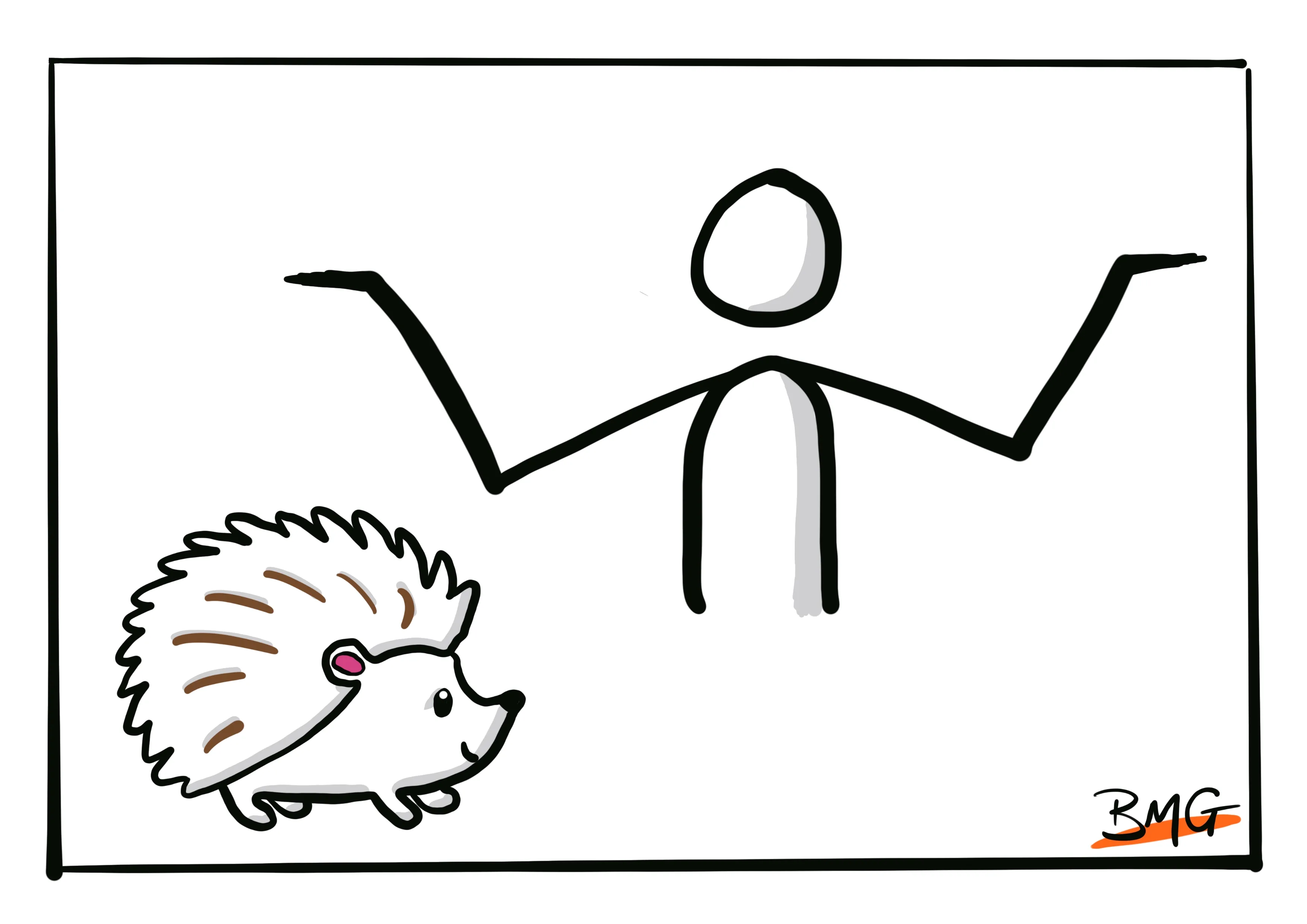
This concept is inspired by the ancient Greek parable of the fox and the hedgehog.
The fox is clever and knows many things, using a variety of tactics to pursue its goals. In contrast, the hedgehog knows one big thing and relies on a single, focused strategy to defend itself, rolling into a spiky ball.
In the context of ‘Good to Great’, the parable is used to illustrate how great companies tend to think like hedgehogs. They focus on one overarching principle or vision (their “Hedgehog Concept”) that guides all their decisions, rather than chasing after multiple, less cohesive strategies like the fox.
This singular focus helps them achieve sustained success.
Identifying Your Core Competence
To identify your core competence, ask yourself: What can we be the best in the world at?
This isn't about being good at many things but excelling in one area.
Companies need to be honest about their strengths and weaknesses to find their true core competence.
Understanding Economic Drivers
Economic drivers are the factors that most affect your company's financial performance.
Determine what drives your economic engine by asking: What is the key metric that has the greatest impact on our financial success?
This could be profit per customer, profit per product, or another relevant measure.
Passion and Its Role in Strategy
Passion is a crucial element of the Hedgehog Concept.
It's about what your team cares deeply about. When your work aligns with your passion, it fuels motivation and commitment. Ask: What are we deeply passionate about?
This passion will drive your strategy and help sustain long-term success.
Integrating the Three Circles
The Hedgehog Concept is found at the intersection of three circles: what you can be the best at, what drives your economic engine, and what you are passionate about.
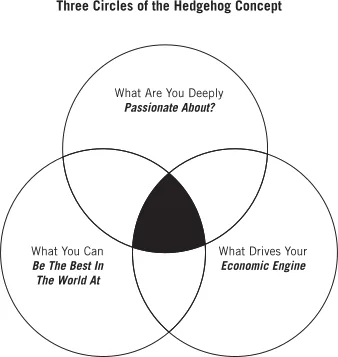
When these three elements align, you have a clear and focused strategy that can guide all your decisions.
Creating a Culture of Discipline
Principles of a Disciplined Culture
A culture of discipline is not about strict rules or stifling creativity.
A culture of discipline, in the context of Good to Great, refers to an organisational environment where disciplined people engage in disciplined thought and take disciplined action.
This means that individuals within the company are self-motivated, operate within a clear framework of responsibilities, and consistently adhere to the company’s core values and strategies.
Instead of relying on strict rules or bureaucracy, a culture of discipline empowers employees to make decisions aligned with the company’s long-term goals, driving sustained success and excellence.
A culture of discipline is not a principle of business; it is a principle of greatness.
Role of Leadership in Discipline
Leaders play a crucial role in establishing a disciplined culture.
They must lead by example, demonstrating commitment and focus.
This includes setting clear expectations and holding everyone accountable.
Implementing Disciplined Processes
To implement disciplined processes, organisations should:
Define clear goals and objectives.
Establish consistent procedures and standards.
Monitor progress and make adjustments as needed.
Balancing Discipline and Flexibility
While discipline is essential, flexibility should not be overlooked.
Organisations must find a balance between maintaining structure and allowing for innovation and adaptability.
A disciplined culture empowers individuals to prioritise tasks, adhere to deadlines, and maintain a steadfast commitment to excellence despite challenges.
Challenges in Maintaining Discipline
Maintaining a culture of discipline can be challenging.
It requires ongoing effort, commitment from leadership, and a willingness to adapt processes as the organisation evolves.
The Flywheel and the Doom Loop: Momentum in Business
The Flywheel and the Doom Loop are contrasting concepts from ‘Good to Great’ that describe how companies achieve or fail to achieve momentum.

Understanding the Flywheel Effect
The Flywheel Effect is a concept that explains how success is built over time, not in an instant.
Imagine a giant, heavy flywheel.
At first, it takes a lot of effort to get it moving. But with consistent effort, it starts to gain momentum and eventually spins on its own.
This is how businesses achieve sustained success.
Building Momentum in Business
To build momentum, teams need to make consistent, strategic pushes in one direction.
This involves:
Setting clear goals
Making steady progress
Celebrating small wins
Over time, these efforts accumulate, and the business starts to move forward with less effort.
Avoiding the Doom Loop
The Doom Loop is the opposite of the Flywheel Effect.
It happens when companies lack patience and clarity, jumping from one new direction to another, seeking instant results.
This leads to:
Disappointing results
Frequent changes in direction
Loss of momentum
Companies in the Doom Loop often find themselves in a downward spiral, unable to build sustained success.
Case Studies of the Flywheel Effect
Consider the transformation of Kroger, featured in the book.
One such surprise, the Kroger Co.,a grocery chain,bumped along as a totally average performer for 80 years and then somehow broke free of its mediocrity to beat the stock market by 4.16 times over the next 15 years. And it didn't stop there. From 1973 to 1998, Kroger outperformed the market by 10 times.
Instead of launching big change programmes, Kroger's leadership focused on gradual, consistent improvements.
They built tangible evidence that their plans made sense, which helped gain the confidence of their team.
This steady approach led to significant, long-term success.
Strategies for Sustaining Momentum
To sustain momentum, businesses should:
Maintain a clear vision
Focus on consistent progress
Avoid drastic changes in direction
By following these strategies, companies can keep their flywheel spinning and achieve lasting success.
Challenges in Maintaining the Flywheel
Maintaining the Flywheel Effect can be challenging.
Companies may face:
Pressure for quick results
Temptation to change direction
Difficulty in maintaining consistency
However, by staying focused and committed to their long-term goals, businesses can overcome these challenges and continue to build momentum.
Technology Accelerators: Leveraging Innovation
Technology alone cannot create sustained great results, but when used right, it is an accelerator of momentum, not a creator of it.
Role of Technology in Business Strategy
Technology Accelerators, in the context of ‘Good to Great’, refer to the strategic use of technology to amplify and accelerate a company’s existing strengths, rather than relying on it as the primary driver of success.
Great companies adopt new technologies thoughtfully, ensuring they align with their core Hedgehog Concept.
When used effectively, Technology Accelerators can enhance innovation, streamline processes, and boost performance, but only when they support and accelerate a company’s disciplined, strategic focus.
Embracing digital technology can open up new strategic options that were previously unfeasible.
Identifying Key Technologies
To leverage technology effectively, companies must identify key technologies that align with their strategic goals.
This involves understanding which technologies can provide a competitive edge and integrating them into the business model.
Integrating Technology with Strategy
Successful integration of technology with business strategy requires a clear understanding of how technology can support and enhance the company's core objectives.
This includes aligning technology investments with the company's vision and goals.
Balancing Technology and Human Capital
While technology is essential, it is equally important to balance it with human capital.
This means ensuring that employees are equipped with the skills and knowledge to leverage new technologies effectively.
Challenges in Technology Implementation
Implementing new technologies can be challenging.
Companies may face resistance to change, high costs, and technical difficulties.
However, overcoming these challenges is crucial for leveraging technology as a business accelerator.
Conclusion of Part One
In conclusion, transforming a good team into a great one is not just about setting high goals, it's about laying a foundation that supports sustainable excellence.
As outlined in ‘Good to Great”, the journey from mediocrity to greatness hinges on a clear, well-thought-out strategy paired with disciplined and consistent execution.
Look out for Part Two where we will go into more principles of ‘Good to Great’ and round off what has been a comprehensive review.
Remember, the path to extraordinary is walked with a thousand small steps, you’re doing great!
Want to learn more? Let's grow together!
Your Small Steps
What is Level 5 Leadership?
Level 5 Leadership is about having leaders who are humble yet driven to achieve the best for their company. These leaders focus on the success of the organisation rather than personal gain.
Why is having the right people on the bus important?
Having the right people in the right roles is crucial because it ensures that the team is capable and aligned with the company's vision. Without the right people, even the best strategies can fail.
What is the Stockdale Paradox?
The Stockdale Paradox is about facing the harsh realities of your situation while maintaining faith that you will prevail in the end. It teaches balance between optimism and realism.
How does the Hedgehog Concept simplify strategy?
The Hedgehog Concept simplifies strategy by focusing on three circles: what you are passionate about, what you can be the best at, and what drives your economic engine.
What is the Flywheel Effect?
The Flywheel Effect describes how small, consistent efforts can build momentum over time, leading to significant results. It's about steady progress rather than quick wins.
Why is technology important in business strategy?
Technology is important because it can accelerate growth and innovation. It helps businesses stay competitive and meet the changing needs of customers.

Barry Marshall-Graham
Executive coach and leadership advisor
Get the Difficult Conversations Guide
A practical resource for leaders who want to say the thing that needs saying, without burning bridges or avoiding the moment.
Keep reading
13 March 2026
The Weight of Unshared Doubt
Why senior leadership feels lonelier as you rise, and why confidence is often just unshared doubt.

9 March 2026
Why Your Best Advice is the Problem
Why the rush to fix others is actually a specific insecurity, and how to stop.

6 March 2026
The Weight in Your Voice
Your words carry more weight than you realise. Calm authority is often a matter of pace, tone, and the courage to name what matters.

2 March 2026
The Quiet Drift You Inherit
Inherited teams rarely collapse in a moment. They drift. Resetting standards isn't about being harsh, it's about clarity, dignity, and trust.

27 February 2026
When Everyone Owns It
Shared ownership sounds healthy, but when everyone owns a decision, nobody owns the decision. Clarity needs a single accountable owner.
23 February 2026
The Private Ledger of Leadership
Senior leaders carry a private ledger of risks, promises, and people. Naming that inner load isn't weakness, it's how you lead without breaking.

20 February 2026
The Avoided Conversation Is a Decision
The conversation you're avoiding isn't neutral. It's a decision to let the current pattern continue, and that decision shapes the culture.

16 February 2026
Calm Authority in Tense Rooms
Authority isn't volume or force. It's the ability to hold a tense room steady, name what matters, and set a clear boundary without heat.

13 February 2026
The First Small Tolerance
Standards rarely collapse in a moment. They slip through the first small tolerance you let pass, then the next one feels easier.

9 February 2026
The Decision Vacuum
When decision rights are unclear, every meeting becomes a referendum. Clarity is less about answers and more about who owns the call.
