From Obligation to Opportunity
12 May 2025
Three Simple Words that Shift Your Inner Dialogue and Reconnect to Purpose
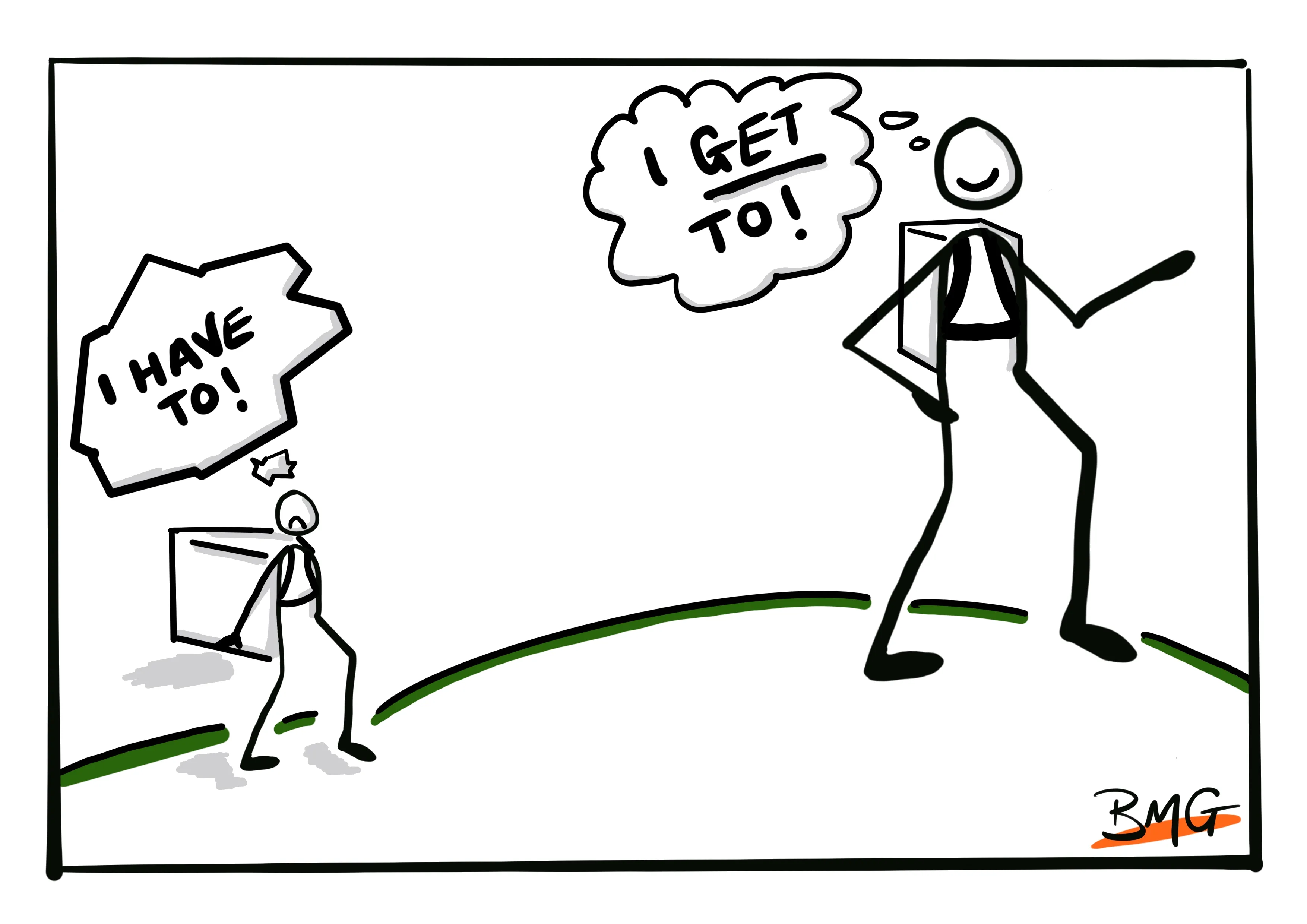
“Gratitude turns what we have into enough.”
, Aesop
It started with a simple sentence.
A colleague, reflecting honestly on their own journey, said something that stayed with me:
“I keep reminding myself - I don’t have to do this. I get to. Not just at work, but in everything I do.”
And just like that, the conversation turned. I recalled how I use “I get to” in my own life, but we will get to that a little later.
The energy shifted.
We moved from weight to wonder, from routine to privilege.
That small reframing - from “I have to” to “I get to” - is deceptively simple but for leaders, teams … everyone really, it holds huge transformational potential.
Let me explain …
The Psychology of Reframing
Our brains are wired to conserve energy and spot threats. So it’s no surprise that we default to language like:
“I have to go to another meeting.”
“I have to handle this issue.”
“I have to work late again.”
This language subtly reinforces a sense of burden, pressure, and resentment.
It frames our actions as obligations … as if we’re trapped in a system we didn’t choose.
But when we say “I get to” (even silently, quietly) we introduce perspective.
We reconnect to privilege, choice, and purpose.
“I get to meet with my team, because they trust me to lead.”
“I get to solve this problem, because I worked really hard to get to a position where I am trusted to make things better.”
“I get to work on multiple projects, because the business knows I care about the outcomes and have the freedom to invest in them.”
It’s not about sugar-coating real pressures.
It’s about remembering what’s underneath them: meaning.
When Language Shapes Leadership
As leaders, the stories we tell ourselves shape the climate we create for others, and the language we choose (especially in moments of challenge) becomes the emotional weather system our teams work in.
A team that hears, “We have to push through this,” feels pressure.
They hear the weight of duty. They sense grind, struggle, and sacrifice.
A team that hears, “The people you all see in this room get to tackle this challenge together,” feels purpose.
They hear inclusion. Opportunity. A shared sense of agency and belief.
This isn’t just about semantics - it’s real culture.
“I have to” can create a compliance mindset.
“I get to” fosters ownership, engagement, and meaning.
When we consistently frame work as privilege rather than punishment, people don’t just perform better, they connect more deeply to why the work matters. They feel invited to participate, not imposed upon to step up.
This subtle shift in language tells a very different story:
This is something we believe in. Something that deserves our energy. Something worth showing up for.
So much of leadership is tone-setting. And tone is built in the margins …through careful thought to words, pauses, framing, and presence.
Choose language that opens hearts as well as minds.
That connects performance with meaning.
That reminds people of the privilege it is to do meaningful work, together.
A quick pause
If this is helpful, the free guide goes deeper, and the newsletter brings ideas like this twice a week.
When I Needed the Reminder
There have been times, especially in busy, demanding periods, when I’ve caught myself in “have to” mode.
I have to prep for this meeting.
I have to mentor this colleague.
I have to write this update, or dare I say … article.
And each time I’ve caught it, and swapped in “get to,” something has softened.
I get to have a voice in shaping this future.
I get to support someone’s growth.
I get to write for people who care.
It doesn’t erase the hard work. But it reconnects me with why the work matters.
And that shift - from obligation to opportunity - is often the difference between exhaustion and fulfilment.
In the conversation I mentioned at the start of this article, the bridge between what I was hearing really caught me. In the background was a treadmill (the person was working at home) … I use the very same technique for my own health and fitness.
I wake up very early to get in my workouts before the noise of my day takes over. Some days it’s tough - the bed is warm, I am very comfortable and I know I have a busy day ahead of me. But amongst those thoughts I have taught myself to listen very carefully … because I know it’s there.
That little voice from my subconscious that tells me - there are many people who do not have this privilege … I get to step into my gym gear and run, they do not.
Powerful.
Reflection Prompts
Where in your day do you default to “have to”? What might shift if you said “get to” instead?
What are you taking for granted that once felt like a dream, a goal, or a privilege?
How does your language shape the mood of your team or your household?
What’s one routine task you can reframe with fresh gratitude this week?
Who around you could use a reminder of how fortunate they are to do what they do?
Final Thoughts
So much of what we call work was once a wish.
A role we hoped for.
A responsibility we dreamed of earning.
A voice we longed to have.
It’s easy to forget that.
To let familiarity breed frustration.
To let daily rhythm become daily burden.
But sometimes, the most powerful form of gratitude is presence.
To look at our calendars, our meetings, our tasks … and say:
“I get to.”
Not because it’s easy.
But because it’s ours.
And that’s something worth showing up for. Right?
Remember, the path to extraordinary is walked with a thousand small steps, you’re doing great!
Your Small Steps
Isn’t “I get to” a bit naïve during stressful times?
Not at all. It’s it’s about reclaiming meaning. “I get to” doesn’t remove pressure, but it restores perspective and personal agency.
Action:
Choose one task you’re currently dreading. Say out loud: “I get to…” before it. Notice how the tone shifts, even slightly. Repeat it twice more and see what opens up.
Can this mindset really change how I feel about work?
Yes. Research in positive psychology shows that reframing your perspective boosts motivation, engagement, and resilience. Over time, these small shifts compound.
Action:
For the next three days, write down one thing at the end of each day you’re grateful you got to do. Look for meaning, not magnitude.
What if my team feels overwhelmed, won’t this sound tone-deaf?
Context is key. This mindset works best when paired with empathy. “I get to” isn’t a slogan … it’s a posture. Model it quietly and consistently. People will feel the difference before they adopt it.
Action:
Try framing one shared challenge this week as an opportunity: “We get to do this because…” and then invite your team to reflect on why the work matters.
How can I practise this without it feeling forced?
Start small. Choose one recurring task and try the shift. The key is repetition, not perfection. Let it become familiar through use, not performance.
Action:
Pick a daily routine, like answering emails or your morning commute and intentionally say, “I get to do this because…” to yourself before starting.
Is this about toxic positivity?
No. Toxic positivity ignores discomfort. “I get to” acknowledges challenge and connects it to purpose. It’s not about faking happiness, it’s intentional framing.
Action:
When something feels hard, write down two truths: “This is difficult because…” and “I still get to do it because…” Let both be valid.
How do I teach this to others without preaching?
Action:

Barry Marshall-Graham
Executive coach and leadership advisor
Get the Difficult Conversations Guide
A practical resource for leaders who want to say the thing that needs saying, without burning bridges or avoiding the moment.
Keep reading
13 March 2026
The Weight of Unshared Doubt
Why senior leadership feels lonelier as you rise, and why confidence is often just unshared doubt.
9 March 2026
Why Your Best Advice is the Problem
Why the rush to fix others is actually a specific insecurity, and how to stop.
6 March 2026
The Weight in Your Voice
Your words carry more weight than you realise. Calm authority is often a matter of pace, tone, and the courage to name what matters.

2 March 2026
The Quiet Drift You Inherit
Inherited teams rarely collapse in a moment. They drift. Resetting standards isn't about being harsh, it's about clarity, dignity, and trust.
27 February 2026
When Everyone Owns It
Shared ownership sounds healthy, but when everyone owns a decision, nobody owns the decision. Clarity needs a single accountable owner.
23 February 2026
The Private Ledger of Leadership
Senior leaders carry a private ledger of risks, promises, and people. Naming that inner load isn't weakness, it's how you lead without breaking.

20 February 2026
The Avoided Conversation Is a Decision
The conversation you're avoiding isn't neutral. It's a decision to let the current pattern continue, and that decision shapes the culture.

16 February 2026
Calm Authority in Tense Rooms
Authority isn't volume or force. It's the ability to hold a tense room steady, name what matters, and set a clear boundary without heat.

13 February 2026
The First Small Tolerance
Standards rarely collapse in a moment. They slip through the first small tolerance you let pass, then the next one feels easier.

9 February 2026
The Decision Vacuum
When decision rights are unclear, every meeting becomes a referendum. Clarity is less about answers and more about who owns the call.
