How Superiority Steals Your Joy
17 November 2025
Why the moment you put yourself above (or below) anyone, you lose something essential.
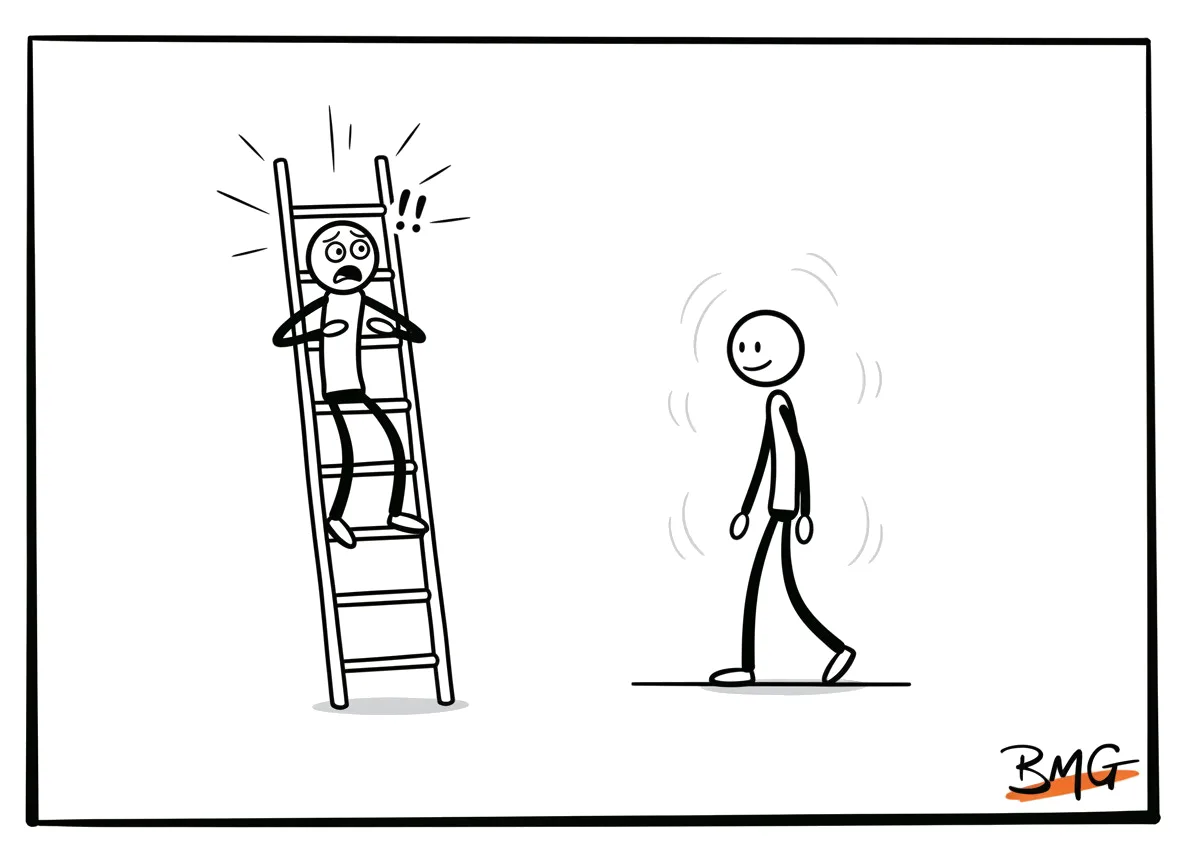
Ask anyone who has spent a decent amount of time with me and they will tell you this: “That guy hates any form of hierarchy!”.
Wherever I have heard: “My boss, my manager, I report to or I work for …”, I cut it off immediately and remind people that we are all a team, each an important cog in the engine - remove just one, and the engine fails.
We are in it together - each as important and the next.
Most people don’t walk around consciously thinking, “I’m more important, or better than you.”
But many leaders I come across walk around feeling it…
Or hiding from it…
Or fearing the opposite (that they are secretly less than the people around them).
This is the hierarchy trap.
You look at someone’s title, income, calmness, creativity, fulfilment, or insight and think:
“They’ve got it figured out, I’m falling behind … I should be more like them.”
Or you look the other way and think:
“At least I’m ahead of them, they’re not operating at my level … I’m the one carrying this.”
In either direction, something subtle happens inside you:
Your joy shrinks.
This is what is referred to by psychologists as your Comparative Mind.
It’s a mental habit that keeps you trapped in a never-ending hierarchy … even if you’re perceived to be at the top.
And the cost isn’t just emotional.
It’s the loss of presence, connection, authenticity …
It’s fundamentally a loss of joy.
Superiority and Deep Joy Cannot Coexist
Try to think of one single person who feels superior and is also deeply joyful and grateful.
I’ll wait …
You won’t find them.
Superiority requires comparison, and joy requires connection. The two cannot occupy the same inner space.
Superiority feeds the ego - Joy feeds the soul.
Superiority isolates - Joy includes.
Superiority is posture - Joy is presence.
And here’s the sting:
You cannot place yourself above someone without (somewhere in your psychology) placing yourself below someone else.
Hierarchies are two-way traps.
Put someone beneath you and you instantly create someone above you.
And this is where Comparative Mind eats your peace.
The Comparative Mind Is Misery
I read an article from Joe Hudson recently and he says it very clearly:
Putting people below you is comparative mind - and that’s misery.
Putting people above you is comparative mind - and that’s misery.
Even putting people equal to you is comparative mind - the mind still needs a reference point, a measurement.
The moment you start comparing, you abandon yourself.
You stop feeling, and you start evaluating.
You stop being present, and you start performing.
You stop leading from truth, and you start leading from insecurity.
The Comparative Mind is exhausting because it makes your worth conditional … always drifting, always fragile, always dependent on who just walked into the room.
A quick pause
If this is helpful, the free guide goes deeper, and the newsletter brings ideas like this twice a week.
From Hierarchy to Humanity
The exit from Comparative Mind is about dismantling the habit of measurement altogether, not pretending everyone is the same.
Instead of:
“Where do I rank?”,
“Am I winning?”
“What do they think of me?”
Try:
“How do I feel?”
“Am I aligned?”
“What do I think of me right now?”
Leaders who step out of Comparative Mind become radically more present, grounded, open, creative, compassionate and, dare I say, human.
And the absolute irony?
Their performance improves because they’re no longer wasting energy managing imaginary hierarchies in their heads.
Reflection Prompts
Where in your leadership do you feel the need to be “above” others?
Who do you consistently put “above” you, and why?
What does Comparative Mind cost you in energy, presence, and confidence?
What might become possible if you stopped measuring altogether?
Where do you feel the most joy, and what’s absent during those moments?
What would lead you to show up as a human first, leader second?
Final Thought
You do not need to be above anyone.
You do not need to be below anyone.
You do not even need to be equal to anyone.
You only need to be you, that is to say, fully present, fully alive, and fully connected.
The ladder isn’t real, it only exists in your mind.
And here’s the truth that changes everything:
When you stop climbing, you start living.
When you stop ranking, you start connecting.
When you stop comparing, you rediscover joy.
Beliefs can trap you.
Stories can shrink you.
Comparisons can suffocate you.
But presence?
Presence sets you free.
Remember, the path to extraordinary is walked with a thousand small steps, and you’re doing great.
Your Small Steps
How do I know if I’m stuck in Comparative Mind?
If your mood shifts depending on who walks into the room, you’re in it.
Action: Notice one moment today where comparison arises. Label it gently: “Thats my Comparative Mind.”
Isn’t comparison sometimes motivating?
Only in the short term. Long term, it creates insecurity and burnout.
Action: Replace comparison with inspiration. Ask, “What can I learn from them?”
How do I stop putting people above me?
Shift from judgement to curiosity.
Action: If someone intimidates you, ask them one meaningful question this week.
How do I stop putting people below me?
Humanise them. Look for the shared struggle.
Action: Spend time genuinely understanding someone you usually judge.
Can leaders operate without hierarchy?
Yes. Leadership is about influence, not rank.
Action: Treat one interaction this week as a human-to-human exchange, not a role-to-role one.
What’s the fastest way to reconnect with joy?
Stop comparing and start feeling.
Action: Pause for 10 seconds today. Ask: “What am I feeling right now?”

Barry Marshall-Graham
Executive coach and leadership advisor
Get the Difficult Conversations Guide
A practical resource for leaders who want to say the thing that needs saying, without burning bridges or avoiding the moment.
Keep reading
30 January 2026
Conviction Without Force
How to hold a clear position without pushing, and why steady conviction builds more trust than intensity ever will over time.
26 January 2026
When Calm Carries Authority
Why credibility grows when you stop performing certainty and start leading with calm, consistency, and clear boundaries.
22 January 2026
The Meeting After the Meeting
Why real alignment only happens when truth can survive the room.
19 January 2026
The Quiet Tax of Avoidance
Why avoidance creates decision debt and quietly erodes standards.
16 January 2026
When Being Believed Too Quickly Becomes Dangerous
12 January 2026
The Subtle Art of Doing Nothing
Why doing nothing is rarely neutral, and often the riskiest choice of all

9 January 2026
The Cassandra Effect - When Being Right Isn’t Enough

5 January 2026
A New Year, Not a New You
Why big goals only work when they fit into real life

22 December 2025
Thank You!
A Small Pause Before Christmas

19 December 2025
If You Give the Answers, You’ll Create a Queue
