On Conjunctions
16 May 2025
How The Language of Leadership Shapes Mindset and Meaning
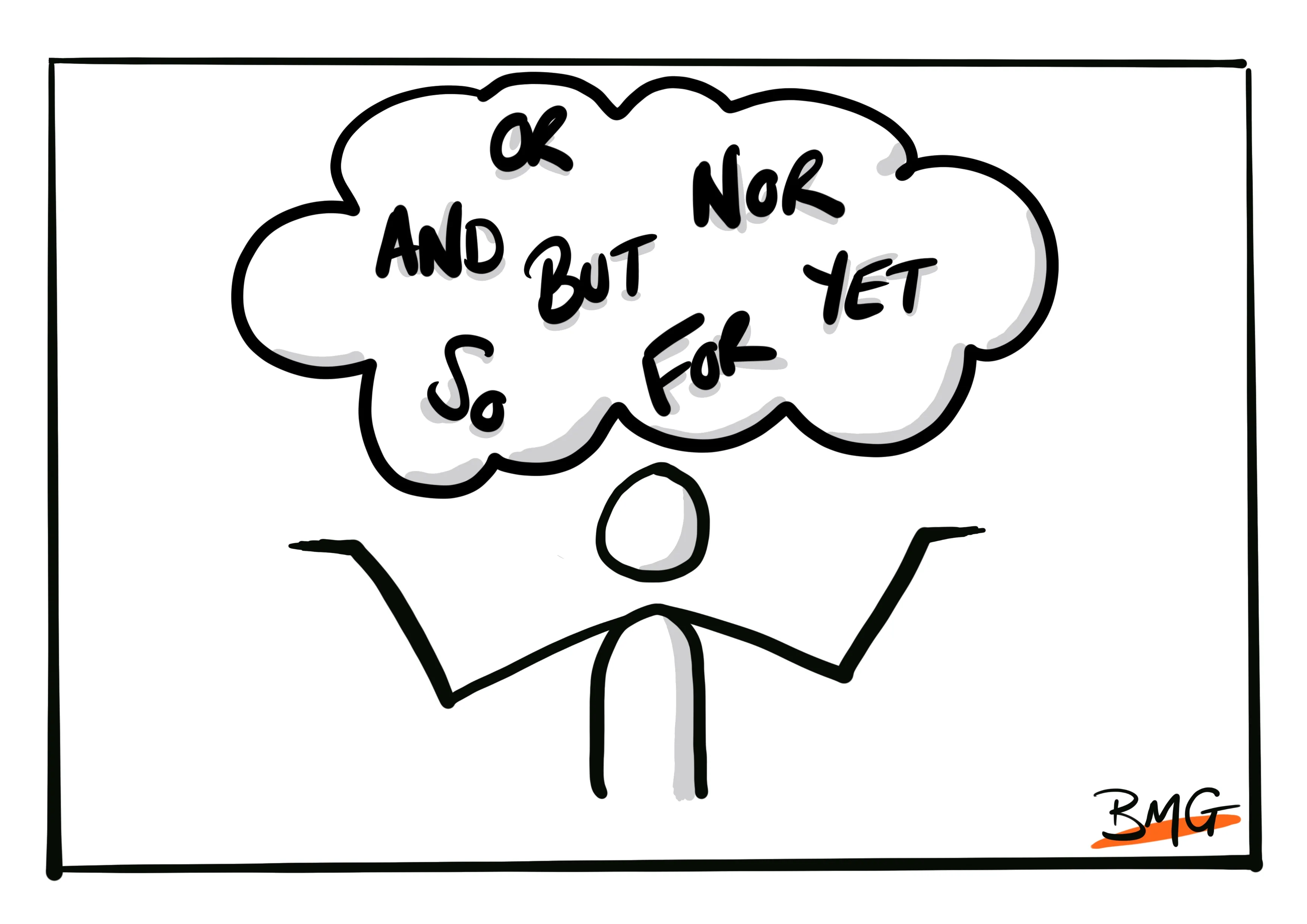
“The words we use to connect our thoughts are the same words that connect (or disconnect) our people”
In leadership and coaching, language is everything.
It’s how we create clarity, build trust, challenge assumptions, and hold space for growth.
And sometimes, the most powerful shifts come from the smallest words.
Conjunctions - those simple connectors we learned in school - may seem minor, but when used intentionally, they shape direction, and create space for possibility in our conversations.
Today, I want to explore seven small but mighty words and how each can serve as a subtle yet strategic tool in leadership and coaching.
For – The Connector of Cause and Context
“For” links ideas by showing cause or reasoning. In leadership, it reflects the ability to give context before direction.
Leadership in action:
When we say, “Let’s pause this project, for we need to really deeply understand the customer needs,” we’re not just giving an instruction … we are offering the ‘why’ that builds alignment.
Why it matters:
People don’t resist change, they resist confusion. “For” adds reasoning, and reason builds trust.
Coaching move:
Use “for” to explore motives and meaning:
“What outcome are you hoping for?”
“Let’s reflect on why this matters - for your growth, for your team, or for your values.”
And – The Word of Expansion
“And” is the most powerful of all. It invites thinking, integrates complexity, and keeps possibility alive.
Leadership in action:
Saying, “You’re doing a great job, and there’s an opportunity to grow here,” holds both affirmation and challenge without cancelling either.
Why it matters:
In performance conversations, “and” builds bridges. It fosters psychological safety while still making room for stretch and honesty.
Coaching move:
Swap “but” for “and” to remove defensiveness:
“You’re frustrated, and you still want to be seen as collaborative.”
This creates tension without opposition, and invites reflection.
Nor – The Boundary Setter
“Nor” may be used less often, but it’s a strong word for holding standards. It clarifies what we are not willing to accept or pursue.
Leadership in action:
“We won’t compromise on our values, nor will we rush delivery just to meet an arbitrary deadline.”
Why it matters:
Leaders need to be clear on what’s not on the table. “Nor” is a boundary-setting word. It helps articulate the principles we lead by, not just the goals we chase.
Coaching move:
Help someone define their limits:
“You’ve said you don’t want to be overlooked - nor do you want to come across as pushy. Where’s the balance?”
But – The Word of Contrast
“But” signals contrast. It’s useful, but dangerous when overused.
Leadership in action:
“I hear your concerns, but we have to move forward.”
This often unintentionally dismisses the first half of the sentence.
Why it matters:
“But” can create tension or resistance. Used carelessly, it shuts down conversation. Used wisely, it offers clarity and redirection.
Coaching move:
Use sparingly,and with intention:
“You want more autonomy, but your current workload isn’t sustainable. What might shift?”
Or better yet: try “and” to soften the contrast while maintaining the point.
Or – The Choice Creator
“Or” introduces options. It opens the door to agency and decision-making.
Leadership in action:
“We could escalate the issue, or we could spend another hour trying to resolve it together.”
Why it matters:
In times of uncertainty or stress, people feel trapped. Offering choices (even small ones) restores a sense of control.
Coaching move:
Ask, “What options are on the table?” or “Would you prefer to challenge that now, or gather more evidence first?”
“Or” shifts people from passivity into possibility.
A quick pause
If this is helpful, the free guide goes deeper, and the newsletter brings ideas like this twice a week.
Yet – The Bridge of Optimism
“Yet” is a mindset tool. It affirms current reality while leaving space for growth.
Leadership in action:
“We haven’t cracked this challenge yet.”
It’s honest, but it signals hope.
Why it matters:
“Yet” encourages a growth mindset. It reframes perceived failure into potential. It reminds teams that setbacks are not endpoints,they’re waypoints.
Coaching move:
Use “yet” to plant seeds of belief:
“You haven’t had that conversation yet. What would help you prepare?”
“You’re not fully confident yet. What would move you forward?”
So – The Word of Direction
“So” is about consequence and action. It creates flow between insight and outcome.
Leadership in action:
“We’ve gathered the feedback, so let’s decide what to do next.”
Why it matters:
“So” moves conversations from thinking to doing. It creates forward motion. It translates learning into momentum.
Coaching move:
After a deep conversation, try:
“So, what’s your next step?”
“So, what do you want to take from this into the week ahead?”
“So” makes insight tangible.
The Leadership Language We Don’t Always Hear
When I reflect on my best moments, they’ve often come down to not just what I said but how I said it.
A well-timed “and” kept someone open.
A carefully placed “so” helped someone move from thought to action.
A quiet “yet” sparked belief in a moment of doubt.
These words may seem small. But they reveal our posture.
Are we dismissive, or curious?
Directive, or invitational?
Rigid, or expansive?
The language we use becomes the culture we create … first in our minds, then in our teams.
Reflection Prompts
Which conjunction do you overuse and what message might that be sending?
When could you replace “but” with “and” to foster collaboration over conflict?
How often do you offer choices using “or” instead of defaulting to binary outcomes?
What might shift if you added a “yet” to a challenge you are facing?
Do I make space for “so” for translating insight into meaningful action?
Final Thoughts
Language is not neutral.
Every sentence we speak shapes mindsets, emotions, and relationships. Sometimes in subtle ways, sometimes profoundly.
As leaders, we’re not just responsible for what gets done. We’re responsible for the climate in which things get done.
And that climate is often crafted sentence by sentence, moment by moment, word by word.
So the next time you’re tempted to say “but”,pause.
Try “and.”
See what happens.
Remember, the path to extraordinary is walked with a thousand small steps, you’re doing great!
Your Small Steps
Do these words really make that much of a difference?
Absolutely. Conjunctions reveal mindset and shape tone. Small changes in language can unlock trust, reduce defensiveness, and open new pathways for thinking.
Action:
Choose one upcoming conversation - perhaps a 1:1 or team discussion - and consciously use “and” or “yet” where you’d normally say “but.” Observe how the energy and receptiveness shifts.
Isn’t this just semantics?
In leadership, semantics are substance. The words we choose influence how people feel, engage, and respond. These aren’t just connectors, they’re subtle strategies.
Action:
Review a recent email or message you sent to your team. Highlight all the conjunctions. Ask yourself: Did my language create clarity, or could it have fostered more connection or nuance?
How can I build more awareness of my language habits?
Start by recording key meetings or reflecting on your written comms. Look for patterns. Are you using “but” often? Do you default to “or” when “and” would build bridges? Awareness is the first step to conscious use.
Action:
At the end of the day, jot down three phrases you used in conversation that shaped tone - positively or negatively. Ask: Was there a different conjunction that could have changed the outcome?
Can I teach this approach to my team or in coaching sessions?
Absolutely. It makes a fantastic team discussion or 1:1 coaching session. Use this article to introduce the concepts, then invite others to reflect on how their language shapes their leadership.
Action:
What’s one small change I can make today?
Start replacing “but” with “and” in one conversation. Notice what happens. It’s a deceptively simple shift and often a transformational one.
Action:
Before your next feedback conversation, write out what you want to say using “but.” Then rewrite it using “and.” Choose the version that builds more trust and say it that way.

Barry Marshall-Graham
Executive coach and leadership advisor
Get the Difficult Conversations Guide
A practical resource for leaders who want to say the thing that needs saying, without burning bridges or avoiding the moment.
Keep reading
13 March 2026
The Weight of Unshared Doubt
Why senior leadership feels lonelier as you rise, and why confidence is often just unshared doubt.
9 March 2026
Why Your Best Advice is the Problem
Why the rush to fix others is actually a specific insecurity, and how to stop.
6 March 2026
The Weight in Your Voice
Your words carry more weight than you realise. Calm authority is often a matter of pace, tone, and the courage to name what matters.

2 March 2026
The Quiet Drift You Inherit
Inherited teams rarely collapse in a moment. They drift. Resetting standards isn't about being harsh, it's about clarity, dignity, and trust.
27 February 2026
When Everyone Owns It
Shared ownership sounds healthy, but when everyone owns a decision, nobody owns the decision. Clarity needs a single accountable owner.
23 February 2026
The Private Ledger of Leadership
Senior leaders carry a private ledger of risks, promises, and people. Naming that inner load isn't weakness, it's how you lead without breaking.
20 February 2026
The Avoided Conversation Is a Decision
The conversation you're avoiding isn't neutral. It's a decision to let the current pattern continue, and that decision shapes the culture.

16 February 2026
Calm Authority in Tense Rooms
Authority isn't volume or force. It's the ability to hold a tense room steady, name what matters, and set a clear boundary without heat.

13 February 2026
The First Small Tolerance
Standards rarely collapse in a moment. They slip through the first small tolerance you let pass, then the next one feels easier.

9 February 2026
The Decision Vacuum
When decision rights are unclear, every meeting becomes a referendum. Clarity is less about answers and more about who owns the call.
