Why Your Best Advice is the Problem
9 March 2026
Why the rush to fix others is actually a specific insecurity, and how to stop.
The Problem
You have an addiction. It’s subtle, it’s socially rewarded, and it’s slowly eroding the capability of your team. You are addicted to being the person with the answer.
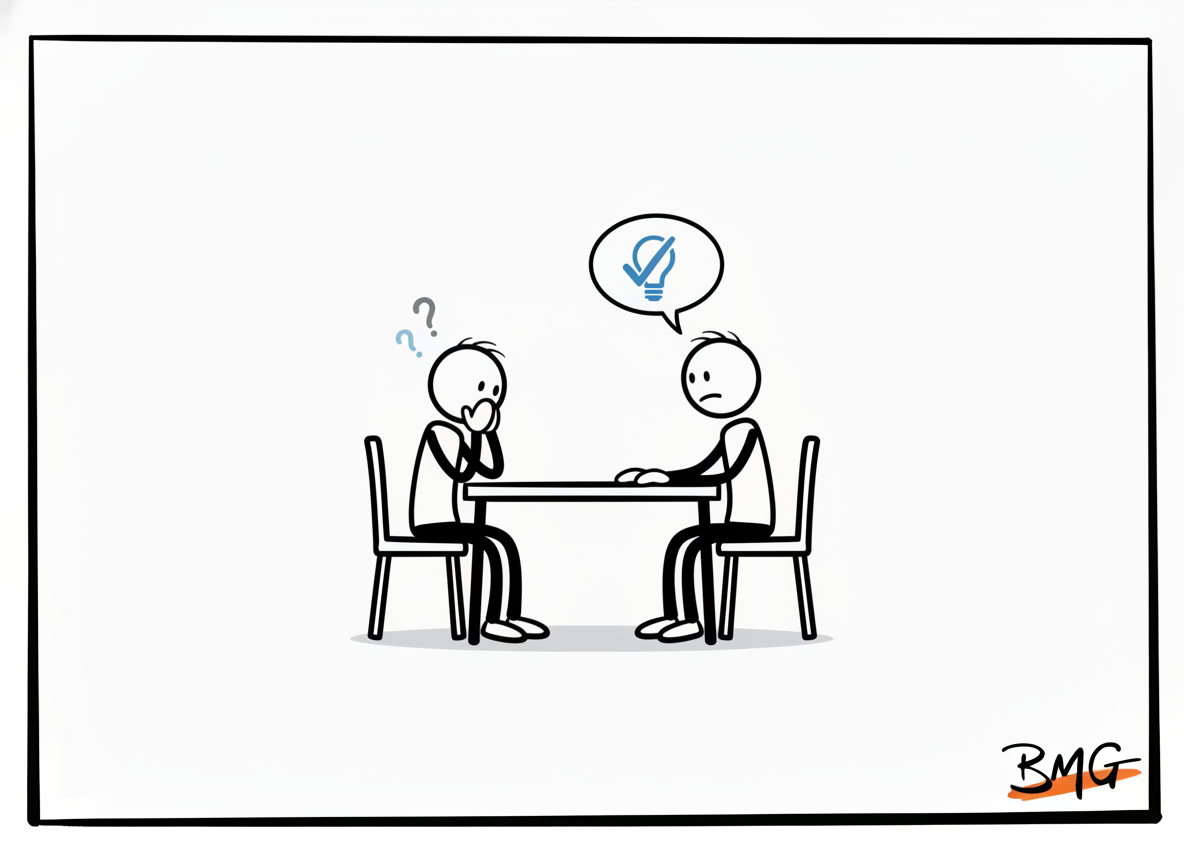
Someone walks into your office or pings you on Slack. They have a problem. Immediately, your brain lights up. You know this. You’ve seen this before. You have three solutions ready before they’ve finished their second sentence. You interrupt, politely, to save time. You offer the fix. They nod, they leave, and you feel good. You added value. You led.
But three days later, they are back with a similar problem. And three days after that. You are drowning in other people’s work, and you tell yourself it’s because you are the only one who can handle it.
That’s the lie. The truth is, your advice is the bottleneck. By rushing to fix, you are training your people that their thinking is unnecessary and your approval is mandatory. You aren’t building a team; you’re building a cult of dependency. You are playing the role of the Fixer, when the room desperately needs a Guide.
The Reframe
We think we give advice to help the other person. We don’t. We give advice to calm our own anxiety.
When someone presents a problem, it creates a tension gap. We don’t know the answer yet. Ambiguity is uncomfortable. Your brain hates ambiguity. So it rushes to close the gap with a solution, any solution, just to make the world steady again.
The advice isn’t for them. It’s for you. It’s your way of saying, ‘I am still useful here. I am still the expert.’
Real leadership requires a deliberate shift. It is the willingness to sit in that ambiguity a little longer. It is the discipline to keep the tension open so that their brain has to do the work, not yours. The goal isn’t to provide the answer; it’s to provoke the insight. If you want to create a high-fidelity culture, you have to prioritise their capacity to solve problems over your comfort in solving them.
The Advice Trap
It comes from a good place. You want to help. You’ve been promoted because you were good at fixing things. For years, your value equation was simple: Problem + You = Solution.
But as a senior leader, that equation is broken. If you are the solution, you are the limit. Every time you solve a problem for someone else, you rob them of the competence to solve it themselves next time. You are stealing their growth to feed your ego.
This happens in small, recognizable moments. The quick ‘Have you tried X?’ in a corridor. The ‘I’d just rewrite that paragraph’ in a document review. It seems efficient. But efficiency with people is often ineffective. You are solving the local, tactical issue, but ignoring the human capacity issue.
The cost is hidden but massive. It’s the team that waits for you to sign off on minor decisions. It’s the calendar full of back-to-back meetings where you are just ratifying what others should have decided. It’s the exhaustion of feeling like nothing moves unless you push it.
The Power of Curiosity
The antidote to the instinct to fix is curiosity. But not fake curiosity. Not the ‘have you considered doing exactly what I would do?’ kind of question.
I mean genuine, humble curiosity. The kind where you truly don’t know the answer, and you trust them to find it.
It starts with slowing down. When you feel the urge to jump in, you pause. You take a breath. And you ask a question instead.
‘What’s the real challenge here for you?’
This question is a laser. It cuts through the complaining, the storytelling, and the noise. It forces them to stop venting and start thinking. Usually, the first problem they mention isn’t the real problem. It’s just the first thing they said. By asking ‘And what else?’, you push them deeper. You invite them to do the heavy lifting.
This is terrifying for most leaders. It feels passive. It feels like you aren’t earning your pay. But watching someone else have an insight is far more valuable than giving them one. An insight they generate is an insight they own. An insight you give them is just another instruction.
A quick pause
If this is helpful, the free guide goes deeper, and the newsletter brings ideas like this twice a week.
Personal Reflection
I remember a specific 1:1 with a direct report years ago. He was struggling with a stakeholder who was blocking a project. He started explaining the situation, and within thirty seconds, I had diagnosed it. I knew the stakeholder. I knew the politics. I knew exactly what email he needed to send.
I sat there, nodding, waiting for him to take a breath so I could deliver the brilliance. I was literally rehearsing the phrasing in my head.
When he finally paused, I launched. I gave him the three-step plan. I was articulate, strategic, and precise.
He looked at me, gave a tight smile, and said, ‘Right. Okay. I’ll try that.’
The energy left the room instantly. Two weeks later, nothing had changed. He hadn’t sent the email. I was frustrated. ‘Why didn’t he listen?’ I thought.
It took me a long time to realise that I hadn’t helped him. I had just crushed him. I hadn’t asked him what he thought the blocker was. I hadn’t asked what he had already tried. I had just proven, once again, that I was the smart one and he was the implementer. I solved the puzzle, but lost the person.
Reflection Prompts
What is the deeper fear driving my need to give the answer?
Who on my team am I accidentally training to be helpless?
Where am I confusing 'being helpful' with 'being in control'?
What would happen if I stayed curious for just two minutes longer?
Final Thought
Taming the urge to jump in is not about never giving advice. Sometimes there is a building on fire and you need to shout ‘Exit!’. Sometimes they truly lack the knowledge and need teaching.
But those moments are rarer than you think. Most of the time, they know. Or they could know, if you gave them the space to find it.
Your job is not to be the smartest person in the room. Your job is to be the person who makes everyone else in the room smarter. That doesn't happen by giving them your answers. It happens by asking them for theirs.
The path to extraordinary is walked with a thousand small steps, you’re doing great!
Your Small Steps
What if they honestly don't know the answer?
If you’ve asked ‘What do you think?’ and ‘What else?’ and they are genuinely stuck, then you can offer advice. But offer it as a hypothesis, not a decree. Say, ‘Here’s how I’m seeing it. How does that land with you?’
Small Step: Use the phrase ‘I have an idea, but I want to hear your thinking first.’
What if the situation is urgent?
Urgency is the favorite disguise of the Fixer. Ask yourself: Is this actually a crisis, or just a deadline? If it’s a true crisis, take command. If it’s just busy, stay curious.
Small Step: Count to three slowly before responding to any ‘urgent’ request.
How do I stop interrupting?
Physical cues help. If you are in a meeting, put your pen down. Lean back. Drink water. You can’t speak while you are drinking.
Small Step: Bring a glass of water to every meeting and take a sip whenever you want to jump in.
What is the best starting question?
Keep it simple. Don’t over-engineer it. The goal is to open the door, not interrogate them.
Small Step: Start your next three interactions with ‘What’s on your mind?’
What if they get frustrated with my questions?
They might. They are used to you fixing it. Name it. Say, ‘I know I usually jump in here, but I want to support you to solve this one.’
Small Step: Explain the change in intent before you start the questioning.
How do I know if I’m doing it right?
Watch their eyes. If they are looking at you waiting for approval, you’re fixing. If they are looking up or away, thinking, you’re coaching.
Small Step: Notice where their eyes go when you stop talking.

Barry Marshall-Graham
Executive coach and leadership advisor
Get the Difficult Conversations Guide
A practical resource for leaders who want to say the thing that needs saying, without burning bridges or avoiding the moment.
Keep reading
13 March 2026
The Weight of Unshared Doubt
Why senior leadership feels lonelier as you rise, and why confidence is often just unshared doubt.
6 March 2026
The Weight in Your Voice
Your words carry more weight than you realise. Calm authority is often a matter of pace, tone, and the courage to name what matters.

2 March 2026
The Quiet Drift You Inherit
Inherited teams rarely collapse in a moment. They drift. Resetting standards isn't about being harsh, it's about clarity, dignity, and trust.

27 February 2026
When Everyone Owns It
Shared ownership sounds healthy, but when everyone owns a decision, nobody owns the decision. Clarity needs a single accountable owner.
23 February 2026
The Private Ledger of Leadership
Senior leaders carry a private ledger of risks, promises, and people. Naming that inner load isn't weakness, it's how you lead without breaking.

20 February 2026
The Avoided Conversation Is a Decision
The conversation you're avoiding isn't neutral. It's a decision to let the current pattern continue, and that decision shapes the culture.

16 February 2026
Calm Authority in Tense Rooms
Authority isn't volume or force. It's the ability to hold a tense room steady, name what matters, and set a clear boundary without heat.

13 February 2026
The First Small Tolerance
Standards rarely collapse in a moment. They slip through the first small tolerance you let pass, then the next one feels easier.

9 February 2026
The Decision Vacuum
When decision rights are unclear, every meeting becomes a referendum. Clarity is less about answers and more about who owns the call.

6 February 2026
The Standard You Walk Past
How small exceptions become the quiet rule, and why leaders must name the slip before it sets the team's real expectations.