The Decision Vacuum
9 February 2026
When decision rights are unclear, every meeting becomes a referendum. Clarity is less about answers and more about who owns the call.
The Problem
In senior rooms, the question rarely is, what's the right decision.
The harder problem is who's allowed to decide at all.
When decision rights are blurred, every discussion becomes a trial, every plan becomes a draft, and the calendar fills with meetings that feel busy but never complete.
You can feel it when it happens. A project drifts because nobody wants to move first. A simple choice becomes a long chain of opinions. The more people involved, the safer it feels, yet the organisation slows, and the person at the top carries the final weight anyway.
This isn't a lack of intelligence. It's a lack of clarity. Without clear decision rights, capable leaders become cautious, teams become political, and you end up carrying both the decision and the resentment of making it.
The Reframe
Clarity isn't just about having the right answer. It's about knowing who owns the call, who's consulted, and who's informed after the fact. The decision itself can be hard. The decision rights mustn't be.
When decision rights are clean, you can move faster even when the decision is difficult. When decision rights are foggy, even easy decisions become risky because everyone is trying to work out who will be blamed.
This is why clarity about ownership is often the fastest path to speed, even before the decision itself is perfect.
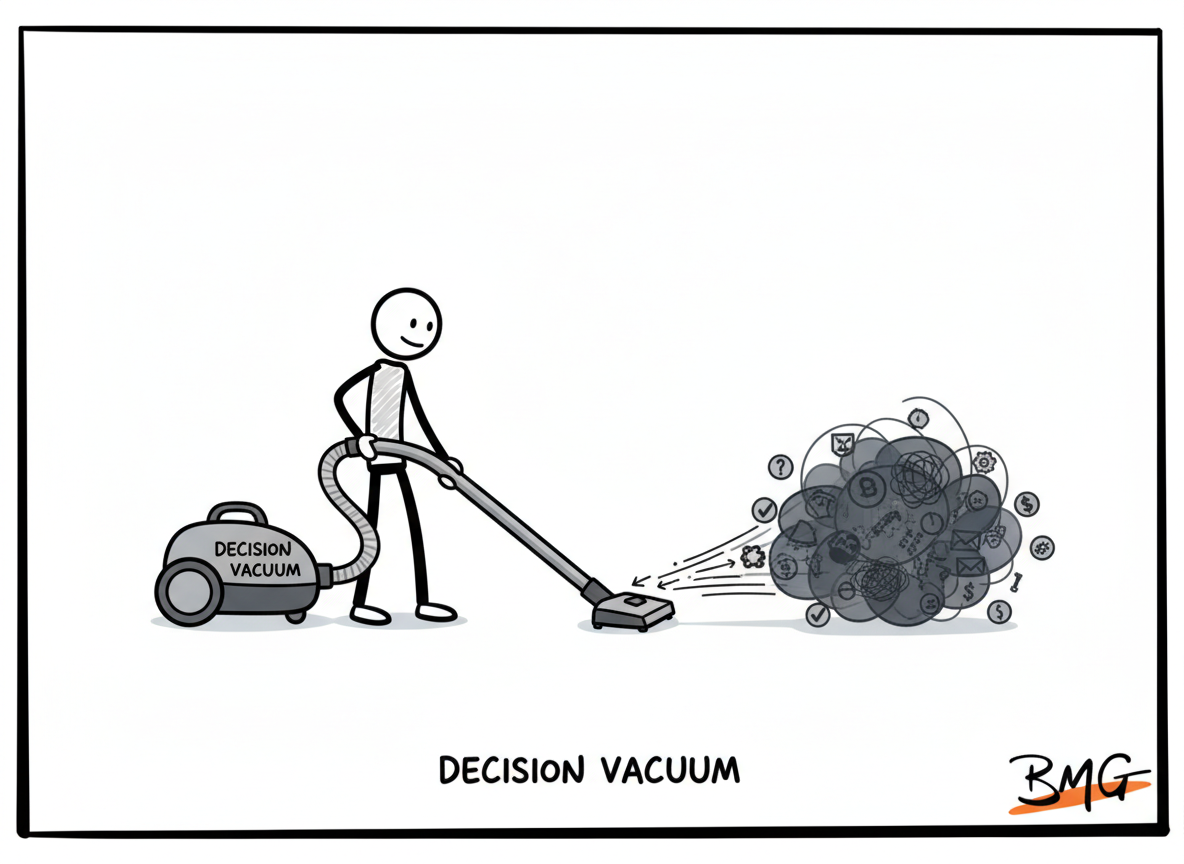
The Decision Vacuum
A decision vacuum doesn't show up as drama. It shows up as polite uncertainty.
A leader asks for input, the room delivers opinions, and nobody makes the call. A follow up meeting appears, then another, then a working group.
I watched this happen in a Monday leadership meeting about a hiring pause.
The conversation was thoughtful and responsible. People named risks, floated options, and warned about morale. The meeting ended with a vague plan to revisit next week. Thirty minutes later a Teams thread appeared asking, "so are we pausing or not".
Nobody answered. The room had talked itself into safety, but it hadn't chosen.
It also shows up in the subtle language of deflection. People say, "we should take this to the steering group", or "we need wider alignment". Those phrases often mean, I don't feel safe to own this, and so the vacuum grows and pulls more people into its gravity.
It creates a strange sort of theatre, in my experience.
People bring extra analysis to defend their position, not to move the decision forward. A meeting that could have been a clear twenty minute call turns into a ninety minute justification exercise. The more the vacuum grows, the more people protect themselves with detail.
And it isn't a cultural problem. It's an operating problem. It's structural, not emotional, and that's good news, because structures can be rebuilt.
I think of it like fog on a runway.
The plane still has a destination, but nobody wants to take off because visibility is low. Decision rights clear the fog. They don't make the journey easy, they make it possible.
What Gets Confused
I've found that decision rights are often confused with consensus.
Consensus feels inclusive, but it can also be vague. It asks everyone to agree, which isn't always possible. It can also be performative, with people nodding in a room and undoing the decision later in private.
If the purpose isn't clear, people arrive with the wrong posture. They debate what should have been an update, or they assume a decision is coming when the leader only wanted input. The confusion leaves everyone slightly disappointed, and a little more cautious next time.
It's tempting to create a big matrix, a rights chart, or a set of rules. Those can help, but they aren't the core. The core is the shared understanding in the room that when a certain type of decision appears, a specific person owns it.
There's a practical distinction that shifts everything...
If a decision is reversible and low risk, it should be owned close to the work.
If a decision is high risk and hard to reverse, it should be owned at the appropriate level.
That's the shape of decision rights. It's simple, not simplistic.
A quick pause
If this is helpful, the free guide goes deeper, and the newsletter brings ideas like this twice a week.
What Clarity Looks Like in Practice
Clarity can look like a senior leader saying, this decision sits with me, and I'll be informed by your views. It sounds simple, but the room relaxes because the tension of ownership is resolved. People can contribute honestly without needing to protect themselves.
Of course, it can also be surfaced by the leader saying, this decision is yours. I need to know your criteria, your risks, and the date you'll choose. That isn't abdication. It's a clean handover. It tells the team you trust them with real responsibility.
In practice, either works. The cleanest decisions are supported by a short rhythm:
Decide who owns it. Decide when the decision will be made. Decide how input will be gathered. Decide how the decision will be communicated.
That rhythm reduces emotional weight.
I've seen organisations transform when decision rights are cleaned up. Fewer meetings, less theatre, and people act faster because they aren't waiting for someone else to make them feel safe. The work becomes lighter because the uncertainty is reduced.
This is why decision rights are a leadership behaviour, not a management tool. You're setting the emotional environment in which people will or won't take ownership. When you're clear, people relax and move. When you're vague, they hedge and wait.
Personal Reflection
I've been the person who kept decisions open for too long. Yes. Me too.
I told myself I was seeking alignment.
In truth, I was avoiding the responsibility of a call that might disappoint someone. I didn't want to be seen as the person who shut a door.
I've also been the person who took the decision back after delegating it. I did it because I could see risks they couldn't. It looked like care. It was also control. It taught the team to keep decisions soft, just in case I wanted to change them later.
The moment I started to change was when I noticed how much energy I was spending on the politics of decision making instead of the decision itself. That was a warning sign. My job is to make the room clearer, not noisier.
Reflection Prompts
Where am I asking for alignment when what I really need is ownership?
Which decision do I keep circling because I don't want to own the consequence?
Who in my team is waiting for clarity that I've not yet given?
What small decision could be delegated today to build trust in the system?
Where's consensus slowing us down more than it's helping us?
Final Thought
You don't need perfect decisions to build trust.
You need clear ownership, clean communication, and a consistent rhythm. That's what people are looking for when they ask for alignment.
If decision rights are unclear, the organisation will keep circling.
If decision rights are clear, the organisation will move, even when the decision is hard.
The path to extraordinary is walked with a thousand small steps, you’re doing great!
Your Small Steps
How do I know which decisions I should keep?
If the decision is high risk, hard to reverse, or tied to your personal accountability, you should own it. If it's low risk and reversible, it can sit closer to the work. The rule isn't about hierarchy, it's about consequence.
Small Step: Pick one decision type you currently keep and write down the smallest version of it you could delegate safely.
What if my team asks me to decide everything anyway?
That's often a sign of mixed signals from the past. If you've stepped in before, people will wait for you. You'll need to be clear and consistent, then stay out of the way long enough for them to trust the new boundary.
Small Step: When someone asks you to decide, ask them to bring two options and a recommendation, then let them decide within their scope.
How do I stop endless alignment meetings?
Name the decision owner at the start of the meeting. Use the time for input, not negotiation. End with a clear call and a clear next step. Alignment can happen after the decision if it needs to.
Small Step: Open your next meeting with a single sentence that names who owns the decision and when it'll be made.
What if the decision cuts across multiple teams?
Cross team decisions need a clear owner, not a committee. A committee can consult, but someone must own the call. Without that, every team protects its own interests and nothing moves.
Small Step: Choose one person to own the decision and publish their criteria for input before the discussion starts.
How do I repair trust after a messy decision?
Own the process, not just the outcome. Explain what you heard, what you weighed, and why you decided. People can accept a decision they dislike if the process feels fair.
Small Step: Write a short decision note that explains what you considered and what trade offs you chose.
How do I build decision rights into the culture?
Make it visible. Repeat who owns what, and protect those boundaries. People learn the real rules by watching who decides and who gets overruled.
Small Step: Create a simple list of five recurring decisions and name the owner for each. Share it with your team.

Barry Marshall-Graham
Executive coach and leadership advisor
Get the Difficult Conversations Guide
A practical resource for leaders who want to say the thing that needs saying, without burning bridges or avoiding the moment.
Keep reading
6 March 2026
The Weight in Your Voice
Your words carry more weight than you realise. Calm authority is often a matter of pace, tone, and the courage to name what matters.

2 March 2026
The Quiet Drift You Inherit
Inherited teams rarely collapse in a moment. They drift. Resetting standards isn't about being harsh, it's about clarity, dignity, and trust.
27 February 2026
When Everyone Owns It
Shared ownership sounds healthy, but when everyone owns a decision, nobody owns the decision. Clarity needs a single accountable owner.
23 February 2026
The Private Ledger of Leadership
Senior leaders carry a private ledger of risks, promises, and people. Naming that inner load isn't weakness, it's how you lead without breaking.
20 February 2026
The Avoided Conversation Is a Decision
The conversation you're avoiding isn't neutral. It's a decision to let the current pattern continue, and that decision shapes the culture.

16 February 2026
Calm Authority in Tense Rooms
Authority isn't volume or force. It's the ability to hold a tense room steady, name what matters, and set a clear boundary without heat.

13 February 2026
The First Small Tolerance
Standards rarely collapse in a moment. They slip through the first small tolerance you let pass, then the next one feels easier.
6 February 2026
The Standard You Walk Past
How small exceptions become the quiet rule, and why leaders must name the slip before it sets the team's real expectations.
2 February 2026
The Private Load of Public Roles
Senior roles can feel heavier as private responsibility accumulates, decisions multiply, and there are fewer safe places to speak plainly.
30 January 2026
Conviction Without Force
How to hold a clear position without pushing, and why steady conviction builds more trust than intensity ever will over time.