The Gap Between Knowing and Doing
28 July 2025
Why Good Intentions Aren’t Enough and What to Do About It
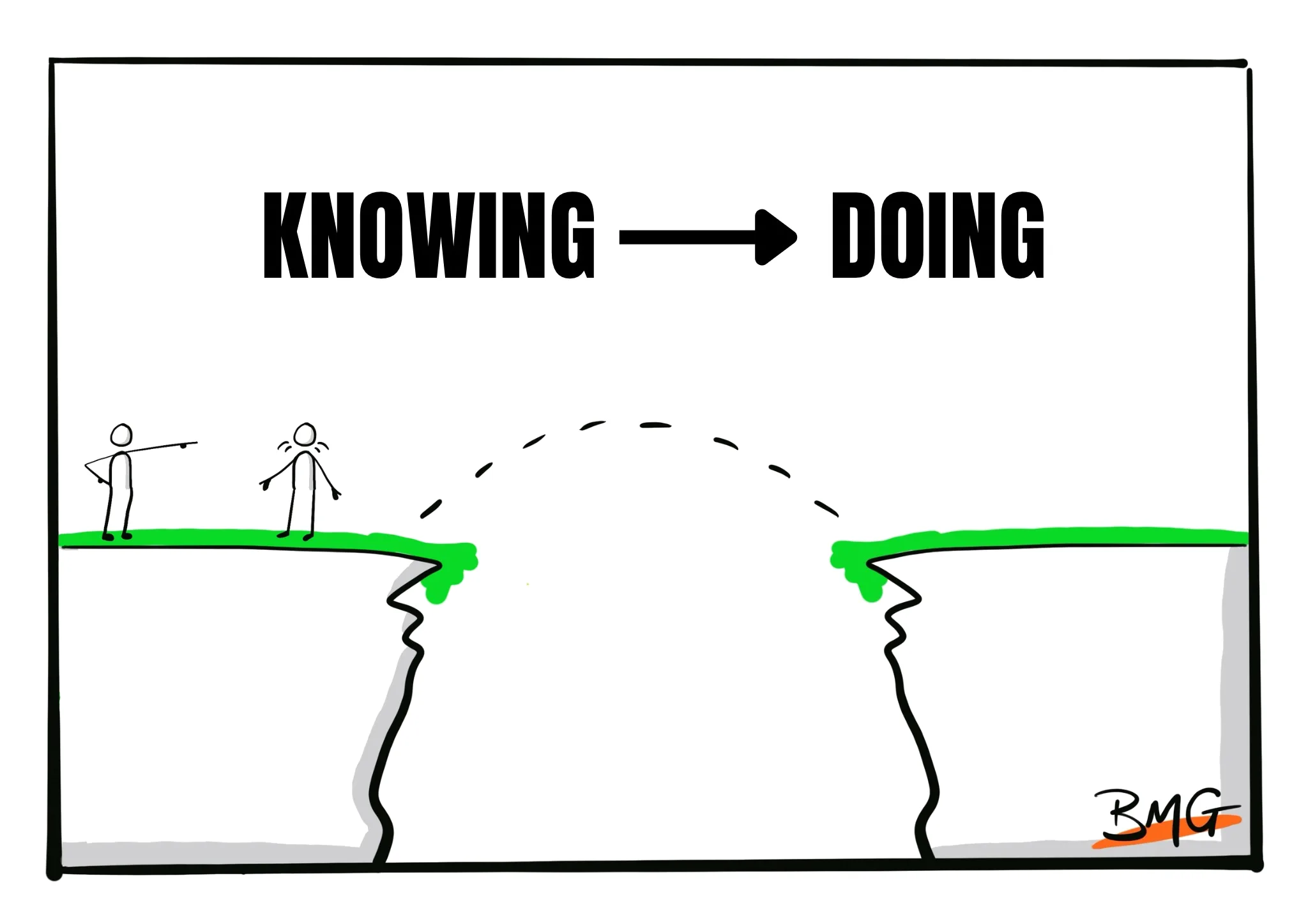
“To know and not to do is not to know.”
, Stephen R. Covey
You already know what to do.
If you are like me, you’ve read the books (all the books), heard the feedback, written down the goals. So why haven’t we cracked it yet?
This is the quiet frustration so many of us carry: an ever-growing gap between our insights and our actions. I know that for me, it’s not laziness or lack of responsibility, it can often be something deeper … something messier.
We live in an age of endless insight. Books, podcasts, leadership courses, YouTube videos or articles like this one.
We are not short on knowledge.
Most of us already know what we should do. We know we need to delegate more, hold clearer boundaries, say no with more conviction, rest more deeply, or step into bolder leadership.
And yet… we don’t always do it.
That’s the gap!
There’s a particular sting in those moments when we know what we should do (but don’t).
I’ve felt it plenty of times: ignoring the quiet nudge to speak up, shelving an idea that mattered because I worried about how it would land, putting off the rest I knew I needed because I didn’t want to feel “behind” or let anyone down.
Now, I try to meet those moments with curiosity. What stopped me before? What story was I believing? What might I try differently next time?
Often, we don’t need new information, we need a new relationship with the knowledge we already have.
Bridging that gap isn’t about getting more advice or mentorship, nor taking more information in. Instead, I think we should work to understand what holds us back, surface what really matters, and build the courage to act on what we already know.
Let me explain …
The Knowing–Doing Gap
The concept of the “knowing–doing gap” was introduced in the book The Knowing-Doing Gap by Pfeffer and Sutton. In it, they highlight how organisations often fail because they fail to act on what they know, not because they lack knowledge.
In leadership and coaching and life in general, it’s no different.
You can teach someone about psychological safety, but it doesn’t mean they’ll create it. You can explain feedback models, but it doesn’t mean they’ll have the conversation. Knowing doesn’t equal doing.
Why not you ask? Because action is messier than insight. It requires discomfort, risk, vulnerability, and sometimes, unlearning.
Insight lives in the head. Action lives in the body.
That’s where really great coaching can help.
What Stops Us From Acting
Several common blockers stop even the most self-aware people from bridging the gap:
Fear: of failure, rejection, judgement, or uncertainty.
Overwhelm: too many competing priorities and not enough clarity.
Perfectionism: the need to wait until it feels ‘safe’ or ‘ready’.
Lack of accountability: knowing what to do but having no one to walk the path with and hold you to it.
Emotional resistance: old patterns, stories, or beliefs that sabotage momentum.
These aren’t fixed traits, they’re movable. The work isn’t to eliminate them entirely, but to meet them with awareness, and support.
Make the Old Way Harder to Follow
One of the most overlooked truths in behaviour change is this: it’s often more effective to remove friction from the new behaviour than to muster willpower against the old one.
One of my top takeaways from the book mentioned above highlights a powerful principle:
If you want new behaviours to stick, make the old ones harder to do.
In practice, this means designing your environment and routines so that the path of least resistance leads to progress … without procrastination.
Want to encourage more collaboration? Sit teams together , make it harder not to collaborate.
Want to write more? Log out of social media or block access during your peak hours.
Want to lead with more intention? Schedule reflection time before and after your meetings.
This is where a coach or an accountability partner becomes invaluable for you.
A quick pause
If this is helpful, the free guide goes deeper, and the newsletter brings ideas like this twice a week.
Coaching the Bridge
Coaching has been a revolution for me personally, both as the person bing coached, and through my years of research and training to become a coach myself.
The fact is, effective coaching builds those bridges to action.
Here’s how:
Clarity: Helping the person being coached understand why something matters to them personally. When the ‘why’ is strong enough, the ‘how’ often emerges.
Accountability: Gentle, supportive structures that remind people of their intention and hold space for follow-through.
Challenge: Asking questions that go beyond the surface. “I’m sensing some apprehension here, what would you do if you weren’t afraid?” or “What story are you telling yourself that might not be true?”
Permission: Sometimes, people need to be reminded that it’s okay to try. To stumble. To not get it right the first time.
Pacing: Bridging the gap doesn’t mean leaping the chasm. It means moving one solid step at a time. Momentum matters more than scale.
Bridging the gap between knowing and doing is hard to do alone. It’s here where an accountability partner (especially a coach) becomes invaluable.
A coach will not just cheer you on from the sidelines; they walk beside you, helping you clarify what matters. They challenge your blind spots, and stay anchored when your old habits try to reclaim their place.
We know that when we are left to our own devices, we rationalise delays or sometimes settle for ‘good enough.’ However, when we say our intentions out loud to someone who holds us to our own highest standards, action is not only more likely but more consistent.
If you want to go beyond insights and into generating real impact, don’t walk the bridge alone.
Walk it with someone who will help you cross.
Reflection Prompts
Where in your life or leadership do you know what to do, but find yourself stuck?
What’s the cost of staying in the knowing without moving to doing?
What one small action could move you into doing right now?
Who could support or hold you accountable?
What fear or story might be sitting in the way causing your inaction?
What would it feel like to take a small, imperfect step today?
Final Thought
So hopefully having read this far, you’re realising that It’s not enough to read the book, understand the principle, or watch the inspirational video. Real transformation happens when we close the gap between what we know and how we live.
That gap is where most people get stuck, but it’s also where the most growth lives.
Great coaches help you cross that bridge. Not always perfectly and not always at speed, but courageously, one small step at a time.
As I said when I opened the article, the world doesn’t need more knowledgeable people, but we do need more doing people.
The people who are brave enough to act on what they already know.
How do you intend on bridging your gap?
Remember, the path to extraordinary is walked with a thousand small steps, you’re doing great!
Small Steps, Giant Leaps is a reader-supported publication. To receive new posts and support my work, consider becoming a free or paid subscriber.
Your Small Steps
Why do people struggle to act on what they know?
Fear, perfectionism, old habits, and lack of support are major reasons.
Action: Identify one personal blocker that’s holding you back right now. Name it. Then explore how you might work around it.
Is more knowledge ever the answer?
Sometimes - but more often, the next step is about gaining clarity and deploying courage, not more theory.
Action: Before you seek more information, ask: What have I already learned that I haven’t yet applied?
Can coaching really help someone act differently?
Absolutely. Coaching builds awareness, accountability, and safe space to test new behaviours.
Action: Try asking yourself a coaching question today: What’s one thing I could do that I’ve been putting off?
What’s the risk of staying in the “knowing” phase?
Frustration, stagnation, burnout. Knowing without doing creates a backlog of intention that weighs us down.
Action: Clear one backlog item by taking a 10-minute step toward it right now.
How do you coach someone who already “knows it all”?
Focus on values, impact, and identity. Ask: “If this really matters to you, what’s stopping you from moving?”
Action: Try shifting from advice to inquiry - help them reconnect to their why.
What’s a small way to practise bridging the gap this week?
Pick one thing you “know” you want to do. Break it into a five-minute action. Then do it.
Action: Set a reminder for tomorrow morning to repeat it. Let momentum do the heavy lifting for you.
How can teams benefit from this insight?
Shared awareness of the knowing–doing gap creates a culture of action and trust.
Action: Ask in your next team meeting: “What’s something we all know will help us here … but haven’t yet acted on?”

Barry Marshall-Graham
Executive coach and leadership advisor
Get the Difficult Conversations Guide
A practical resource for leaders who want to say the thing that needs saying, without burning bridges or avoiding the moment.
Keep reading
13 March 2026
The Weight of Unshared Doubt
Why senior leadership feels lonelier as you rise, and why confidence is often just unshared doubt.
9 March 2026
Why Your Best Advice is the Problem
Why the rush to fix others is actually a specific insecurity, and how to stop.
6 March 2026
The Weight in Your Voice
Your words carry more weight than you realise. Calm authority is often a matter of pace, tone, and the courage to name what matters.

2 March 2026
The Quiet Drift You Inherit
Inherited teams rarely collapse in a moment. They drift. Resetting standards isn't about being harsh, it's about clarity, dignity, and trust.
27 February 2026
When Everyone Owns It
Shared ownership sounds healthy, but when everyone owns a decision, nobody owns the decision. Clarity needs a single accountable owner.
23 February 2026
The Private Ledger of Leadership
Senior leaders carry a private ledger of risks, promises, and people. Naming that inner load isn't weakness, it's how you lead without breaking.
20 February 2026
The Avoided Conversation Is a Decision
The conversation you're avoiding isn't neutral. It's a decision to let the current pattern continue, and that decision shapes the culture.

16 February 2026
Calm Authority in Tense Rooms
Authority isn't volume or force. It's the ability to hold a tense room steady, name what matters, and set a clear boundary without heat.

13 February 2026
The First Small Tolerance
Standards rarely collapse in a moment. They slip through the first small tolerance you let pass, then the next one feels easier.
9 February 2026
The Decision Vacuum
When decision rights are unclear, every meeting becomes a referendum. Clarity is less about answers and more about who owns the call.
