The Ghost Economy: When Activity Replaces Ownership
20 April 2026
When teams optimise for visible activity instead of named ownership, work appears busy while outcomes quietly drift.
The Problem
Most leadership teams can show you a full calendar, a long status report, and a respectable number of meetings attended.
What they can't always show you is who actually owns the result.
This is the ghost economy of modern leadership.
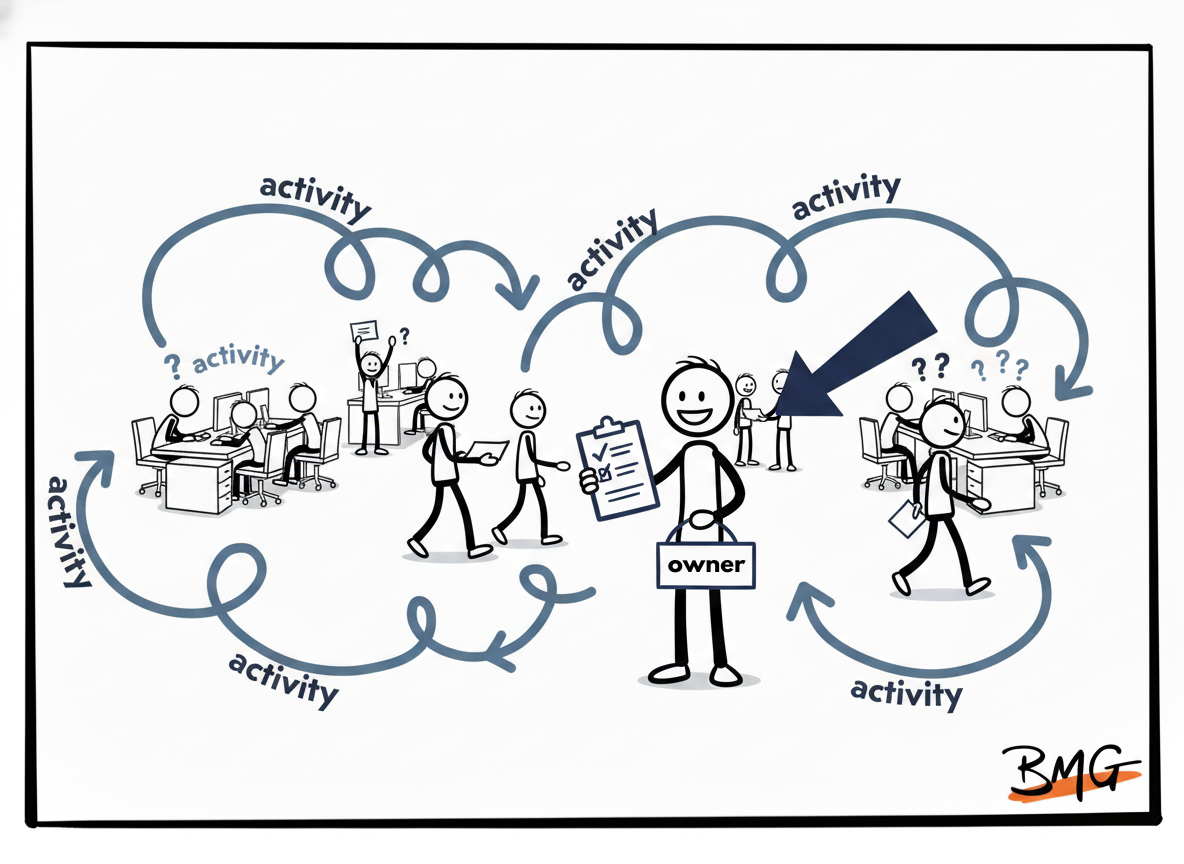
Work is happening. Updates are moving. The room feels full. Yet deadlines keep slipping, quality keeps wobbling, and everybody can explain what happened while nobody can point to where ownership lived.
This is close to what I call The Ghost.
Not because people are lazy. Not because they don't care. Because teams get rewarded for motion before they are held to account for outcomes.
You see it in language first.
- “I have been all over this.”
- “We have had loads of activity.”
- “I thought someone else had that strand.”
- “I assumed we were aligned.”
Those aren't malicious lines. They are survival lines inside a system where activity is visible and ownership is often implied.
The problem isn't one bad meeting. The problem is a whole operating pattern where effort is measured loudly and accountability is measured softly.
That's expensive.
It's expensive in trust because high performers can see the gap. It's expensive in pace because decisions loop instead of landing. It's expensive in leadership load because unresolved work keeps rising to the most senior person in the chain.
The Reframe
Leaders often describe this as a productivity problem.
It's usually a standards problem.
If your standard is “stay active”, you get high activity. If your standard is “land the result and name the owner”, behaviour changes very quickly.
This is where many organisations get stuck.
They want a calm, accountable culture. But they keep praising busyness and rescuing unclear ownership.
In practice, that teaches the team one rule:
Keep moving, keep talking, and someone senior will settle the edges.
That rule creates polite drift.
The antidote isn't aggression. It's operational clarity.
Ownership must be explicit. Decision rights must be explicit. What “done” means must be explicit.
Without that, effort becomes theatre.
With that, activity starts to produce outcomes again.
How The Ghost Economy Shows Up
You can spot it in five places.
1. Updates are full of verbs and empty of ownership
You hear:
- “Progressing.”
- “Reviewing.”
- “Socialising.”
- “Tracking.”
You don't hear:
- “I own this.”
- “My recommendation is X.”
- “If this misses, the impact is Y.”
The meeting feels productive. The output is still unowned.
2. Meetings become the substitute for decisions
If three meetings are needed to decide what one owner could have landed in one day, your process is signalling a confidence problem.
Meetings are useful for alignment. They are dangerous when used as protection from responsibility.
3. Escalations arrive as context, not asks
Senior leaders get looped in “for visibility” with no recommendation and no clear request.
This turns leadership time into a sorting function.
4. Standards are discussed in principle, not in behaviour
Teams say they value accountability. Then they tolerate unclear ownership because “everyone is stretched”.
That's where drift begins.
A quick pause
If this is helpful, my free guide goes deeper, and the newsletter brings ideas like this twice a week.
My book, High-Fidelity Leadership, explores these same themes in more depth, with practical frameworks for standards, clarity, and the conversations that leaders avoid for too long.
5. Follow-through is assumed
The room nods. The action list is long. No one has a clean review checkpoint.
By the next week, the same issue is back in a different slide deck.
Why Capable Teams Still Fall Into It
This pattern isn't caused by low capability. It's often caused by mixed signals from capable leaders.
Three signals create most of the damage.
Signal one - speed over clarity
When pressure rises, leaders often ask for updates faster instead of ownership clarity first.
That gets information quickly. It doesn't guarantee outcomes.
Signal two - helpful rescuing
A senior leader sees confusion and steps in to “unblock”.
In the moment, this feels useful. Repeated over months, it trains the team to escalate ambiguity upward before doing the ownership work themselves.
Signal three - vague definitions of done
If “done” means different things to different people, accountability becomes negotiable.
One person means “draft sent”. Another means “approved and live”. A third means “socialised but awaiting final steer”.
Now nobody is wrong. Nobody is finished either.
Move From Activity Metrics To Ownership Metrics
This is the practical shift I use with teams under pressure.
Keep activity visibility, but make ownership non-negotiable.
Every meaningful update should carry five fields:
- Owner: one named person
- Outcome: what must be true when this is done
- Decision right: who can decide and who must be consulted
- Risk line: what breaks if this misses
- Review point: exact date and owner for follow-up
If one of those is missing, the issue isn't ready for senior review.
That isn't bureaucracy. It's dignity for everyone in the room.
It removes guessing. It removes shadow ownership. It removes the need for heroic rescue.
A Recognisable Example
A product-and-operations meeting is running hot. A launch dependency has slipped.
The update sounds like this:
“We have had a lot of activity with the vendor. There are some moving parts. We should have more clarity next week.”
That's ghost-economy language.
Try this instead:
“Owner is me. Outcome is signed vendor schedule by Friday. Decision right is with me after legal review. If we miss Friday, launch slips by one week. Next checkpoint is Thursday 15:00 with my recommendation and options.”
Same issue. Different culture.
The second update creates trust because it gives the room something concrete to hold.
One Practical Test For This Week
Take your next leadership meeting and run a simple filter.
For every major line item, ask:
- Who owns this?
- What is the outcome?
- What is the next decision?
- What is the review point?
If the room can't answer in under sixty seconds, you're still in the ghost economy.
Don't shame anyone. Just refuse to move on until the line is clear.
That one behaviour change shifts standards very quickly.
Reflection Prompts
Where in my team are we mistaking movement for ownership?
Which recurring issue keeps returning because nobody is clearly accountable for closure?
Where am I rewarding activity because it looks reassuring under pressure?
What one standard could I enforce this week that would reduce ghost work by ten per cent?
Final Thought
Leadership debt rarely starts with dramatic failure.
It starts with tolerated ambiguity around ownership.
The ghost economy thrives where activity is praised and accountability is implied.
If you want a high-fidelity culture, don't start by demanding more effort.
Start by naming ownership so clearly that effort has somewhere useful to land.
That's how drift slows. That's how trust rises. That's how leaders stop carrying work that should never have climbed that high in the first place.
The path to extraordinary is walked with a thousand small steps, you’re doing great!
Your Small Steps
How do I challenge unclear updates without sounding combative?
Use a neutral operating question, not a personality judgement.
Small Step: Try: “Before we move on, can we lock owner, outcome, and review point?”
What if shared ownership is genuinely needed?
Shared ownership often means no ownership at execution time.
Small Step: Name one accountable owner even when multiple contributors are involved.
How quickly can this change behaviour?
Faster than most leaders expect, if you hold the same line consistently for two or three cycles.
Small Step: Run the five-field ownership format in your next two weekly reviews.

Barry Marshall-Graham
Executive coach and leadership advisor
Get the Difficult Conversations Guide
A practical resource for leaders who want to say the thing that needs saying, without burning bridges or avoiding the moment.
Keep reading
31 August 2026
The Sentence They Nearly Said
A pause or changed expression may lead to the useful part of a conversation, but noticing it doesn't give the coach permission to decode it.
24 August 2026
You Cannot Coach Someone You Are Secretly Judging
Second-hand information may be useful, but once it becomes a character verdict it changes the leader’s listening, questions and tone.
17 August 2026
A Good Question Can Be Badly Timed
The wording may be excellent, but a coaching question can still arrive before the relationship or the moment is ready to carry it.
10 August 2026
Whose Goal Is It Anyway?
A goal can be strategically sensible and still feel unowned. The answer is honest internalisation, not coaching somebody into believing it was their idea.
3 August 2026
The Leader Who Uses Coaching to Avoid Leading
Coaching can create room for another person to think, but it can also help a leader postpone the feedback, standard or decision that belongs to them.
27 July 2026
Advice Wearing a Hat
A coaching question can sound wonderfully curious while quietly steering somebody towards the answer their leader already prefers.
20 July 2026
The Emotional Cost of Being the Reliable One
Reliability earns trust, but it can also turn one capable leader into the place where unfinished work, uncertainty, and organisational risk accumulate.
13 July 2026
The Relief of Finally Saying the Thing
An overdue conversation occupies far more space than the words themselves. Relief begins when reality is finally allowed back into the room.
6 July 2026
The Sideways Shove
Peer conflict cannot be solved with the Manager Card. Influence begins when leaders stop pushing across borders and repair the working relationship.
29 June 2026
Clarity Under Pressure
Authority is tested when the room tightens. Clear leaders make reality, uncertainty, and the next decision visible without adding drama.