When Everything Finds You
13 April 2026
When every question, tension, and half-finished decision climbs to the leader, the issue isn't workload alone. It is the absence of a clear routing system.
The Hidden Leadership Tax of Being the Default Escalation Path
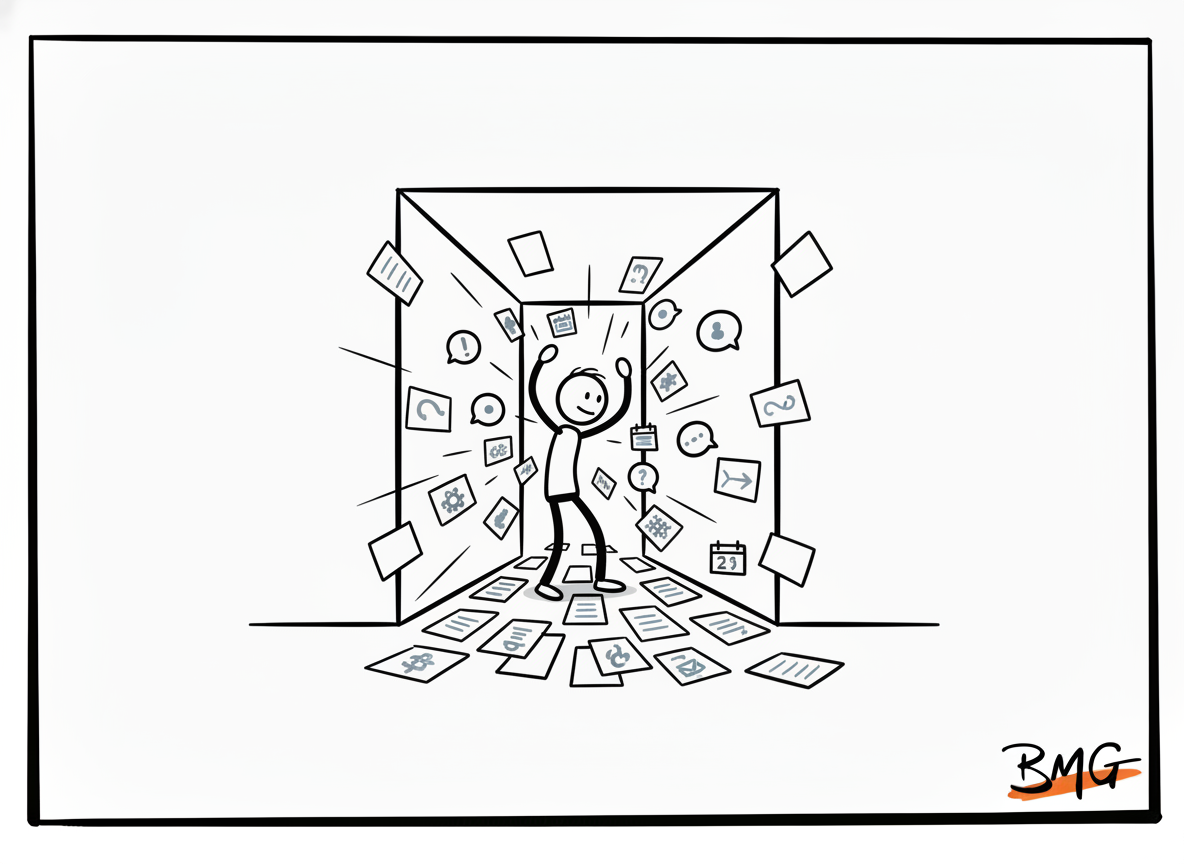
Some leaders have a diary full of meetings and still feel strangely absent from their own work.
They start the day with a plan. A strategy note to finish. A decision to think through. A proposal that needs clean attention. Then the first interruption arrives. It sounds small enough to accept. A message asking for a ‘quick steer’. A manager wanting ‘five minutes to sense-check something’. A meeting invite with no agenda, but a note that says, ‘Would be useful to have you there in case questions come up.’
By mid-morning, the day has started collapsing inward.
You are no longer doing your real work. You are catching things. Clarifying things. Settling things. Reassuring people. Closing gaps that should have been closed before they reached you. The work still looks senior because you are involved in it, but much of it is not senior work at all. It is unresolved traffic.
This is one of the quiet ways capable leaders become overloaded without quite understanding why.
They assume the issue is volume. Sometimes it is. More often, the deeper problem is that the organisation has learned to use the leader as its default escalation path. Anything uncertain, uncomfortable, politically awkward, or not fully thought through is allowed to keep climbing until it reaches the person with the broadest authority and the highest tolerance for ambiguity.
That person is often you.
At first, this can feel flattering. It can even feel responsible. You tell yourself people are keeping you close because the stakes are high, or because they trust your judgement, or because you are the one person who can join the dots. There may be truth in that.
But there is usually another truth sitting underneath it.
When everything can find you directly, very little is forced to mature before it reaches you.
Questions arrive before the owner has taken a view. Tensions arrive before the standard has been named. Decisions arrive before the options have been weighed. Meetings arrive before someone has decided whether a meeting is even necessary. You become less a leader and more a sorting mechanism.
That is expensive.
It is expensive for your attention, because deep work gets broken into anxious fragments. It is expensive for your team, because they stop building the muscles that should have strengthened below you. It is expensive for the culture, because everybody learns that the safest route is not to resolve the issue, but to move it upward.
This is how leaders become the safety net for problems that should have been handled by the system.
The Reframe
When everything finds you, the issue usually isn't access. It is the absence of a front door.
Healthy organisations don't remove access to senior leaders. They create a clearer path for work to move through. They make it obvious where something belongs, what should be resolved before escalation, and what quality threshold is required before the issue reaches the next layer.
Without that, access turns into leakage.
Leaders often say they want openness. They want people to feel they can raise issues early. They don't want to be seen as distant, political, or hard to approach. That instinct is understandable. An organisation where people hide problems is dangerous.
But an organisation where people escalate half-formed problems as their first move is dangerous too.
Open access without routing standards does not create trust. It creates dependency. It teaches people that the work is not complete until a senior person has absorbed the uncertainty on their behalf.
That is why some leaders are busy all day and still feel they are carrying strangely low-grade work.
It can look like responsiveness on the surface. Underneath, it is often a failure of ownership, sequencing, and decision hygiene.
The real job of leadership here is not to answer everything faster. It is to create enough structure that most things don't need to reach you in their current shape.
In other words, the aim is not to become unavailable. The aim is to stop being the place where unfinished work comes to rest.
What Actually Climbs Upward
When leaders talk about overload, they often describe it as ‘too many issues’. That is true, but incomplete. The more useful question is: what kind of issue keeps climbing?
Usually, it is not the truly strategic work. Strategic work is often clearer than that. It has a known owner, a known consequence, and a known reason for senior attention.
What climbs is the fuzzy middle.
It is the project update that contains activity but no recommendation. It is the team tension that everybody can feel but nobody wants to name. It is the decision that has been discussed by six people, each of whom would rather be seen as collaborative than accountable. It is the note that lands in your inbox with three pages of context and no line telling you what call you are being asked to make.
It is also the small stuff that should never have had this much altitude in the first place. The calendar conflict. The wording tweak. The meeting that exists because two peers will not settle a boundary without a witness. The document review where five people are present largely because no one trusts the process enough to let one person close it.
Each item looks minor.
Together, they create a leadership tax.
The tax is not only time. It is cognitive drag. Every time an undercooked issue lands with you, your brain has to do at least four pieces of work:
- work out what the issue really is
- identify what should already have happened
- decide whether the current owner is clear
- choose whether to answer, redirect, coach, or escalate further
That is a lot of invisible labour.
I have seen senior leaders spend entire weeks in this mode. Their diary looks important. Their hours are full. Yet very little of their actual leverage is being used. They are adjudicating, translating, tightening, and rescuing. By Friday, they feel exhausted, vaguely irritable, and oddly guilty that the bigger work still has not moved.
The deeper problem is that everybody around them feels slightly relieved.
The unresolved thing has left their desk and landed on yours.
This is why unfiltered escalation becomes self-reinforcing. The person who pushes the issue upward experiences short-term relief. The person above absorbs short-term pain. Unless the pattern is deliberately interrupted, the organisation quietly trains itself to keep repeating it.
A quick pause
If this is helpful, my free guide goes deeper, and the newsletter brings ideas like this twice a week.
My book, High-Fidelity Leadership, explores these same themes in more depth, with practical frameworks for standards, clarity, and the conversations that leaders avoid for too long.
Why Leaders Keep Allowing It
Most leaders don't build this pattern on purpose.
They create it through a series of well-intentioned moves.
One common driver is helpfulness. You are in motion, someone appears with a problem, and you can see the answer quickly. It feels easier to give the steer than to push the issue back for another round of thinking. In the moment, that is efficient. Across a year, it becomes a culture.
Another driver is anxiety. If you have lived through missed risks, political surprises, or decisions made badly without you, it is easy to conclude that more visibility is safer. So you keep yourself close to everything. You tell yourself you are staying informed. What often happens is that the system learns to send you every rough edge before it has been sharpened.
There is also an identity layer here.
Being the person everybody needs can feel like proof of value. If the organisation keeps coming to you, it can look as though your role matters deeply. And of course it does. But there is a difference between being valuable and being used as an unofficial processing centre for unresolved work.
Some leaders are especially vulnerable to this because they are competent across many domains. They can tighten a strategy line, mediate a people tension, improve an operating note, and spot the hidden risk in a project status update. The very breadth that makes them effective also makes them easy to overload.
Then there is politeness.
Many organisations are better at escalation than confrontation. Rather than tell a colleague, ‘This is yours to close’, people invite a more senior person into the loop. Rather than define a decision owner, they create another meeting. Rather than hold the standard at the current layer, they let the issue drift upward and hope hierarchy will clarify what courage has not.
If you are the leader at the top of that slope, everything starts rolling in your direction.
The cruel part is that the more generously you respond, the more the pattern strengthens. People begin to experience your availability as part of the process. Soon it no longer feels like escalation. It feels normal.
That is when you know the system has started to depend on your absorption capacity more than its own structure.
What a Real Front Door Does
A real front door does not block work. It gives work shape.
It makes three things visible before an issue reaches you.
First, ownership. Who actually owns this? Not who noticed it, not who is worried about it, not who happens to be in the chat thread. Who is accountable for moving it?
Second, recommendation. What does the owner think should happen? You don't need every answer to be perfect. You do need people to take a position. A leader should not have to create the first point of view inside every escalation.
Third, threshold. Why does this need your layer now? What makes it worthy of escalation rather than resolution where it sits?
That can sound procedural when written down. In practice, it often creates relief. The team knows what good escalation looks like. The leader knows what to expect. The conversation gets shorter, cleaner, and more useful because the thinking has already started before the issue arrives.
This is one of the hidden benefits of strong operational support, whether that support comes from a chief of staff, a capable operations lead, a disciplined leadership team, or simply a well-held cadence.
The point is not the title. The point is that work has a place to land, be shaped, and be routed before it reaches the principal voice in the system.
Without that layer, the leader becomes the layer.
That may keep things moving for a while. It will not scale. More importantly, it will not create calm execution. Calm execution depends on the system doing more of the sorting before it reaches the person with the broadest scope.
Reflection Prompts
What kinds of issue reach me in a half-finished state most often?
Where have I become the safety net because the system has no clear front door?
What am I answering that somebody else should be required to recommend first?
Which meetings only exist because ownership is still blurred?
What would improve if work had to arrive with an owner, a view, and a reason for escalation?
Final Thought
When everything finds you, it can feel like a sign of leadership importance.
Sometimes it is a sign of leadership drift.
The strongest leaders are not the ones who absorb the most unresolved work. They are the ones who build enough clarity around ownership, thresholds, and routing that most work grows up before it reaches them. That is how attention is protected. That is how standards become real. That is how you stop spending your week as the system's emotional and operational overflow channel.
If you want calmer execution, don't begin by trying to answer faster. Begin by making it harder for unfinished work to travel upward unchanged.
The path to extraordinary is walked with a thousand small steps, you’re doing great!
Your Small Steps
How do I know if I have become the default escalation path?
Look for repetition in the shape of what reaches you. If you are constantly being asked to clarify work that should already have an owner, a recommendation, or a next step, you are not just busy. You are acting as the routing layer.
Small Step: For one week, keep a short note of every issue that lands with you. Mark whether it arrived with an owner, a recommendation, and a clear ask. The pattern will become obvious quickly.
What is the first fix without becoming inaccessible?
Don't close the door. Raise the entry standard. People should still be able to bring issues to you, but they should know what good escalation looks like before they do.
Small Step: Use one sentence this week: ‘Before we discuss it, tell me who owns it, what you recommend, and what you need from me.’
What should people include before bringing me a problem?
At minimum, you need four things: the issue, the owner, the recommendation, and the consequence of waiting. That moves the conversation from anxiety-sharing into decision-making.
Small Step: Add those four prompts to the top of your next project review agenda or update template.
How do I stop rescuing in real time?
Rescuing often happens because the answer feels faster than the coaching. But every rapid rescue teaches the team where to place unfinished work next time.
Small Step: The next time someone asks for a quick steer, pause and ask, ‘What is your view?’ before offering yours.
What if my team says it is faster just to ask me?
It probably is faster in the moment. That is not the same as being healthier for the system. Convenience at one layer often creates dependency at another.
Small Step: Reply with, ‘It may be faster today, but I want us building a cleaner route for next time. Come back with your recommendation.’
Does a single front door mean bureaucracy?
No, not if it is done well. Bureaucracy adds steps without adding clarity. A front door reduces noise by making ownership and thresholds visible earlier.
Small Step: Choose one repeated issue type, such as document reviews or cross-team tensions, and define a simple rule for what must be true before it reaches you.
How do I handle genuinely urgent issues?
Urgent issues should still move fast. The difference is that urgency should be real, not simply inherited from discomfort, uncertainty, or weak ownership.
Small Step: Ask one calming question in urgent moments: ‘What happens if this waits until tomorrow?’ If the answer is vague, the issue may be noisy rather than urgent.

Barry Marshall-Graham
Executive coach and leadership advisor
Get the Difficult Conversations Guide
A practical resource for leaders who want to say the thing that needs saying, without burning bridges or avoiding the moment.
Keep reading
31 August 2026
The Sentence They Nearly Said
A pause or changed expression may lead to the useful part of a conversation, but noticing it doesn't give the coach permission to decode it.
24 August 2026
You Cannot Coach Someone You Are Secretly Judging
Second-hand information may be useful, but once it becomes a character verdict it changes the leader’s listening, questions and tone.
17 August 2026
A Good Question Can Be Badly Timed
The wording may be excellent, but a coaching question can still arrive before the relationship or the moment is ready to carry it.
10 August 2026
Whose Goal Is It Anyway?
A goal can be strategically sensible and still feel unowned. The answer is honest internalisation, not coaching somebody into believing it was their idea.
3 August 2026
The Leader Who Uses Coaching to Avoid Leading
Coaching can create room for another person to think, but it can also help a leader postpone the feedback, standard or decision that belongs to them.
27 July 2026
Advice Wearing a Hat
A coaching question can sound wonderfully curious while quietly steering somebody towards the answer their leader already prefers.
20 July 2026
The Emotional Cost of Being the Reliable One
Reliability earns trust, but it can also turn one capable leader into the place where unfinished work, uncertainty, and organisational risk accumulate.
13 July 2026
The Relief of Finally Saying the Thing
An overdue conversation occupies far more space than the words themselves. Relief begins when reality is finally allowed back into the room.
6 July 2026
The Sideways Shove
Peer conflict cannot be solved with the Manager Card. Influence begins when leaders stop pushing across borders and repair the working relationship.
29 June 2026
Clarity Under Pressure
Authority is tested when the room tightens. Clear leaders make reality, uncertainty, and the next decision visible without adding drama.