The Shadow Campaign: The Cost of Corridor Agreement
27 April 2026
When people agree in formal rooms and dissent in corridors, leaders lose execution signal and authority quietly leaks.
The Problem
Some teams don't have open conflict.
They have private conflict.
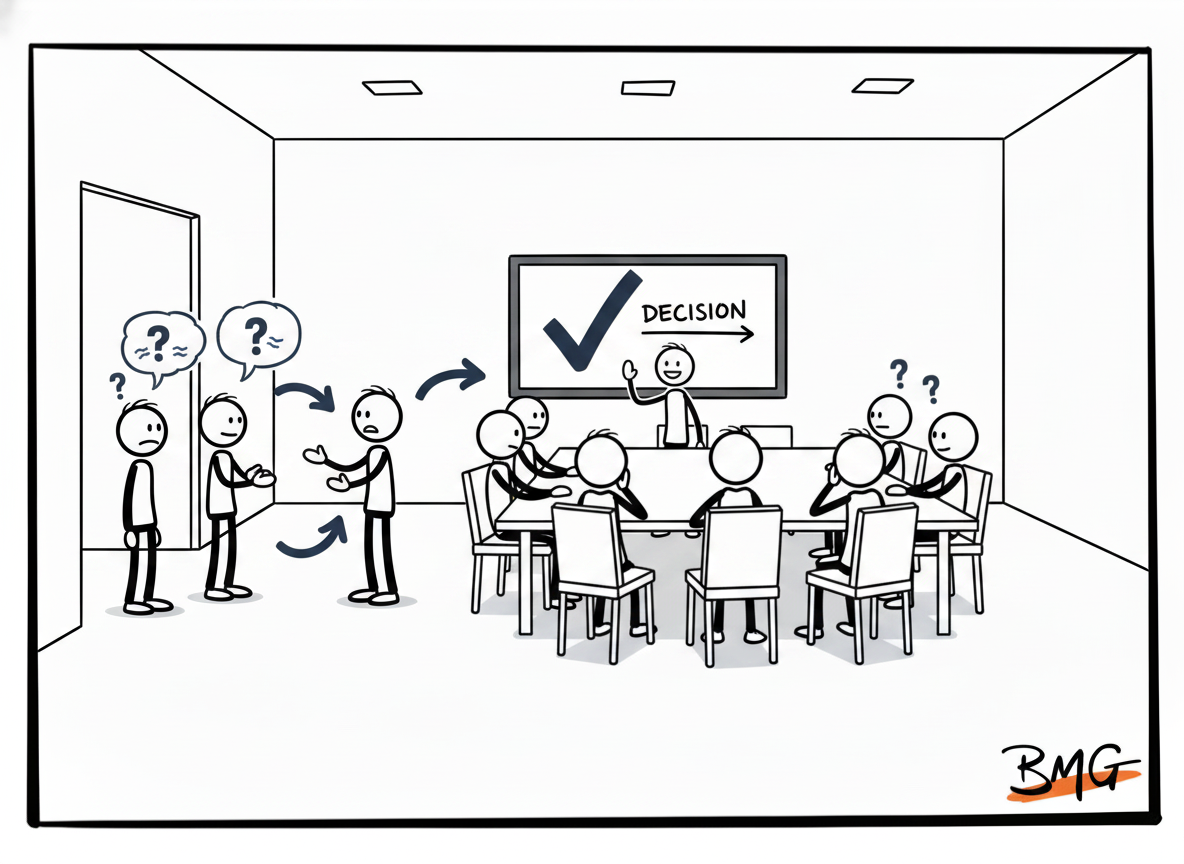
In the meeting, alignment appears clean. Heads nod. Actions are captured. The room closes with polite confidence.
Then the real conversation begins in corridors, private messages, side calls, and post-meeting debriefs where the tone changes.
The agreed plan is described as unrealistic. The decision is reframed as political. The owner is questioned when they are no longer present.
Nothing is challenged where it can be resolved. Everything is questioned where it can't be owned.
This is what I call the shadow campaign.
It's expensive because it creates two operating realities.
Reality one is the official record. Reality two is the private resistance network.
Execution drifts between the two.
Leaders are often the last to see it clearly because formal channels still look intact. Minutes are tidy. Status language sounds compliant. No one has openly rejected the plan.
Yet progress slows. Trust thins. Authority weakens.
The leader starts to feel that something is off without being able to name it.
The Reframe
Most people treat this as a communication issue.
It's an authority and integrity issue.
Authority without force depends on one core condition:
the same standard applies in the room and outside the room.
When people can agree publicly and undermine privately without consequence, you don't have healthy dissent. You have strategic leakage.
Healthy organisations need dissent.
Bad ideas should be challenged. Risks should be named. Trade-offs should be debated.
But dissent must happen where ownership lives.
If dissent lives in the corridor, decisions become performative.
The room turns into theatre. Execution turns into politics.
How The Shadow Campaign Forms
It rarely starts as sabotage.
It usually forms through three tolerated habits.
Habit one: conflict avoidance disguised as professionalism
People avoid direct challenge because they don't want to “create noise” in formal settings.
So they defer. They nod. They leave. Then they voice resistance later to people with no decision right.
Habit two: status over substance
In some cultures, being seen as collaborative matters more than being clear.
Publicly, people avoid hard edges to preserve social standing. Privately, they release frustration in safer spaces.
Habit three: leadership over-indexing on visible harmony
When leaders reward smooth meetings and penalise frictional truth, the team learns quickly.
Don't challenge in the room. Challenge after the room.
That's how private resistance becomes the default channel.
The Cost Of Corridor Agreement
The cost shows up in predictable ways.
1. Decision latency rises
The official decision is made. Unofficial resistance delays implementation.
Projects move slower than the decision cadence suggests.
2. Accountability diffuses
Because resistance is informal, ownership is hard to pin down.
People can deny intent while still shaping outcomes through quiet non-cooperation.
3. Trust becomes selective
People trust their private alliances more than formal structures.
That fractures cross-functional execution.
A quick pause
If this is helpful, my free guide goes deeper, and the newsletter brings ideas like this twice a week.
My book, High-Fidelity Leadership, explores these same themes in more depth, with practical frameworks for standards, clarity, and the conversations that leaders avoid for too long.
4. Leaders lose signal
If true sentiment is hidden in unofficial channels, the leader receives compliance data, not reality data.
Good judgement becomes harder because the information environment is distorted.
5. Cultural cynicism grows
High performers stop believing that room-level alignment means anything.
They either disengage or join the shadow campaign to protect themselves.
How To Pull Dissent Back Into The Room
You can't manage this by demanding loyalty.
You manage it by redesigning the decision environment.
Move 1 - Define the dissent window explicitly
Before major decisions, state this clearly:
“Challenge is expected before we commit. Once committed, we execute and surface new evidence directly, not in side channels.”
This legitimises challenge and closes the loophole for passive resistance.
Move 2 - Separate debate phase from execution phase
Many teams blur these phases.
Debate continues after commitment, which keeps decisions unstable.
Name the transition point. Capture it visibly.
Move 3 - Ask for counter-views in the room
Don't wait for volunteers. Invite challenge directly:
- “What are we missing?”
- “What is the strongest case against this?”
- “What risk are we under-weighting?”
When leaders model this, dissent becomes legitimate where ownership can respond.
Move 4 - Re-contract behaviour after the meeting
When corridor dissent appears, address it early and privately with precision.
Not moral language. Behaviour language.
Example:
“In the room you agreed to execute. Outside the room you campaigned against the plan. We need dissent in the room, not private undermining after commitment.”
Direct. Fair. Actionable.
Move 5 - Track execution integrity, not just task completion
Add one review question to major initiatives:
“Are we seeing in-room alignment and out-of-room consistency from key stakeholders?”
This keeps behavioural integrity visible, not assumed.
A Recognisable Moment
A leadership team signs off a commercial plan.
No formal objections. Owner leaves with clear actions.
Within forty-eight hours, two senior peers privately tell their teams the plan is “not realistic” and suggest waiting before committing real effort.
Now the plan is officially live and unofficially contested.
The owner experiences resistance without clear accountability. The leader sees slippage without a clean cause.
This isn't a planning failure. It's a room-integrity failure.
Once named, it can be corrected.
One Practical Experiment This Week
For your next high-stakes decision, run this structure:
- Debate phase: invite direct counter-views in the room.
- Commitment line: state when debate closes.
- Execution contract: confirm owner, timeline, and behavioural expectation.
- Integrity checkpoint: review alignment between public commitment and private behaviour.
Do this for two cycles and observe what changes.
Usually, speed improves and political noise drops because people know where disagreement belongs.
Reflection Prompts
Where in my team does polite agreement hide private resistance?
Which decision looked aligned on paper but stalled in practice?
Have I made in-room challenge safe enough for honest dissent?
What one behaviour standard would reduce corridor campaigning this month?
Final Thought
The shadow campaign survives where leaders confuse visible harmony with real commitment.
If you want authority without force, hold one standard consistently:
challenge in the room, commit in the room, execute with integrity outside the room.
That protects trust. That protects pace. That protects the credibility of every future decision you ask people to carry.
The path to extraordinary is walked with a thousand small steps, you’re doing great!
Your Small Steps
How do I invite dissent without losing control of the room?
Set clear boundaries before the discussion begins.
Small Step: Open with: “I want robust challenge now. Once we commit, we execute and raise new evidence directly.”
What if someone keeps undermining after agreeing publicly?
Address behaviour privately and quickly, using observable facts.
Small Step: Name the in-room agreement and the out-of-room contradiction in one short conversation.
How do I know this is a pattern, not a one-off?
Look for repeated gaps between official commitment and actual follow-through.
Small Step: Add a fortnightly integrity check on major initiatives: agreement quality, resistance signals, and execution consistency.

Barry Marshall-Graham
Executive coach and leadership advisor
Get the Difficult Conversations Guide
A practical resource for leaders who want to say the thing that needs saying, without burning bridges or avoiding the moment.
Keep reading
31 August 2026
The Sentence They Nearly Said
A pause or changed expression may lead to the useful part of a conversation, but noticing it doesn't give the coach permission to decode it.
24 August 2026
You Cannot Coach Someone You Are Secretly Judging
Second-hand information may be useful, but once it becomes a character verdict it changes the leader’s listening, questions and tone.
17 August 2026
A Good Question Can Be Badly Timed
The wording may be excellent, but a coaching question can still arrive before the relationship or the moment is ready to carry it.
10 August 2026
Whose Goal Is It Anyway?
A goal can be strategically sensible and still feel unowned. The answer is honest internalisation, not coaching somebody into believing it was their idea.
3 August 2026
The Leader Who Uses Coaching to Avoid Leading
Coaching can create room for another person to think, but it can also help a leader postpone the feedback, standard or decision that belongs to them.
27 July 2026
Advice Wearing a Hat
A coaching question can sound wonderfully curious while quietly steering somebody towards the answer their leader already prefers.
20 July 2026
The Emotional Cost of Being the Reliable One
Reliability earns trust, but it can also turn one capable leader into the place where unfinished work, uncertainty, and organisational risk accumulate.
13 July 2026
The Relief of Finally Saying the Thing
An overdue conversation occupies far more space than the words themselves. Relief begins when reality is finally allowed back into the room.
6 July 2026
The Sideways Shove
Peer conflict cannot be solved with the Manager Card. Influence begins when leaders stop pushing across borders and repair the working relationship.
29 June 2026
Clarity Under Pressure
Authority is tested when the room tightens. Clear leaders make reality, uncertainty, and the next decision visible without adding drama.