The GROW Model.
15 December 2025
Simple, Familiar … Rarely Used Well
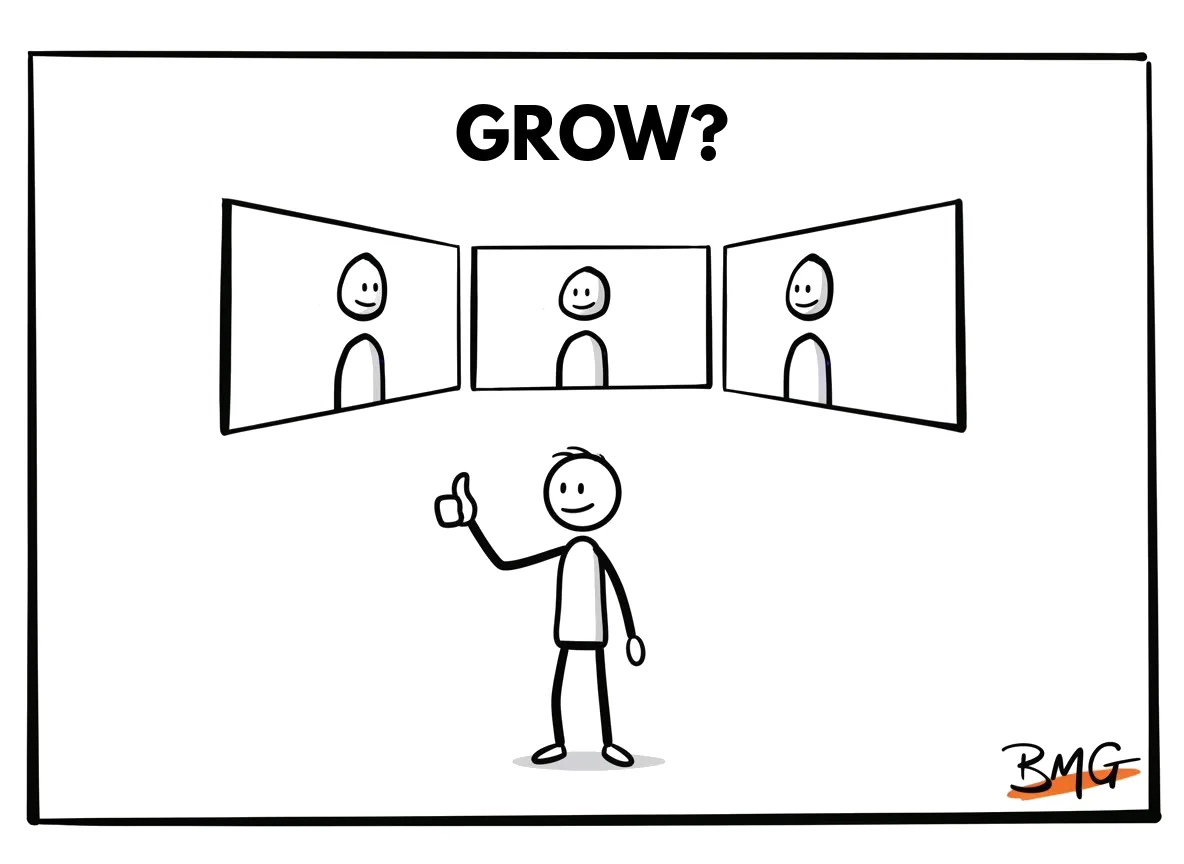
We Say We Use GROW … But Do We Really?
Ask a room full of people if they know the GROW model and most hands will go up.
Ask how often they actually use it (consciously, deliberately, skilfully) and things get quieter and the hands will fall.
GROW has become one of those workplace concepts that everyone recognises, few truly understand, and even fewer apply well.
It’s referenced in training decks, coaching frameworks, and leadership programmes. In practice however, many conversations still default to advice-giving, problem-solving, or telling people what to do.
Which raises three important questions:
What exactly is the GROW model?
Why should you genuinely care?
And how can it help you in everyday life (not just formal sessions when you’re asked)?
What is This GROW Model Anyway
At its heart, GROW is a thinking framework.
It helps someone move from confusion to clarity and from standstill to forward momentum, by structuring how they think - not by telling them what to do.
GROW stands for:
G - Goal
What do you want? Really?
Not vaguely. Not eventually. Specifically. Right Now. Describe it to me. Write it down.
R - Reality
What’s happening right now?
Not the story you tell yourself (and others). Not the excuse. The current facts and feelings. Tell me how things are “as-is” … in this moment. Keep it real.
O - Options
What could you do?
Not the perfection. Just possibilities. The more, the better. Think backwards from your future state. How did you get there? “And what else?” is your friend here.
W - Will (or Way Forward)
What will you actually do?
By when? And how committed are you? Plot your path. Make it official. How will you know when you’re done? What can you do right now. Today? In the next hour?
Simple on paper. Powerful in practice.
Why Most People Don’t Really Use It
Here’s the uncomfortable truth:
GROW requires restraint.
It asks people to:
Stand fast, instead of fixing
Ask first, instead of telling
Stay curious, instead of clever (You know who you are!)
Let others struggle just enough to learn their way through
Most of us skip straight to solutions because it feels helpful. It feels efficient. It feels like leadership. “I’ve walked that path before, let me show you the way”.
All this creates is dependency.
Next time they have a problem - their brain will tell them the simplest solution is … come back and ask again.
Our brains are wired for easy, which is ironic as we all know deep down from thousands of experiences - short cuts never ever pay off.
The GROW model flips this by trusting that most people already have more answers than they think.
They just need space, structure, and safety to access them.
Close your mouth. Open your ears.
Why You Should Care (Even If You’re Not a “Coach”)
You don’t need to be a professional coach or member of the company HR team to use GROW.
You can just as easily use it when:
Someone you know is stuck
A child is frustrated
A teammate or direct report lacks clarity
You’re trying to think something through yourself
Used well, GROW:
Builds ownership instead of reliance
Increases confidence and capability
Improves decision quality
Reduces firefighting and micromanagement
Strengthens trust and psychological safety
And perhaps most importantly - it changes the quality of your conversations.
Less noise. More thinking. Better outcomes.
A quick pause
If this is helpful, the free guide goes deeper, and the newsletter brings ideas like this twice a week.
Using GROW in Everyday Conversations
This doesn’t have to be formal.
A GROW-style conversation might sound like:
“What are you trying to do?” (Goal)
“How does that work now?” (Reality)
“What are you thinking?” (Options)
“What are you going to do next?” (Will)
Four questions.
One conversation.
A very different result.
Sometimes people will struggle. That’s not failure. That’s thinking.
Just repeat the process.
My History with GROW
I’ll be honest, when I first learned GROW, I thought I was using it far more than I actually was. It’s a common mistake.
In reality, I was often doing G-T-S (and not the cool car kind):
Goal > Tell > Solve.
It took conscious effort to slow down. To sit with silence. To resist the urge to rescue … but when I did those things, something shifted.
People didn’t just leave with answers , they left with ownership.
They grew faster.
They trusted themselves more.
And over time, they needed me less which, paradoxically, made my leadership more impactful - the queue to my door fell away. I had way more time.
That’s when I realised: GROW isn’t about being hands-off.
It’s about being thoughtful for the other person (or people) and just showing up as someone who will listen - then ask 4 simple questions.
Reflection Prompts
Where do you jump to solutions too quickly?
Who in your world might benefit from being coached instead of advised?
Which part of GROW do you skip most often - Goal, Reality, Options, or Will?
How comfortable are you with silence in conversations?
How might your leadership change if you trusted others’ thinking more?
Final Thoughts
The GROW model isn’t clever.
It’s not new.
And it’s not complicated.
But it is demanding.
It demands patience.
It demands humility.
It demands that you believe people are capable of more than they think themselves.
Used properly, GROW doesn’t just solve problems, it enables people.
And in leadership, that’s the real work. Right?
So do the work.
Then next time you’re asked about GROW … your hand will be one of the few that stays in the air, saying “Yeah, I know!”.
And truthfully - probably one of fewer still in that small group that ACTUALLY MEAN IT!
Remember, the path to extraordinary is walked with a thousand small steps, you’re doing great!
Your Small Steps
Is GROW only for formal coaching sessions?
No. It works best in everyday conversations.
Action: Use one GROW question in your next informal check-in or conversation with someone. See how powerful, yet natural it feels.
What if someone says “I don’t know”?
That’s often the doorway to deeper thinking.
Action: Ask, “What might you ask me if I didn’t know?”
Isn’t this slower than just telling people what to do?
In the moment, yes. Over time, no.
Action: Coach once. Avoid solving the same problem repeatedly.
Can I use GROW on myself?
Absolutely. It’s a powerful self-coaching tool.
Action: Journal through GROW for a decision you’re currently stuck on.
What’s the most common mistake with GROW?
Turning it into a checklist instead of a conversation (even with yourself).
Action: Focus on curiosity, not sequence.
How do I know if I’m using it well?
If the other person leaves clearer and more confident than when they arrived.
Action: Ask them, “What was useful about this conversation?”
How can I build this habit as a leader?
Through repetition and restraint.
Action: Choose one week to lead with more questions than answers.

Barry Marshall-Graham
Executive coach and leadership advisor
Get the Difficult Conversations Guide
A practical resource for leaders who want to say the thing that needs saying, without burning bridges or avoiding the moment.
Keep reading
13 March 2026
The Weight of Unshared Doubt
Why senior leadership feels lonelier as you rise, and why confidence is often just unshared doubt.
9 March 2026
Why Your Best Advice is the Problem
Why the rush to fix others is actually a specific insecurity, and how to stop.
6 March 2026
The Weight in Your Voice
Your words carry more weight than you realise. Calm authority is often a matter of pace, tone, and the courage to name what matters.

2 March 2026
The Quiet Drift You Inherit
Inherited teams rarely collapse in a moment. They drift. Resetting standards isn't about being harsh, it's about clarity, dignity, and trust.
27 February 2026
When Everyone Owns It
Shared ownership sounds healthy, but when everyone owns a decision, nobody owns the decision. Clarity needs a single accountable owner.
23 February 2026
The Private Ledger of Leadership
Senior leaders carry a private ledger of risks, promises, and people. Naming that inner load isn't weakness, it's how you lead without breaking.

20 February 2026
The Avoided Conversation Is a Decision
The conversation you're avoiding isn't neutral. It's a decision to let the current pattern continue, and that decision shapes the culture.

16 February 2026
Calm Authority in Tense Rooms
Authority isn't volume or force. It's the ability to hold a tense room steady, name what matters, and set a clear boundary without heat.

13 February 2026
The First Small Tolerance
Standards rarely collapse in a moment. They slip through the first small tolerance you let pass, then the next one feels easier.

9 February 2026
The Decision Vacuum
When decision rights are unclear, every meeting becomes a referendum. Clarity is less about answers and more about who owns the call.
