The Private Load of Public Roles
2 February 2026
Senior roles can feel heavier as private responsibility accumulates, decisions multiply, and there are fewer safe places to speak plainly.
The Problem
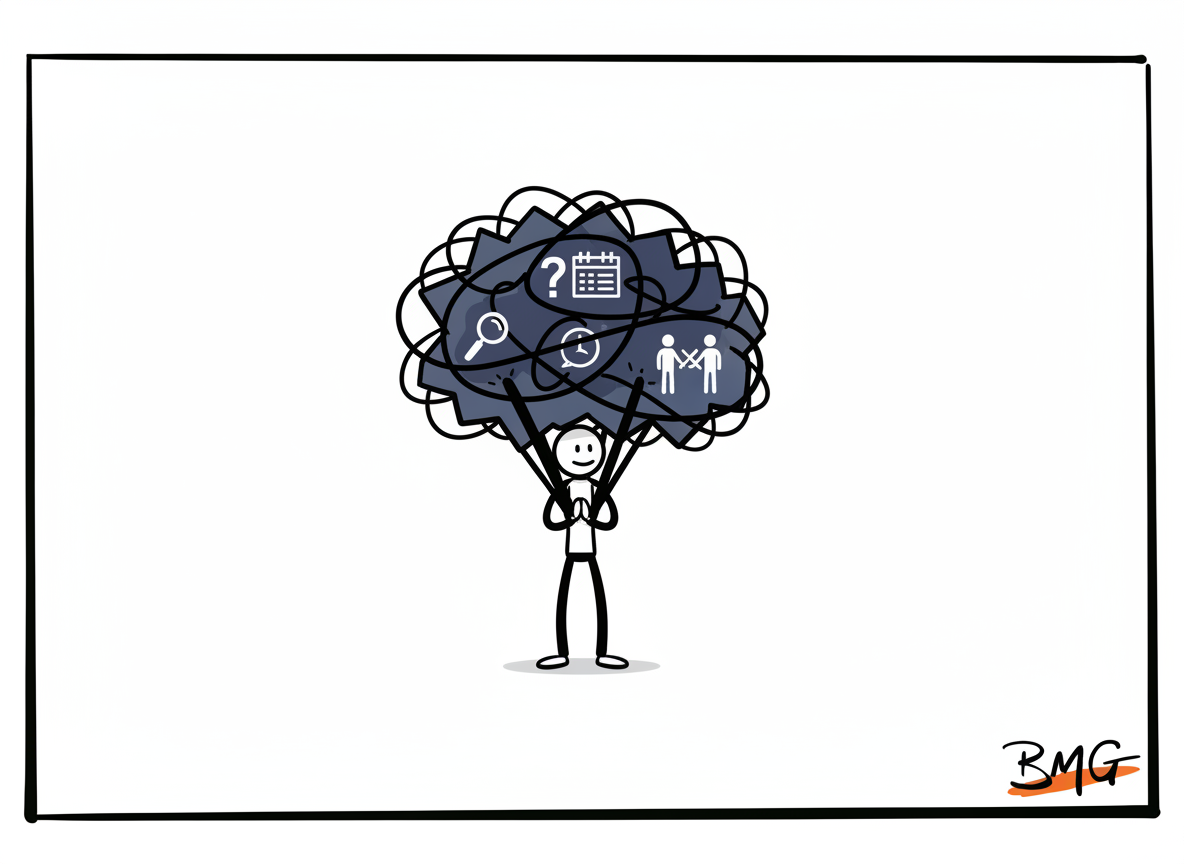
In senior roles, there is a private weight that never shows on a calendar. The task list is not the issue, the quiet responsibility is.
You carry decisions that affect people. You carry uncertainty that others look to you to resolve. You carry the consequences if it goes wrong.
The weight is often invisible. On the surface you look composed, yet inside you are holding a long list of unresolved tensions. Some of them are not yours to solve, yet they still land on your desk.
There is also the private maths you do every day. What can be said now. What must wait. What you can share with your team without creating unnecessary fear. That filtering takes energy, and it rarely gets acknowledged.
It shows up in small ways. The way your mind keeps turning after a meeting. The way your sleep thins out before a board update. The way you feel relief when a decision is made, even if it is not perfect.
It shows up in your body too. A tight chest before a difficult conversation. The sense that you are always half listening because your mind is already on the next consequence.
Over time, this private load becomes the dominant feature of the role. You are not just managing people and projects, you are holding the emotional cost of consequences that other people will never see.
You also become the steward of tone. You choose words carefully so the organisation does not wobble. That care is invisible work, yet it is the reason many teams remain steady during change.
The Reframe
This load is not weakness. It is the cost of being the person who carries the consequences. The higher you rise, the fewer places you can process openly.
The role becomes more visible, while the burden becomes more private. Capability is assumed, yet support is rarely built in.
There is a distinction worth making. Workload is the visible list. Load is the invisible responsibility. You can reduce one and still be crushed by the other.
Naming the load does not remove it. It makes it workable, and it stops it turning into quiet isolation.
Some of the load should stay private. That is part of senior responsibility. The issue is when all of it stays private. That is when it hardens into something you carry alone, and it starts to shape your mood, your decisions, and your relationships.
What the Load Is Made Of
The inner load is not one thing. It is the accumulation of the calls you cannot share, the doubts you cannot express, and the trade-offs you cannot make everyone happy with.
It is the tension between clarity and care. You need to be direct, yet you also know the impact of your words. You manage both at once, often without anyone noticing.
It is the weight of unfinished decisions. You might be waiting for data, yet the organisation wants certainty now. You hold the gap between what is known and what is needed, and you still have to lead.
It is the quiet conflict between your standards and the realities of the system. You can see what is slipping, yet you also know how many fires are already burning.
It is the constant calibration of risk. A decision in the afternoon could become a headline by the evening. You move carefully, yet you cannot stop moving.
It also includes the responsibility to keep the room steady. You are the person others look to when things wobble. That expectation is rarely spoken, yet it shapes everything.
It is also the collision of loyalties. You care about the people, the performance, and the long term health of the business. Those loyalties do not always point in the same direction, and the tension lives inside you long after the meeting ends.
There is moral residue too. You make the best call you can with imperfect information, then you sit with the consequences in silence. That residue can feel heavier than the decision itself.
How the Load Shows Up
The private load often shows itself in over preparation. You write the notes, rehearse the message, and anticipate the questions because you do not want surprises.
It shows up as vigilance. You listen for a change in tone. You watch how people respond. You scan the room for hesitation you might need to address later.
It shows up in small avoidance. You delay the conversation that will trigger a difficult response. You choose the safer wording even when you know the clearer one is needed.
It can also show up as emotional distance. The more weight you carry, the more you protect yourself from feeling it fully. That distance can look like composure, yet it can also lead to quiet isolation.
It can show up as impatience with small things. A minor delay feels bigger because you are already carrying so much. You hear yourself respond more sharply than you intended, then spend the evening replaying it.
It can also show up as constant availability. You keep your calendar open, respond quickly, and stay reachable because it feels safer to catch issues early. Over time, that availability becomes another layer of load.
It can show up in what you do not say. You choose to protect the team from uncertainty, yet you carry the uncertainty yourself. The protection is real, and so is the cost.
A quick pause
If this is helpful, the free guide goes deeper, and the newsletter brings ideas like this twice a week.
A Day That Looks Normal
Consider a senior leader on a Tuesday that looks ordinary from the outside. The calendar shows three meetings, a board update, and a quick one to one.
The day begins with a note from HR about a performance issue that cannot be escalated yet. It sits there, half solved, half waiting.
In the morning meeting, a peer challenges a decision. You respond calmly, then feel your stomach tighten because you know this will resurface in private.
During the board update, the numbers are fine, yet you are carrying the story behind them. You choose what to reveal, what to hold, and how to hold it without looking defensive.
After lunch, a team member asks for certainty about a change that is still in flux. You give as much clarity as you can, then make a note to follow up later because you do not want them to drift.
Half an hour later, a Slack message arrives from a peer: ‘Can we jump on a quick call?’ You know it is about the concern raised earlier. You say yes, because the relationship matters, and you quietly absorb the cost.
At the end of the day, your inbox is quiet. The noise is in your head. The public role looks stable, yet the private load has grown heavier by two decisions and three conversations.
You tell yourself you will reset tomorrow. Yet tomorrow brings its own load, and the private weight keeps accumulating unless there is a place to put it.
Why It Persists
The private load persists because it often looks like competence. You are praised for composure, so you keep it all inside.
You become the calm person in the room, and that identity starts to narrow your options. It can feel risky to admit you are carrying more than you can hold alone.
There is also an unspoken belief that senior leaders should cope. You can tell yourself ‘This is what the role is’ and keep going, even when the weight is bending your posture.
The load stays private because there are few places to put it. Peer conversations can feel political. Team conversations can feel unfair. Outside support can feel exposed.
Confidentiality adds another layer. Some of what you are holding cannot be shared without breaching trust. The result is a quiet pocket of isolation that grows as your responsibility grows.
What Changes When You Name It
Naming the load does not mean unloading it on everyone. It means finding one or two places where it can be spoken safely. That single act changes the tone in your own head. You move from carrying to holding, from bracing to choosing.
I have seen this in teams where a leader makes one clear statement to a peer: ‘I am carrying the weight of this decision, and I could use another set of eyes.’ The peer does not fix it, yet the leader feels less alone. The quality of the decision improves because it is no longer made in a vacuum.
It also shifts how you lead your team. When you are less overloaded, you listen better. You are less likely to over react to a small issue because the private load is not already consuming your bandwidth.
Most importantly, naming the load creates a boundary. It marks what is yours to carry and what should be shared. That boundary gives you back energy, and it creates a healthier model for the leaders around you.
Personal Reflection
I have felt this most in the weeks when decisions were high stakes and visibility was high. I would keep moving, while the quiet space in my head stayed full.
What helped was finding a place where I could speak plainly without performance. The load did not vanish, it became lighter and more defined.
I learned that leadership is not just about holding. It is also about choosing where the load can safely land, and who can help you carry it.
That shift did not make the work smaller. It made the work more honest. I stopped treating the private load as a personal failing and started treating it as a signal to build better support.
It also changed the way I spoke to my team. I did not share everything, yet I let them see the reality of trade offs. That honesty made our decisions steadier and our relationships stronger.
Reflection Prompts
What part of your role feels heavier than the workload suggests?
Where are you carrying responsibility that could be shared?
What do you keep private because it feels unsafe to name?
Who do you trust enough to be real with, even briefly?
What decision feels heavier because you are holding it alone?
Final Thought
The private load is not a flaw. It is a signal that the role has outgrown your current supports.
You do not need to announce everything. You do need a place where the weight can be named and held.
It is a quiet act of stewardship, not self indulgence at all.
The path to extraordinary is walked with a thousand small steps, you’re doing great!
Your Small Steps
What are you holding that no one sees?
Naming the weight reduces its grip.
Small Step: Write down the two responsibilities that feel most private. Do it for yourself, not for anyone else.
Where are you acting certain when you feel unsure?
Pretending costs energy. It also cuts you off from help.
Small Step: In one conversation this week, say ‘I am still thinking this through.’
Which decision would feel lighter if shared?
Some decisions need privacy, yet not all of them.
Small Step: Choose one decision and ask a trusted peer for perspective, not permission.
What support have you outgrown?
What worked at a smaller scale often fails at a bigger one.
Small Step: Identify one support you need now that you did not need two years ago.
Where are you treating pressure as normal?
Normalising pressure makes it invisible and permanent.
Small Step: Name one pressure point and decide how you will lower it this week.
What is one truthful sentence you could say to a peer?
Short truth is often enough to open a real conversation.
Small Step: Send a short message that begins with ‘Can I be honest about something?’
What is one boundary you can set around your own availability?
The private load grows when every demand feels immediate.
Small Step: Set one protected block in your week where you do not take meetings or calls.

Barry Marshall-Graham
Executive coach and leadership advisor
Get the Difficult Conversations Guide
A practical resource for leaders who want to say the thing that needs saying, without burning bridges or avoiding the moment.
Keep reading
6 March 2026
The Weight in Your Voice
Your words carry more weight than you realise. Calm authority is often a matter of pace, tone, and the courage to name what matters.

2 March 2026
The Quiet Drift You Inherit
Inherited teams rarely collapse in a moment. They drift. Resetting standards isn't about being harsh, it's about clarity, dignity, and trust.
27 February 2026
When Everyone Owns It
Shared ownership sounds healthy, but when everyone owns a decision, nobody owns the decision. Clarity needs a single accountable owner.
23 February 2026
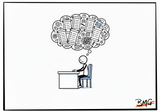
The Private Ledger of Leadership
Senior leaders carry a private ledger of risks, promises, and people. Naming that inner load isn't weakness, it's how you lead without breaking.
20 February 2026
The Avoided Conversation Is a Decision
The conversation you're avoiding isn't neutral. It's a decision to let the current pattern continue, and that decision shapes the culture.

16 February 2026
Calm Authority in Tense Rooms
Authority isn't volume or force. It's the ability to hold a tense room steady, name what matters, and set a clear boundary without heat.

13 February 2026
The First Small Tolerance
Standards rarely collapse in a moment. They slip through the first small tolerance you let pass, then the next one feels easier.
9 February 2026
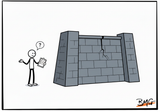
The Decision Vacuum
When decision rights are unclear, every meeting becomes a referendum. Clarity is less about answers and more about who owns the call.

6 February 2026
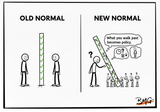
The Standard You Walk Past
How small exceptions become the quiet rule, and why leaders must name the slip before it sets the team's real expectations.
30 January 2026
Conviction Without Force
How to hold a clear position without pushing, and why steady conviction builds more trust than intensity ever will over time.