The Quiet Tax of Avoidance
19 January 2026
Why avoidance creates decision debt and quietly erodes standards.
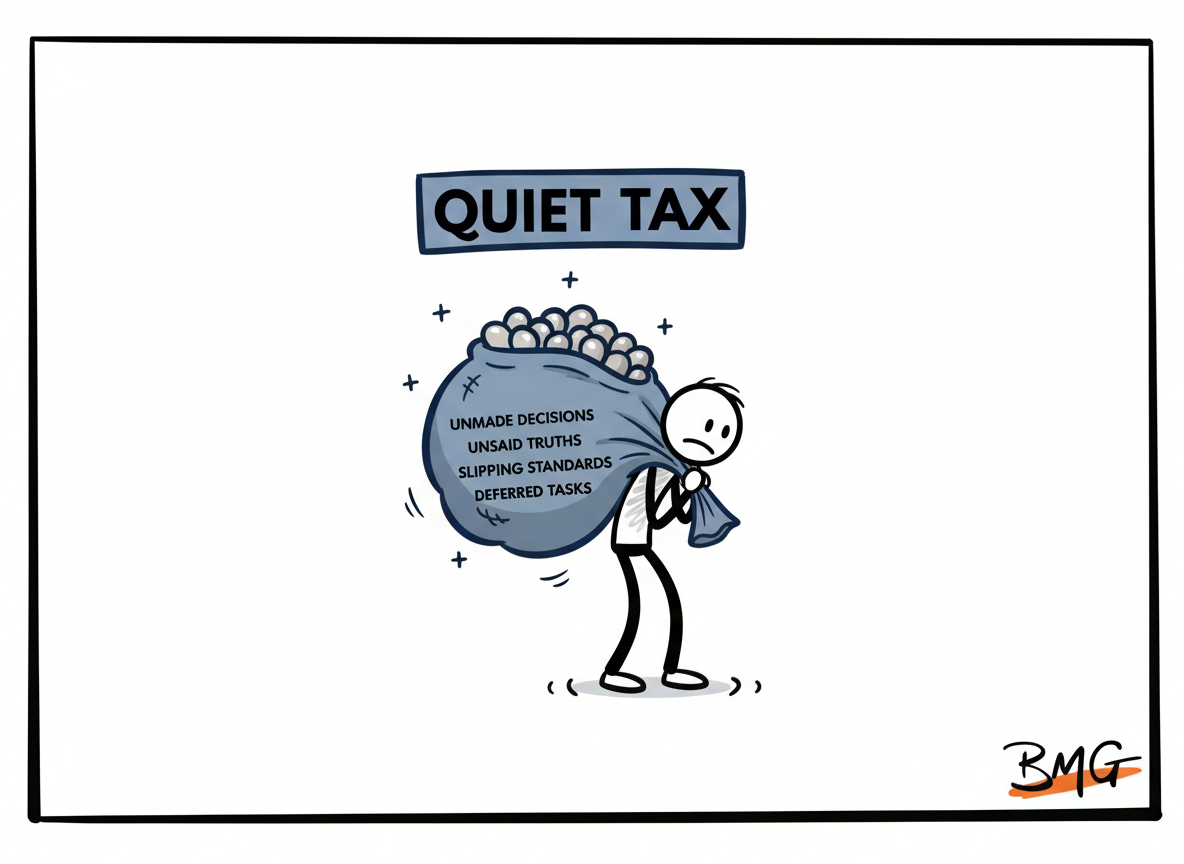
The Problem
There's a particular kind of pressure that shows up when you step into a bigger role.
It isn't workload. You can handle workload.
It's the knowledge that there is something you should address... and you haven't.
A standard that has slipped. A decision you keep deferring. A person you need to be direct with. A conversation you're rehearsing in your head, then postponing again.
From the outside, everything looks fine. You are functioning. You are delivering.
But internally, you are paying a quiet tax.
It shows up as mental load you cannot explain, tension you carry into unrelated meetings, and a creeping sense that you are "managing" the issue rather than leading it.
The Reframe
Most people treat avoidance like a safety move.
- "If I wait, I'll have more information."
- "If I soften it, I'll keep the peace."
- "If I ignore it, it might resolve itself."
- "If I hold it, I'll protect the team."
Sometimes that is true in the short term.
But at senior levels, avoidance does not remove risk, it relocates it.
It turns into:
- Decision debt, because what you do not decide still demands attention.
- Standards drift, because what you tolerate quietly becomes the new normal.
- Relationship erosion, because people feel what you will not name.
- Credibility leakage, because hesitation reads as uncertainty, even when it is care.
Avoidance is rarely laziness. It is often a form of misplaced responsibility.
You are trying to prevent fallout, so you carry the cost yourself.
Why it Persists (even for high performers)
Avoidance persists because it feels rational.
A hard conversation has visible consequences. Someone could react badly. The dynamic could change. You might have to follow through.
So your mind offers you a trade.
Keep things stable today, pay for it later.
The problem is that "later" arrives as compound interest.
When a standard slips and you do not reset it, the next conversation gets harder, not easier. You are no longer addressing a single incident. You are addressing a pattern that you implicitly permitted.
When a decision is delayed, your team starts building workarounds. Workarounds turn into informal systems. Informal systems turn into misalignment. Now the decision you avoided is wrapped in politics and sunk cost.
When you don't name the thing with a peer, you begin to manage them. You route around them. You over-prepare. You add meetings. You carry tension you could have addressed directly with one clean statement.
This is why senior roles can feel heavy even when you are capable. You are not just doing work, you are holding unmade decisions and unsaid truths.
What changes when you stop paying the tax
Relief, first.
Not because the situation is fixed, but because your mind stops splitting into two tracks, the public track where you perform competence, and the private track where you carry what you will not name.
Then clarity.
When you say the thing, you get reality. You find out whether the issue is misunderstanding, misalignment, capability, motivation, or something else entirely.
And then standards.
The moment you address what you have been tolerating, you send a signal, to yourself as much as to others, that your role is not to keep everything comfortable. Your role is to keep things clear.
That does not mean being harsh. It means being clean.
Calm directness. A firm boundary. Dignity intact.
A quick pause
If this is helpful, the free guide goes deeper, and the newsletter brings ideas like this twice a week.
A Personal Reflection
I have been on both sides of this.
I have delayed conversations because I didn't want to trigger defensiveness, or because I thought I could "solve it" by being more patient, more available, more understanding.
Sometimes the person improved. Often they didn't.
What changed for me was noticing the hidden cost. The delay did not protect the relationship. It quietly damaged it, because my behaviour shifted. I became less direct. Less trusting. More controlling. I started compensating for what I hadn't addressed.
The moment I finally spoke, the conversation was rarely as explosive as my mind predicted. The tension had been living mostly in me.
That was the lesson.
The hard part was not the words. The hard part was crossing the internal line from avoidance to ownership.
Reflection Prompts
Where is avoidance currently costing you more than the conversation would?
What are you tolerating that you would not want to become normal?
Which decision is "waiting for more information" but is really waiting for more courage?
Who are you managing around, instead of speaking to directly?
If you were being completely honest, what is the outcome you want here?
What standard do you need to reset, and what would "clean" look like?
Final Thought
Senior leadership doesn't break people through volume. It breaks them through unspoken load.
The quiet tax of avoidance is paid in attention, energy, and self-respect.
You don't need perfect words. You need a clean next step.
If something has been sitting on your mind for weeks, it is probably already costing you.
Remember, the path to extraordinary is walked with a thousand small steps, you're doing great.
Your Small Steps
How do I know if this is worth addressing, or if I'm overreacting?
If it keeps returning to your mind, it's already taking up capacity, that alone is signal. Small step: write one sentence beginning "The real issue is..." and see if it becomes clearer.
What if raising it creates conflict I can't control?
You cannot control reactions, but you can control your intent and your clarity. Small step: write your opening line to include both, "I want to be direct with care, and I want a good outcome for us."
What if I don't have the full picture yet?
You rarely will. Waiting for certainty often becomes an excuse for delay. Small step: list the one thing you must know before acting, and ask for it directly within 24 hours.
How do I stop it turning into a messy, emotional conversation?
Structure reduces heat. Keep it anchored to observation, impact, and request. Small step: write three lines, "What I observed... The impact... What I'm asking for..."
What if the other person denies it or deflects?
That's common, especially when standards are unclear. Return to facts and choices. Small step: prepare one calm follow-up question, "What part do you disagree with, the observation or the impact?"
How do I avoid sounding accusatory?
Use neutral observations and name your intent, not their character. Small step: replace "You always..." with "What I'm noticing is..."
What if I'm the one who has allowed the drift?
That's not a reason to stay silent, it's a reason to lead cleanly. Small step: own your part in one line, "I should have addressed this earlier, that's on me, and I want to reset it well."
What's the smallest possible action if I'm still hesitating?
Don't aim for the whole conversation. Aim for the first 60 seconds. Small step: book the meeting and send a short agenda line, "I'd like to align on expectations and next steps."

Barry Marshall-Graham
Executive coach and leadership advisor
Get the Difficult Conversations Guide
A practical resource for leaders who want to say the thing that needs saying, without burning bridges or avoiding the moment.
Keep reading
13 March 2026
The Weight of Unshared Doubt
Why senior leadership feels lonelier as you rise, and why confidence is often just unshared doubt.
9 March 2026
Why Your Best Advice is the Problem
Why the rush to fix others is actually a specific insecurity, and how to stop.
6 March 2026
The Weight in Your Voice
Your words carry more weight than you realise. Calm authority is often a matter of pace, tone, and the courage to name what matters.

2 March 2026
The Quiet Drift You Inherit
Inherited teams rarely collapse in a moment. They drift. Resetting standards isn't about being harsh, it's about clarity, dignity, and trust.
27 February 2026
When Everyone Owns It
Shared ownership sounds healthy, but when everyone owns a decision, nobody owns the decision. Clarity needs a single accountable owner.
23 February 2026
The Private Ledger of Leadership
Senior leaders carry a private ledger of risks, promises, and people. Naming that inner load isn't weakness, it's how you lead without breaking.
20 February 2026
The Avoided Conversation Is a Decision
The conversation you're avoiding isn't neutral. It's a decision to let the current pattern continue, and that decision shapes the culture.

16 February 2026
Calm Authority in Tense Rooms
Authority isn't volume or force. It's the ability to hold a tense room steady, name what matters, and set a clear boundary without heat.

13 February 2026
The First Small Tolerance
Standards rarely collapse in a moment. They slip through the first small tolerance you let pass, then the next one feels easier.
9 February 2026
The Decision Vacuum
When decision rights are unclear, every meeting becomes a referendum. Clarity is less about answers and more about who owns the call.
