When Calm Carries Authority
26 January 2026
Why credibility grows when you stop performing certainty and start leading with calm, consistency, and clear boundaries.
The Problem
In senior roles, there is a quiet pressure to look certain. You feel it in meetings where the room is watching, waiting for your cue. You hear it in your own head when the stakes are high and the agenda is full.
That pressure can pull you into speed. You answer quickly. You smooth edges before anyone asks. You fill silence so no one can mistake it for doubt.
The room nods, yet the agreement feels thin. People save their questions for later. Someone asks for a follow up. The side conversation starts as soon as the call ends.
You can feel the drag in the days that follow. The decision that should have released energy becomes another thread to manage. You find yourself explaining the rationale again in a one to one, then again to a different stakeholder who was not in the room.
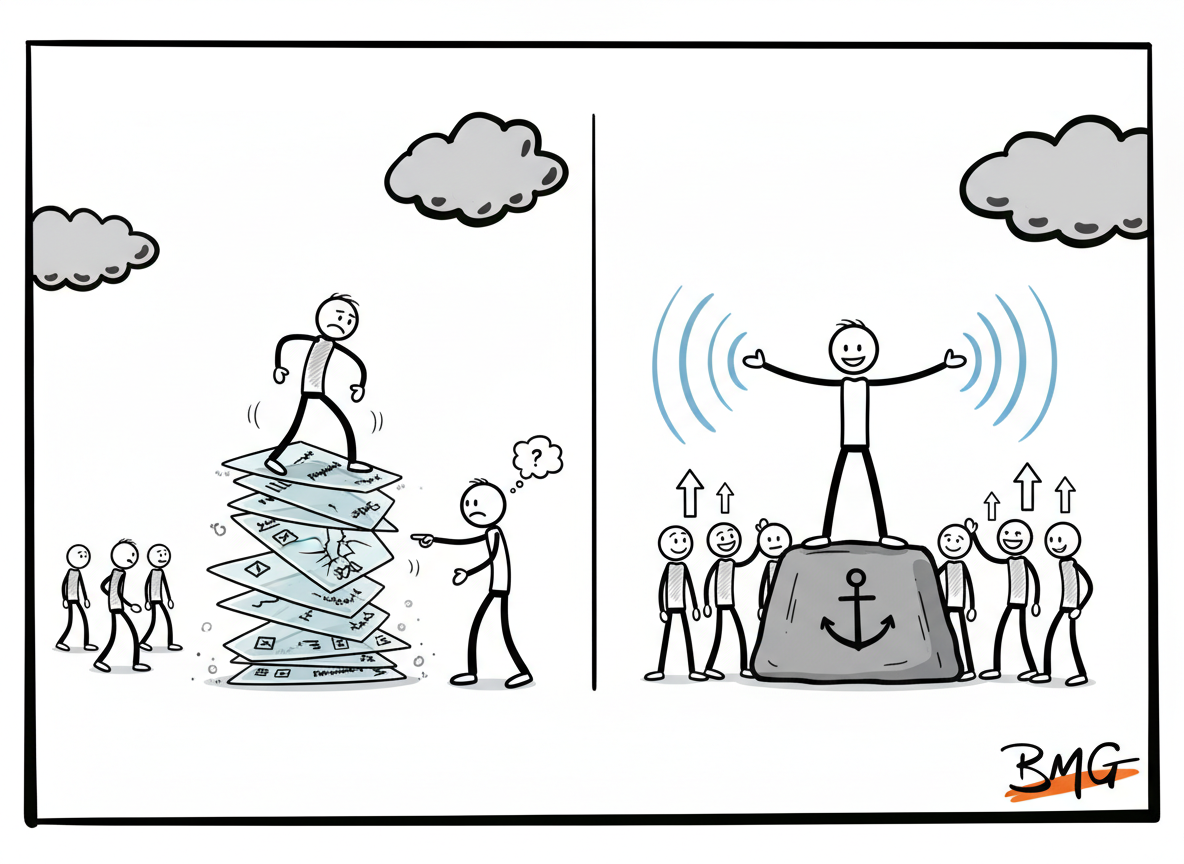
It can feel like you are holding a fragile object. If you stop explaining, it might fall. That is the trap. The more fragile you treat the decision, the more fragile it becomes.
What looks like decisiveness can become performance. You are doing the work and carrying the appearance of certainty at the same time. That double load is hard to hold for long.
Authority begins to leak in these moments. You may still be respected, yet the room feels less anchored than it should. The weight of keeping everything steady starts to sit on you rather than in the shared space.
The temptation is to treat silence as a verdict. You sense the room go quiet and read it as they are unconvinced. You respond with more detail, more logic, more reassurance. The message becomes denser just as people are starting to switch off.
Over time, the pattern becomes exhausting. You replay conversations on the walk home. You draft the follow up email in your head before dinner. You find yourself preparing for the meeting after the meeting, because you know it is coming.
The Reframe
Authority is not volume. It is steadiness. People decide whether to follow you by how you hold yourself when the room is uncertain, not by how many words you use.
Calm is an active signal. It shows that you can hold tension without scrambling, and that you trust the room to do its part of the thinking.
When you are consistent, people relax into clarity. They may disagree and still move. Calm gives people a stable reference point, even if the decision is hard.
The paradox is that your authority grows when you stop trying to prove it. You hold the line with respect, and the room adapts to the clarity you bring.
Calm does not mean being slow or vague. It means being deliberate. You are clear about what is decided, what is still open, and what will not be reopened without new information.
It can look like restraint. The urge to add another slide is strong, yet you choose the sentence that matters. The urge to pre-empt every reaction is strong, yet you leave space for people to ask what they need to ask.
Calm is also a decision about tone. You choose steadiness even when the room is noisy. You choose to be clear even when someone is hoping you will soften. That combination signals authority without aggression.
The Signals People Read
Teams watch your pace, your posture, and the consistency between what you say and what you do. They notice how you handle challenge, not just what you decide.
When your tone speeds up, they feel you are trying to hold the room alone. When you over explain, they hear hesitation and begin to negotiate. When your boundaries move, they learn that standards are flexible.
These signals are rarely conscious. They are felt. Over time they shape whether people bring you the hard truth or only the polished version.
Calm and clarity together create gravity. They tell people what matters without needing to persuade. They also make it safer for others to speak honestly.
One of the most telling signals is how you handle silence. If you rush to fill it, you remove the space where others could offer a better insight. If you can pause without defensiveness, you invite the room to do its own work.
Authority is often lost in small ways. A boundary that shifts by a small amount. A decision that is re opened because someone asked twice. A reluctant laugh that suggests you are trying to keep everyone comfortable. These are tiny cues, yet they compound.
There is also the signal of what you choose to revisit. If a decision is repeatedly re opened, people learn that the most persistent voice wins. If you hold the decision steady and make the review process explicit, people learn to bring their best thinking early instead of lobbying later.
Notice the micro behaviours, too. The tone you use in a quick Slack reply. The way you enter a room when you are late. The response you give when you are pressed for a decision and you choose to delay. These are the textures of authority, and people notice them long before they remember the words.
There is a quiet cost to wobble. Each time a boundary moves, you train people to test it. Each time you defer for the sake of harmony, you postpone a clear standard. Those are not mistakes, they are signals. And signals become culture.
The opposite is also true. When you recover a wobble with calm, people notice. You can say, ‘I gave too much air to this last week. The decision stands, and this is how we will move forward.’ That kind of reset does not require drama. It requires clarity and a willingness to own the moment without apology.
A quick pause
If this is helpful, the free guide goes deeper, and the newsletter brings ideas like this twice a week.
A Room That Tests You
Picture an executive meeting where a decision has already been made. The plan has been communicated, the work has started, and then a respected peer raises a late concern.
You can see the shift in the room. Someone leans back. Another person reaches for their notebook. The energy changes from delivery to debate.
You feel the pull to justify every angle and to prove the decision is still correct. You can feel your own pace rising as you try to answer each objection in real time.
If you over explain, the group senses fragility and the decision reopens. You might win the argument, yet you lose the sense of certainty that was carrying the team.
A calm response looks different. You acknowledge the concern, restate the decision, and name the next step for review. You might say ‘That is a fair risk. The decision stands for now, and I want a short note on the mitigation by Friday.’ The room exhales and the agenda moves on.
Authority shows itself in these small moments. It is the ability to stay steady while allowing the room to adjust to the clarity you bring.
After the meeting, the difference is clear. In the over explained version, people drift into side messages and quiet calls. In the calm version, the follow up is practical. The question becomes how do we execute, not are we still doing this. That shift is what authority looks like in practice.
This is why calm is teachable. People learn it from you. When you show that a clear decision can be held without theatrics, others begin to model that steadiness in their own teams.
Why Calm Gets Lost
Calm is difficult when you care. If you are invested, it can feel irresponsible to leave space. It can feel safer to keep talking until you see agreement.
There is also a social cost to silence. Silence can feel like exposure, especially when you are leading people who look to you for stability.
Many senior leaders carry the memory of a moment when they were too slow, too quiet, or too unsure. The lesson becomes never let that happen again. The result is over correcting in the opposite direction.
There is a distinction worth holding. Decisiveness is about making a clear call. Certainty performance is about showing you have no doubts. People do not need the second, they need the first.
Calm is also a boundary. It says that you are open to questions, but you are not on trial. It gives people a place to stand that is not dependent on your constant reassurance.
Another reason calm gets lost is tempo. Organisations that celebrate urgency often confuse speed with clarity. If the culture rewards fast answers, leaders learn to deliver speed even when the question deserves thought. Calm can feel like risk in that environment, yet it is often the safer choice.
This is where your own nervous system matters. If you are tense, the room feels it. If you can slow your breathing and hold your posture, you change the temperature without saying a word. Calm is a physical practice as much as a communication choice.
Personal Reflection
Earlier in my leadership, I used to rehearse every objection before it arrived. I believed that if I answered everything in advance, I would earn trust.
What changed was learning to speak clearly, then pause. I found that trust grew when I let people feel the clarity rather than drown it in justification.
The real shift was internal. I stopped needing to win the room and started focusing on holding the decision with respect. That decision landed more cleanly, even when people disagreed.
There was also relief. The work became lighter when I stopped carrying the emotional load of every reaction. I realised I could be present without absorbing every response.
It was less about being liked in the moment, more about being trusted over time. That distinction changed how I showed up.
Reflection Prompts
Where are you filling silence instead of letting it do its job?
Which decision are you over justifying because you want comfort rather than clarity?
What boundary do you keep softening to avoid tension?
Where could you slow your pace so others can meet your standard?
Final Thought
Authority is not something you demand. It is something you signal through steadiness, especially when the room feels uncertain.
Your calm does not remove tension, it gives people a way to work with it.
When you show calm, you are not closing down debate. You are framing it. You are saying that questions are welcome, yet clarity remains. That is the balance people need in senior leadership.
The path to extraordinary is walked with a thousand small steps, you’re doing great!
Your Small Steps
Where are you filling silence to avoid discomfort?
Silence gives people space to think. When you rush to fill it, you remove their responsibility and take more than your share.
Small Step: In your next meeting, count to three before you respond. Let the pause do its work.
What decision are you over explaining to win agreement?
Over explaining can invite debate where you need direction. Clarity plus calm is often enough.
Small Step: State the decision in one sentence, then stop. Ask for questions, not permission.
Which boundary are you hinting at instead of stating?
Hints create confusion. Clear boundaries create trust.
Small Step: Name one boundary explicitly this week, including what happens if it is crossed.
Where does your calendar undermine your authority?
If your calendar contradicts your priorities, people read the calendar.
Small Step: Cancel or shorten one meeting that signals a misaligned priority.
How do you respond when challenged in the room?
Defensiveness reduces authority. Curiosity strengthens it.
Small Step: Practise one neutral response, such as ‘That is helpful. Let me think for a moment.’
What is one place you can show calm before you speak?
Calm is communicated before your first sentence.
Small Step: Take one slow breath before you start a difficult conversation.
Who needs a clear expectation from you this week?
Unspoken expectations create drift and quiet frustration.
Small Step: Send one short message that states a single clear expectation.

Barry Marshall-Graham
Executive coach and leadership advisor
Get the Difficult Conversations Guide
A practical resource for leaders who want to say the thing that needs saying, without burning bridges or avoiding the moment.
Keep reading
30 January 2026
Conviction Without Force
How to hold a clear position without pushing, and why steady conviction builds more trust than intensity ever will over time.
22 January 2026
The Meeting After the Meeting
Why real alignment only happens when truth can survive the room.
19 January 2026
The Quiet Tax of Avoidance
Why avoidance creates decision debt and quietly erodes standards.
16 January 2026
When Being Believed Too Quickly Becomes Dangerous
12 January 2026
The Subtle Art of Doing Nothing
Why doing nothing is rarely neutral, and often the riskiest choice of all
9 January 2026
The Cassandra Effect - When Being Right Isn’t Enough

5 January 2026
A New Year, Not a New You
Why big goals only work when they fit into real life
22 December 2025
Thank You!
A Small Pause Before Christmas

19 December 2025
If You Give the Answers, You’ll Create a Queue

15 December 2025
The GROW Model.
Simple, Familiar … Rarely Used Well
