When the Fire Rises
11 August 2025
How to Manage Anger and Frustration in Public Moments
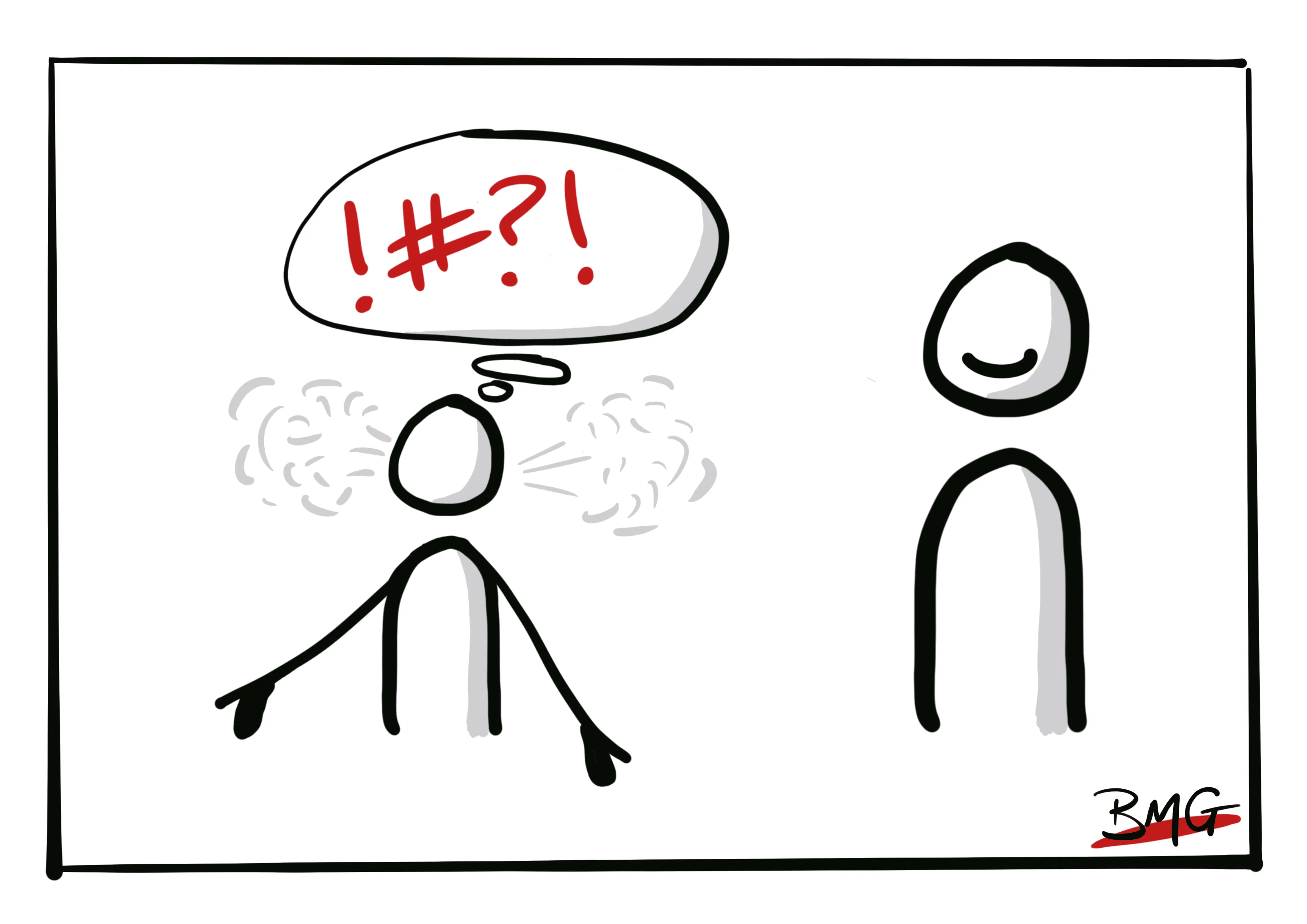
“A moment of patience in a moment of anger saves you a hundred moments of regret.”
- Unknown
I’ve been there. You’ve been there. Everyone you know has been there.
A delay stretches your patience thin.
Someone cuts you off, literally or figuratively.
Suddenly, your body tenses, your heart races, your frustration is written all over your face, and you’re moments away from saying something you’ll regret.
For anyone who cares about integrity, these moments matter.
Not because you shouldn’t feel frustrated (that would be impossible) but how you express it, especially in public, shapes your reputation, your influence, and your sense of control.
Emotional outbursts can unravel trust in seconds.
What is worse, is when that moment of release passes, we are often left feeling worse, not better.
So the real question shouldn’t be “how do I stop being frustrated?“
It should be “how do I move through my frustration with awareness, so it doesn’t own me?”
Let me explain …
Understanding First-Brain Reactions
At the heart of public frustration lies your limbic system, often referred to as your “first brain.”
It’s fast, instinctive, and built for survival. It processes threat long before logic arrives. That’s why you can feel a flush of rage before your inner voice even kicks in.
This isn’t a flaw. It’s biology.
Your limbic system (particularly the amygdala) is wired to detect threat faster than you can consciously think.
It’s a survival mechanism, honed over thousands of years when reacting immediately to danger (a predator in the bush, a rival’s aggression) … it was the difference between life and death.
This rapid-response system bypasses your rational brain to keep you alive. It floods the body with adrenaline, speeds up your heart, and primes your muscles for action, way before your thinking mind catches up.
In modern life, the threats have changed (missed deadlines, a sharp email, public embarrassment) but the biology hasn’t.
The system still fires. So when frustration flares or anger surges, it’s not because you’re weak. It’s because your nervous system is doing exactly what it evolved to do.
Understanding this allows us to meet our reactions with curiosity instead of shame. From there, we can work with the system … instead of against it.
The key to this is how quickly you can interrupt that first impulse and recruit your higher brain (the prefrontal cortex) where reasoning, empathy, and conscious choice live.
Learning to notice the flash before it becomes fire is the difference between reaction and reflection.
Body First, Words Later
One of the most effective ways to manage frustration is to focus on your body, not the story in play.
When anger hits, your body gives you clues:
Your muscles tighten
Your breath becomes shallow
Your fists clench
Your posture stiffens
Before your thoughts spiral, shift the physiology.
Slow your breathing. Unclench your hands. Place your feet flat and soften your stance.
Movement breaks the cycle.
Step away, if you can. Loosen your shoulders. Take a sip of water.
These small physical adjustments signal to your nervous system that the danger has passed, and give your thinking brain a chance to re-engage.
Regulating the Outburst Before It Starts
You don’t need to suppress frustration but you do need to contain it until it’s constructive.
This is where emotional agility comes in:
Label the feeling internally – “This is frustration. This is heat. I’ve seen this before and I know how to deal with it.” Naming emotions reduces their grip.
Acknowledge without acting – “I don’t need to fix this right now.”
Create a pause – Even five seconds of silence can prevent regret.
In a team setting, it might sound like:
“I’m going to take a breath before I respond, because I want to get this right.”
You should see this as weakness. It’s discipline. You are in full control.
A quick pause
If this is helpful, the free guide goes deeper, and the newsletter brings ideas like this twice a week.
When You’re Already in the Moment
Recovery matters more than perfection.
Own it, briefly and clearly. Try:
“That was more frustration than I intended to show. Let’s reset.”
“Sorry about that, I was reacting, I’d like to approach that differently.”
“Let’s take a quick pause. I want to come back to this with clarity.”
Modelling repair builds trust.
And it shows people that emotion isn’t your enemy.
Personal Reflection
For me, this is a muscle I’ve had to build over years. In my days as a consultant I was very often not a very nice person to be around.
Ego was never far from the surface and by definition of my role, people were paying a lot of money for my opinions - and boy did I let them have them.
I have worked tirelessly in subsequent years to change - real hard change - and broadly am past the flashes of frustration.
That said, I’m not immune to it. My own slips generally occur when I am tired, so it’s always present around the edges. But what’s changed over the years is my ability to notice earlier and interrupt faster.
Learning to read my body, slow my breath, and choose when to speak has saved more moments than I can count.
And the irony?
When I honour the emotion without indulging the outburst, people trust me more.
They see that I feel things and have the ability to navigate them with care.
These are skills that are the foundation of great relationships.
Reflection Prompts
What physical signals tell you that frustration is rising?
How do you usually respond when anger shows up in public?
What patterns have you noticed in your body, tone, or decision-making under pressure?
Who in your life models healthy emotional regulation,and what can you learn from them?
What would a “reset phrase” sound like for you in a heated moment?
Final Thought
The facility is that we are not robots.
We’re emotional, reactive, full-spectrum humans. Frustration is part of the package, wired into our biology, shaped by our stories, amplified by stress and tiredness.
Being a model human being doesn’t mean never feeling angry nor frustrated.
It means learning to recognise the signs, understand the triggers, and meet the emotion with skill, and never shame.
Regulation isn’t the absence of fire. It’s knowing how to hold it … without letting it consume you (or those around you).
It’s recognising that your heartbeat is spiking, your jaw is clenched, your shoulders are tight … and despite all that, still choosing a response that aligns with your values.
So the next time tension builds - don’t suppress it. Don’t justify it, and don’t let it speak for you.
Step into it with presence.
Breathe. Move. Name. Pause. Respond.
Because the people we trust the most are not the ones who never feel the heat … they’re ones who can hold the fire.
Without burning the room down.
Remember, the path to extraordinary is walked with a thousand small steps, you’re doing great!
Small Steps, Giant Leaps is a reader-supported publication. To receive new posts and support my work, consider becoming a free or paid subscriber.
Your Small Steps
Is frustration ever useful?
Yes - but only when it’s channelled intentionally. Frustration can signal boundaries or injustice. The key is to choose how and when to act on it.
Action: Reflect on a recent moment of anger. What value or principle was being triggered?
I always regret what I say when I’m angry. What can I do?
Practice “noticing to naming.” Name the emotion silently and delay your response. Even a few seconds can shift the outcome.
Action: Create a go-to reset phrase like, “Let me pause for a moment” to interrupt the pattern.
What if I’m frustrated but don’t know why?
That’s common. Frustration is often a secondary emotion - covering hurt, fear, or stress. Journaling or coaching can help uncover what’s underneath.
Action: Ask yourself, “What else might I be feeling beneath this?” and explore it in writing.
Can I repair a moment where I lost my temper publicly?
Absolutely. A short, authentic acknowledgement goes a long way.
Action: Identify one relationship where a small repair could build trust,and initiate that today.
How can I stop anger before it starts?
You can’t always - but you can reduce triggers by managing sleep, stress, and expectations. Prevention is regulation. I know this more than most.
Action: Audit your week for common triggers, and create one boundary to protect your energy.
Is it okay to feel this angry and still be a good person?
Yes. Emotion doesn’t disqualify you. Awareness, accountability, and how you move through the emotion, that’s what counts.
Action: Reframe anger as data. Use it to guide your growth, not to shape your reactions.

Barry Marshall-Graham
Executive coach and leadership advisor
Get the Difficult Conversations Guide
A practical resource for leaders who want to say the thing that needs saying, without burning bridges or avoiding the moment.
Keep reading
13 March 2026
The Weight of Unshared Doubt
Why senior leadership feels lonelier as you rise, and why confidence is often just unshared doubt.
9 March 2026
Why Your Best Advice is the Problem
Why the rush to fix others is actually a specific insecurity, and how to stop.
6 March 2026
The Weight in Your Voice
Your words carry more weight than you realise. Calm authority is often a matter of pace, tone, and the courage to name what matters.

2 March 2026
The Quiet Drift You Inherit
Inherited teams rarely collapse in a moment. They drift. Resetting standards isn't about being harsh, it's about clarity, dignity, and trust.
27 February 2026
When Everyone Owns It
Shared ownership sounds healthy, but when everyone owns a decision, nobody owns the decision. Clarity needs a single accountable owner.
23 February 2026
The Private Ledger of Leadership
Senior leaders carry a private ledger of risks, promises, and people. Naming that inner load isn't weakness, it's how you lead without breaking.

20 February 2026
The Avoided Conversation Is a Decision
The conversation you're avoiding isn't neutral. It's a decision to let the current pattern continue, and that decision shapes the culture.

16 February 2026
Calm Authority in Tense Rooms
Authority isn't volume or force. It's the ability to hold a tense room steady, name what matters, and set a clear boundary without heat.

13 February 2026
The First Small Tolerance
Standards rarely collapse in a moment. They slip through the first small tolerance you let pass, then the next one feels easier.
9 February 2026
The Decision Vacuum
When decision rights are unclear, every meeting becomes a referendum. Clarity is less about answers and more about who owns the call.
