Silence Compounds Into Leadership Debt
4 May 2026
The conversations leaders avoid do not disappear. They accrue interest in trust, pace, standards, and emotional load.
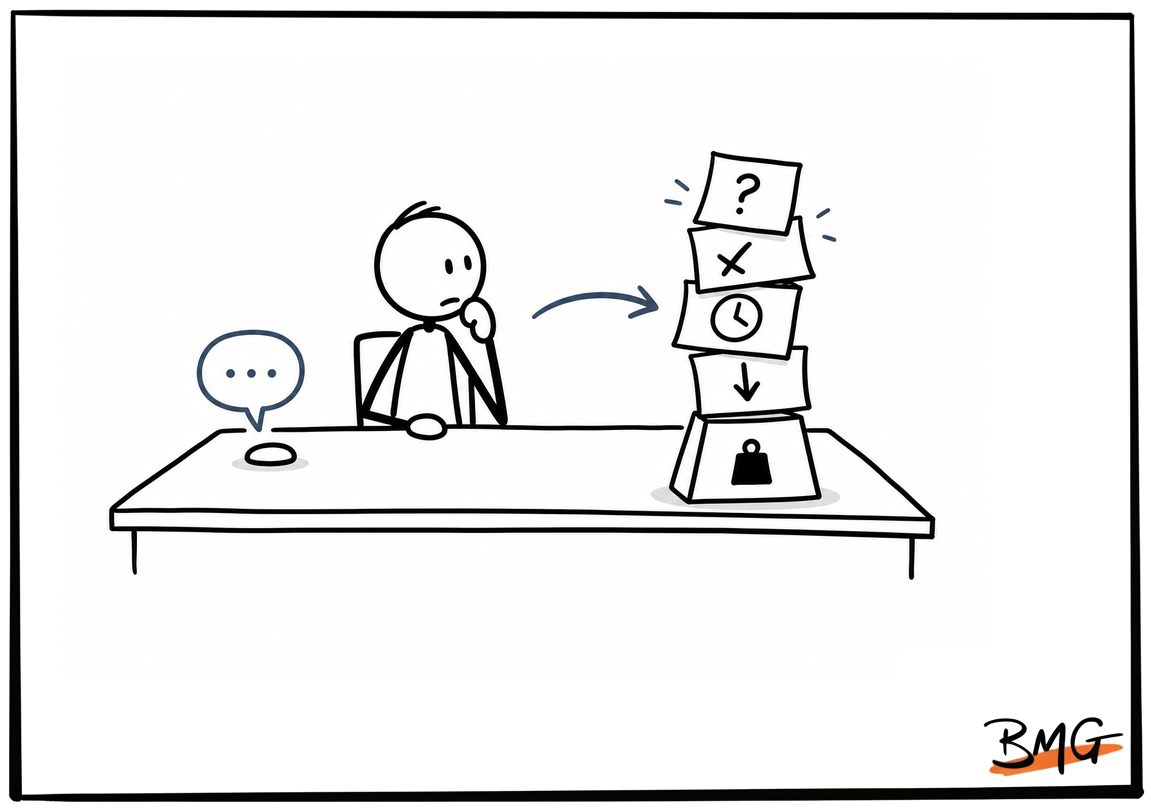
Silence rarely feels expensive when you first choose it. In the moment, it can look like judgement. You decide not to interrupt the flow of the meeting, not to make someone defensive, not to create friction when the room is already tired. The calendar is full, the decision needs to move, and the issue feels small enough to carry for another day.
That is why leadership debt is so easy to accumulate. It doesn't usually begin with neglect or cowardice. More often, it begins with a reasonable instinct used one time too many. A leader absorbs a vague commitment, smooths over a small standard slip, accepts an unclear owner, or lets a decision pass with public agreement and private doubt still sitting under the table.
Nothing breaks immediately. The team leaves the meeting. The minutes look tidy. The action list is updated. Everyone is still polite. If you judged the room only by its surface, you could convince yourself that the moment had passed cleanly.
But some moments don't pass. They go underground.
The expectation that wasn't clarified becomes a source of interpretation. The behaviour that wasn't named becomes a precedent. The concern that wasn't brought into the room becomes a private conversation after the meeting. The decision that wasn't properly closed returns later in a different form, usually when the work has already started and the cost of changing course is higher.
This is what I mean by leadership debt: the accumulated cost of conversations, decisions, standards, and tensions that weren't dealt with when they were still small enough to handle cleanly. Like financial debt, it can feel manageable at first. One deferred conversation doesn't destroy a team. One tolerated ambiguity doesn't collapse a culture. The problem is the interest. Left alone, the debt grows in places that are harder to see and harder to measure.
You see it in the repeated follow-up that shouldn't be necessary. You hear it in the careful private message that arrives after the formal decision has been made. You feel it in the small tightening before a meeting because you know the real issue is still there, waiting beneath the agenda. The work may be moving, but the system is carrying weight that has not been named.
What’s Really Happening
Most leaders underestimate silence because they treat it as absence. If nothing was said, they assume nothing was added. In practice, silence often adds meaning. People study what leaders don't address, especially in senior rooms where everyone is alert to signals about power, safety, standards, and consequence.
If a commitment is vague and the leader lets it pass, the room learns something. If a senior person agrees publicly and then dilutes the message privately, and nothing is said, the room learns something. If a standard slips twice and the leader compensates quietly rather than resetting it clearly, the room learns something. Culture is not only formed by the values people announce. It is also formed by the behaviours that continue without interruption.
The difficulty is that the leader may experience their silence as kindness, patience, or proportionality. They may be trying not to embarrass someone. They may be giving the team space. They may be avoiding a heavy-handed reaction to a problem that still feels recoverable. All of those motives can be decent. The test is whether the silence leaves the system cleaner or more confused.
There is a precise distinction here. Restraint creates space for better judgement. Avoidance creates space for private interpretation. Restraint is active; it knows what it is waiting for. Avoidance is passive; it hopes the situation will resolve itself without the leader having to carry the discomfort of naming it. From the outside, the two can look similar. Internally, they feel different if you are honest.
A restrained leader can usually say, 'I am waiting until Friday because I need one more piece of evidence, and then I will address it directly'. An avoidant leader says, 'I will see how it plays out', while quietly knowing that they are hoping not to have the conversation at all.
Leadership debt grows in that second space.
A Workplace Moment
Picture a senior team meeting where a delivery plan is being approved. The plan is not perfect, but it is workable. The owner has set out the trade-offs, the dependencies are visible, and the room is being asked for commitment. One person raises a mild concern about resourcing, another nods, and then the conversation moves quickly to dates.
The leader senses there is more in the room than has been said. You can often feel it before you can prove it. The posture changes. Someone who is usually direct becomes unusually careful. A colleague says, 'I can live with that', in a tone that suggests they probably cannot. Another says, 'Let's proceed', while already making notes for the follow-up call they will have with their own team afterwards.
This is the moment where a small intervention would be useful. Not a dramatic one. Something as simple as, 'I want to pause before we close this. I am hearing agreement, but I am not yet sure we have the real concern in the room. What would make this plan hard to support once we leave?'
If the leader asks that question, the room may become a little less comfortable for five minutes. The resourcing concern may get sharper. The owner may need to adjust the plan. Someone may have to admit that their support is conditional. That is not inefficiency. That is the cost of buying better signal while the decision can still be improved.
If the leader does not ask, the meeting may end more smoothly. The plan appears to be approved. The action log is cleaner. The visible moment is easier.
Then the debt starts to show up. The next day, one team hears that the plan is 'still being worked through'. Another hears that the deadline is 'ambitious'. The owner starts chasing commitment that looked settled in the meeting. The leader gets a private message saying, 'Just so you know, there are a few concerns about the plan'. None of this looks like open resistance. It looks like sensible caution, stakeholder management, and context sharing. But the cost is real. The decision now has to move through fog that could have been cleared earlier.
The issue is not that people had concerns. Concerns are useful. The issue is that the concerns were allowed to leave the room before they were made accountable.
Why The Cost Feels So Personal
Leadership debt doesn't only slow the work. It also changes the emotional weather around the work. This is the part many senior people recognise but rarely name, because it can sound too soft for the language of business.
An avoided conversation follows you. It appears while you are reading something unrelated. It sits in the background during another meeting. It makes you over-prepare for conversations that should be straightforward. It can turn a simple diary entry into a small physical reaction because your body remembers what your calendar is pretending not to know.
That private load is expensive. Senior leaders often become skilled at carrying it quietly, which can make the cost harder to see. They absorb ambiguity, hold the relational tension, rewrite the awkward message, check the status privately, and protect the room from the consequences of its own lack of clarity. From the outside, this can look like competence. Underneath, it can become a hidden tax on judgement, patience, and presence.
I have noticed this in myself. The issue I have not named rarely stays politely contained. It starts turning up in the way I read an email, the tone I expect from someone, the extra preparation I do before a meeting, or the slight irritation I feel when a predictable problem happens again. By then, the conversation is no longer only about the original issue. It is carrying the weight of all the moments when I knew clarity was needed and delayed it anyway.
This is why delayed clarity often lands harder than early clarity. When a leader finally speaks after carrying something for weeks, they may believe they are addressing one issue. The other person experiences the accumulated weight. The tone is a little sharper, the examples come out in a rush, and the conversation feels bigger than the behaviour that triggered it. Early clarity protects the relationship because it keeps the issue closer to its real size.
A quick pause
If this is helpful, my free guide goes deeper, and the newsletter brings ideas like this twice a week.
My book, High-Fidelity Leadership, explores these same themes in more depth, with practical frameworks for standards, clarity, and the conversations that leaders avoid for too long.
The Reframe
The opposite of silence is not noise. It is useful clarity.
Useful clarity does not require a leader to say everything they think. It requires them to say the thing the system needs in order to keep functioning honestly. Sometimes that is a decision. Sometimes it is a standard. Sometimes it is an expectation. Sometimes it is a question that gives other people permission to say what the room is working too hard to avoid.
This matters because many leaders confuse clarity with force. They imagine the choice is between staying quiet or becoming heavy-handed. That is a false choice. The best interventions are often calm, short, and proportionate. They do not accuse. They do not perform toughness. They simply reduce the amount of interpretation the system has to carry.
There is a world of difference between, 'This is unacceptable and needs to stop', and, 'Before this becomes a pattern, I want to clarify the expectation'. There is a difference between, 'Why did nobody tell me this?', and, 'I think we may have moved past a concern that still matters'. There is a difference between forcing agreement and making disagreement useful while the decision is still open.
The leader's task is not to remove all discomfort. Some discomfort is the price of honesty. The task is to make the discomfort productive while the issue is still small enough to work with.
How To Find The Debt
If you want to locate your current leadership debt, start with the places where you feel repeated weight. Not the loudest issue, necessarily. The recurring one. The situation that keeps returning to your mind with a familiar sense of tightening.
One useful question is: what am I compensating for? Compensation can look like leadership, especially when you are capable. You rewrite the paper rather than address the quality standard. You chase the update rather than reset the ownership. You soften the message because the relationship feels delicate. You add a new process because naming the behaviour feels too direct. Some of that may be necessary in the short term. If it becomes the normal way the system survives, it is debt.
Another question is: what has become normal that should have stayed exceptional? This is where standards drift begins. A late paper, a vague owner, an unprepared meeting, a decision reopened in a side conversation. The first instance may be understandable. The repeated pattern is information. If the leader doesn't treat it as information, the team will treat it as permission.
A third question is: where does public agreement fail to match private behaviour? This is one of the clearest signs that silence is becoming expensive. If people agree in the room but hedge outside it, the decision is not as strong as it looks. The answer is not to demand enthusiasm. The answer is to create a cleaner contract between challenge and commitment.
Finally, ask what you are hoping time will solve. Time can help when people need space to process. It can be useful when emotions are high and the next conversation would benefit from steadiness. But time does not usually solve unclear ownership, weak standards, or repeated avoidance. More often, it makes the eventual conversation carry more history than it needs.
Personal Reflection
I used to think the cost of a delayed conversation was mostly operational. The work would slow, the decision would blur, the standard would wobble. Those things are true, but they are not the whole cost. The deeper cost is that delay changes the quality of your leadership presence.
When you know something needs to be named and keep not naming it, part of your attention is always reserved for the unfinished thing. You may still perform well. You may still be calm. You may still get through the week. But you are not as free as you could be, because some part of you is managing around a truth that has not yet been given a proper place.
That is why small clarity can feel disproportionately relieving. A clean sentence, spoken early, can remove more weight than an hour of private analysis. It is not always comfortable, but it is often lighter than the ongoing labour of avoidance.
The lesson I keep returning to is this: the conversation does not have to be perfect to be useful. In fact, waiting for the perfect version is often another form of delay. A sincere, specific, proportionate first sentence is usually enough to move the issue from private weight into shared reality. Once it is there, it can be worked with.
Reflection Prompts
What issue keeps returning to my mind because it has not yet been properly named?
Where am I compensating for a lack of clarity instead of creating clarity?
What has become normal in my team that should have stayed exceptional?
Where does public agreement not match private behaviour?
What am I hoping time will solve, even though the pattern is already clear?
Final Thought
Silence is not always avoidance. Sometimes it is wisdom, restraint, and timing. But when silence leaves the system more confused, when it protects the present by taxing the future, it becomes leadership debt.
You do not need to clear all of it this week. Start with one small piece. Name one expectation. Close one decision properly. Bring one concern into the room before it becomes a corridor conversation. The conversation you avoid does not leave the system. It waits, and while it waits, it charges interest.
The path to extraordinary is walked with a thousand small steps, you’re doing great!
Your Small Steps
How do I know whether I am being restrained or avoidant?
Restraint usually has a clear reason and a clear next moment. You know what you are waiting for, what evidence you need, or when the conversation will be more useful. Avoidance is vaguer. It tends to sound like 'let's see how it plays out', while quietly hoping the issue disappears.
Small Step: Write down what you are waiting for. If you cannot name it clearly, you may be avoiding rather than timing.
What is the smallest useful conversation I could have?
The smallest useful conversation is the one that reduces ambiguity without trying to solve everything at once. It might clarify an owner, name a pattern, ask for the real concern, or reset one expectation. It should make the system a little more honest than it was before.
Small Step: Start with the line, 'I want to clarify one thing before this gets heavier than it needs to be'.
What if naming the issue makes the relationship worse?
It might feel worse briefly, especially if the relationship has been protected by vagueness. But clarity offered calmly and early usually protects relationships better than delayed frustration. The risk is not only in speaking. There is also risk in letting people continue without knowing the real expectation.
Small Step: Use observable language. Describe what happened, the impact it is creating, and the expectation going forward.
Where should I look first for leadership debt?
Look for repeated emotional weight. The issue you keep thinking about between meetings is often more useful than the one making the most noise. Repetition is data. If the same concern keeps returning, the system is probably asking for a clearer intervention.
Small Step: List the three issues that have crossed your mind more than twice this week. Choose the one where a short conversation would reduce the most drag.
How do I avoid turning clarity into criticism?
Stay close to the work. Focus on the pattern, the impact, and the next expectation rather than the person's character or motive. You do not need to prove intent to name an operating cost. This keeps the conversation fair and practical.
Small Step: Before speaking, remove any sentence that starts with an assumption about motive.
What if the issue is small?
Small is often the best time to speak. The aim is not to dramatise the issue, but to prevent it becoming loaded with history. A small, calm reset can be kinder than waiting until the pattern is obvious and everyone is defensive.
Small Step: Use the phrase, 'Before this becomes a pattern...', then name the specific expectation.
How do I deal with public agreement and private doubt?
Bring the doubt back to where ownership lives. Do not punish disagreement. Make it useful by asking for it while the decision can still be shaped. Then be clear about what commitment means once the decision is made.
Small Step: In your next decision meeting, ask, 'What concern would be expensive if it only appeared after this meeting?'
What if I have already let the debt build for too long?
Start by acknowledging the delay without making the conversation about your guilt. You can say that the pattern should have been named earlier and that you want to reset it cleanly now. This lowers defensiveness because it shows you are not pretending the history is one-sided.
Small Step: Open with, 'I should have named this earlier, and I want to reset it clearly now'.

Barry Marshall-Graham
Executive coach and leadership advisor
Get the Difficult Conversations Guide
A practical resource for leaders who want to say the thing that needs saying, without burning bridges or avoiding the moment.
Keep reading
31 August 2026
The Sentence They Nearly Said
A pause or changed expression may lead to the useful part of a conversation, but noticing it doesn't give the coach permission to decode it.
24 August 2026
You Cannot Coach Someone You Are Secretly Judging
Second-hand information may be useful, but once it becomes a character verdict it changes the leader’s listening, questions and tone.
17 August 2026
A Good Question Can Be Badly Timed
The wording may be excellent, but a coaching question can still arrive before the relationship or the moment is ready to carry it.
10 August 2026
Whose Goal Is It Anyway?
A goal can be strategically sensible and still feel unowned. The answer is honest internalisation, not coaching somebody into believing it was their idea.
3 August 2026
The Leader Who Uses Coaching to Avoid Leading
Coaching can create room for another person to think, but it can also help a leader postpone the feedback, standard or decision that belongs to them.
27 July 2026
Advice Wearing a Hat
A coaching question can sound wonderfully curious while quietly steering somebody towards the answer their leader already prefers.
20 July 2026
The Emotional Cost of Being the Reliable One
Reliability earns trust, but it can also turn one capable leader into the place where unfinished work, uncertainty, and organisational risk accumulate.
13 July 2026
The Relief of Finally Saying the Thing
An overdue conversation occupies far more space than the words themselves. Relief begins when reality is finally allowed back into the room.
6 July 2026
The Sideways Shove
Peer conflict cannot be solved with the Manager Card. Influence begins when leaders stop pushing across borders and repair the working relationship.
29 June 2026
Clarity Under Pressure
Authority is tested when the room tightens. Clear leaders make reality, uncertainty, and the next decision visible without adding drama.