The Worry Tax: What Avoided Conversations Do To Your Head
11 May 2026
Avoided conversations do not only slow the team down. They rent space in the leader’s head and charge interest until clarity arrives.
Some leadership problems don't begin in the meeting room. They begin in the car park.
You are ten minutes early. You turn the engine off, but you don't get out straight away. You sit there with the keys still in your hand, replaying the conversation you know you need to have. The person is good. That is part of the problem. If they were careless, cynical, or obviously checked out, the conversation might feel simpler. But they are helpful. They are liked. They have also missed the same commitment twice and made yesterday's update sound cleaner than it really was.
So your brain starts rehearsing.
You try one opening line, decide it sounds too sharp, then soften it until it no longer says anything useful. You imagine them getting defensive. You imagine yourself over-explaining. You imagine the rest of the team hearing about it later through a slightly distorted private version. By the time you walk into the building, you have already had the conversation eight times and achieved nothing except a tighter jaw.
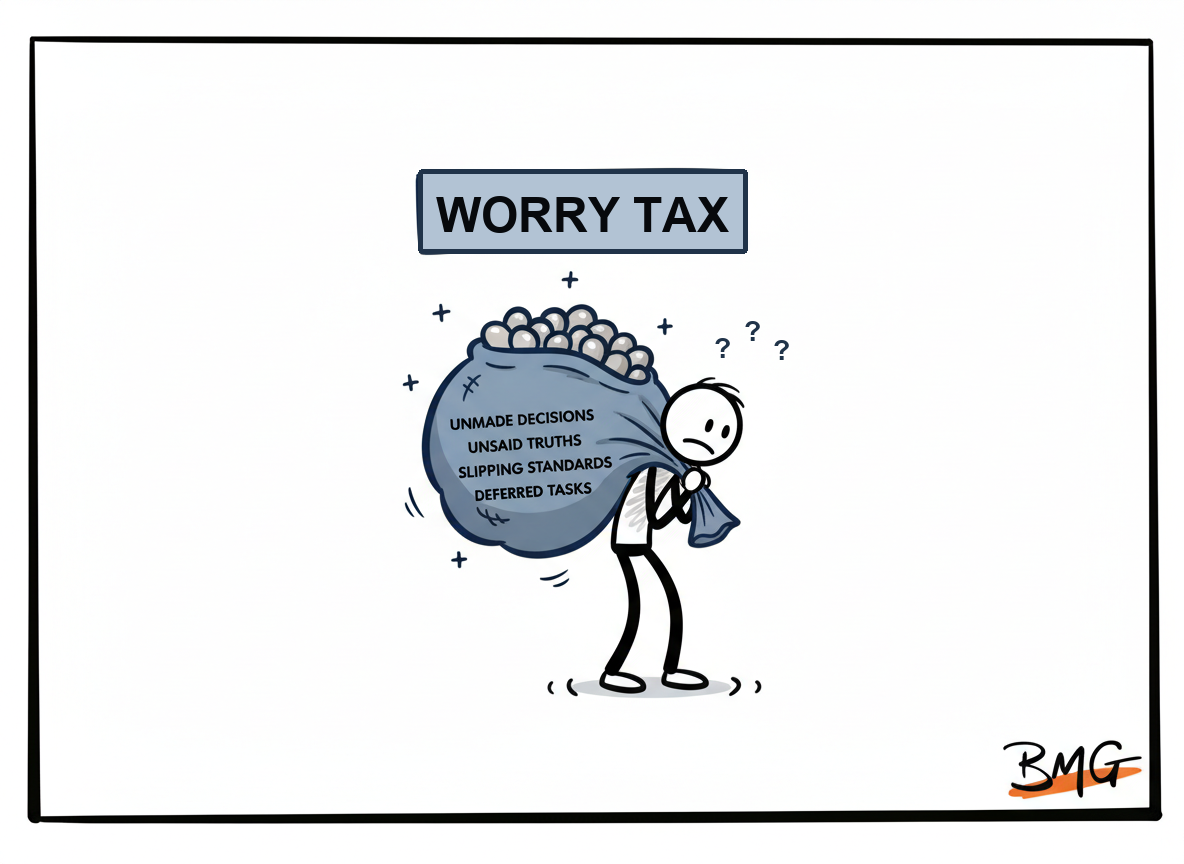
This is the worry tax.
It is the cost of the conversation you haven't had yet. It is paid in attention, sleep, Sunday evening dread, and the low-grade irritation that appears when their name lights up on your screen. It isn't dramatic enough to go in a risk register, but it is real enough to shape your mood, your decisions, and your capacity for the rest of the work.
The awkward thing about the worry tax is that it often feels like responsibility. You tell yourself you are thinking carefully. Sometimes you are. Good leaders don't charge into sensitive conversations just because they want relief. But there is a point where preparation stops being preparation and becomes emotional rent.
If you are rehearsing the same conversation again and again, the issue is already costing you.
What’s Really Happening
Avoidance is rarely empty. It is usually full of mental activity.
That is why it can be so deceptive. From the outside, nothing has happened. No meeting has been booked. No feedback has been given. No standard has been reset. Internally, though, the leader may be working constantly. They are drafting, anticipating, editing, justifying, postponing, and privately gathering more evidence. The work feels active, but it doesn't change the system.
This is one of the reasons difficult conversations become heavier than they need to be. The facts may be fairly small at the beginning: one missed deadline, one vague update, one sharp comment in a meeting, one piece of work that needed more correction than it should have done. But the leader's internal simulation gives the issue emotional weight. By the time the conversation finally happens, the leader isn't only responding to the facts. They are also carrying every private rehearsal, every imagined reaction, and every tiny act of self-censorship along the way.
That additional load changes the tone.
You can hear it in the opening. A leader who has been carrying a conversation for three weeks often sounds either too apologetic or too intense. They are not speaking from the clean facts any more. They are speaking from accumulated strain. The other person may only hear the first direct piece of feedback, but the leader's voice is carrying the whole hidden backstory.
This is why timing matters so much. Early clarity is rarely as heavy as delayed clarity. When the issue is still small, the conversation can stay closer to observation and curiosity. When the issue has been privately rehearsed for weeks, it starts to feel like a verdict.
There is a precise distinction worth holding here: thinking ahead is preparation; repeatedly thinking instead of acting is avoidance with a notebook.
Preparation leaves you clearer.
Avoidance leaves you more tired.
The Private Office Inside Your Head
Most leaders I know have an internal office where the unresolved conversations sit.
It is a strange place. There is no official calendar invite, but the meeting is always open. You are brushing your teeth and suddenly you are back in it. You are on a walk and find yourself composing the third version of the same sentence. You are halfway through a perfectly reasonable family dinner and notice that part of your mind has disappeared into a performance conversation scheduled for some imaginary future Thursday.
The team cannot see that office, but they can feel the effect of it.
They may notice you being a little shorter than usual. They may notice a decision being deferred because you don't want to add one more difficult thing to a week that already feels loaded. They may notice that the person at the centre of the issue is being handled with unusual caution. Nobody names it, because nobody has the full picture. But the atmosphere changes. A team is very good at detecting when the leader is carrying something they are not saying.
This private load also distorts prioritisation. The louder an issue is inside your head, the more important it can feel, even when the next right move is small. That is why avoidance creates such poor internal economics. A ten-minute clarification can take up ten hours of attention before it happens. A simple reset can become a symbolic referendum on whether you are too soft, too harsh, too late, too controlling, too avoidant, or too impatient.
At that point, you are no longer only managing the team.
You are managing the story you are telling about yourself.
This is where many decent leaders get stuck. Their avoidance often comes from caring about too many things at once. They care about fairness, relationships, delivery, morale, reputation, timing, tone, and the person's reaction. All of that care is human. It is also too much for one unsaid sentence to carry.
The worry tax rises when you make one conversation responsible for protecting every possible outcome.
A Recognisable Workplace Moment
Picture a Thursday morning leadership meeting.
The room is nearly full. Coffee cups, laptops, a few people already half-looking at Slack. A project lead gives an update on a customer implementation. The words sound fine at first: we're broadly on track, a few dependencies are being managed, the team is working through the detail. The slide is tidy enough. Nobody looks alarmed.
But you know there is more underneath it.
You know the dependency has been stuck for two weeks. You know the team has been waiting for a named owner. You know the phrase working through the detail is doing a lot of unpaid labour. You feel the small tightening in your chest because this is the second meeting where the issue has been made to sound more settled than it is.
There is a moment, usually no more than three seconds, where leadership either enters the room or leaves it.
You could say: Can we pause there? What is the actual blocker, who owns the next move, and when will we know whether it has cleared?
That would not be cruel. It would not be theatrical. It would simply replace fog with signal.
But perhaps you don't say it. You tell yourself the update will be clearer next week. You tell yourself you don't want to embarrass them in front of peers. You tell yourself you will pick it up privately. Then the agenda moves on and everybody pretends the sentence did its job.
The meeting ends. The issue remains. Your worry tax increases.
Now it follows you into the afternoon. You check the project channel twice. You nearly send a message, then stop because you don't want it to look like you are micromanaging. You put a note in your task list that says, check in on implementation. By Friday morning, you are no closer to clarity, but you have spent a surprising amount of attention orbiting the same unresolved point.
This is how avoided conversations hide in plain sight. They don't always look like fear. They often look like politeness, timing, tact, or reasonable managerial restraint. The cost is that the system remains less honest than the leader privately knows it needs to be.
A quick pause
If this is helpful, my free guide goes deeper, and the newsletter brings ideas like this twice a week.
My book, High-Fidelity Leadership, explores these same themes in more depth, with practical frameworks for standards, clarity, and the conversations that leaders avoid for too long.
The Reframe
The aim is not to become a leader who says every thought out loud.
That would be chaos, and often unkind. Leadership requires judgement. Some things need time. Some concerns need checking. Some conversations need privacy. Some emotional reactions should absolutely be metabolised before they become words. Restraint is a skill.
The reframe is this: if a conversation keeps returning to your head, treat it as information.
It may not mean you need a formal meeting. It may not mean the other person has done something wrong. It may not even mean you are ready to give feedback. But it does mean there is an unresolved signal somewhere in the system. Your job is to convert that signal into a useful next move before it becomes noise.
Sometimes the next move is a question: What am I missing about what is making this hard?
Sometimes it is a clarification: I realise I may not have been explicit enough about what good looks like here.
Sometimes it is a reset: This has slipped twice now, and I want us to agree how we are going to stop that becoming normal.
The best leaders don't wait until they feel perfectly brave. They make the issue smaller by handling it earlier. They understand that courage often arrives after the first clean sentence, not before it. Once the opening is spoken calmly, the conversation usually becomes less mythical and more practical.
That first sentence is not the whole bridge.
It is just the first plank.
What Reduces The Tax
The worry tax falls when you stop trying to solve the whole relationship in one conversation.
A lot of leaders overload the opening. They want to be kind, clear, fair, encouraging, firm, balanced, and future-focused in the first twenty seconds. The sentence buckles under the weight. Then they decide the wording isn't right yet and postpone again. The hidden assumption is that the perfect sentence will remove discomfort.
It won't.
What helps is a clean sentence with a clean intent.
Start with the observable pattern. Stay close to facts. Avoid diagnosing character. Avoid guessing motive. Separate the person from the behaviour and the behaviour from the consequence. The conversation becomes much easier when you stop trying to prove that someone is careless, defensive, disengaged, or not senior enough, and instead name what happened and why it matters.
There is also a physiological element here. If your body is in a threat state, your words will carry threat even when the script is reasonable. That is why the pre-game matters. Take a minute before the conversation. Slow your breathing. Check your intent. Ask yourself whether you are trying to punish, rescue, prove, or clarify. If the honest answer is punish or prove, pause. If the answer is clarify in service of the person, the team, or the work, proceed.
One practical test is this:
Can I say the first sentence without needing them to react well?
That question matters because many leaders are only willing to be clear if they can also control the other person's emotional response. They want the feedback to be received graciously, understood immediately, and integrated without any awkwardness. That would be lovely. It is not a condition for leadership.
You can be responsible for your tone, your facts, your timing, your intent, and your follow-through.
You cannot be responsible for them liking it in the first thirty seconds.
Personal Reflection
I have noticed in myself that the conversations I rehearse the most are often the ones where I am trying to protect my identity as much as the other person's dignity.
I don't always like admitting that. It is easier to say I am being thoughtful, fair, or careful. Sometimes that is true. But sometimes I am also trying to avoid the feeling of being misunderstood. I want to be seen as reasonable. I want the other person to know I am on their side. I want the truth to land without changing the warmth in the relationship. That is a very human wish, but it can quietly turn clarity into a hostage negotiation with my own self-image.
The cost is not only professional. It follows you home. It sits in the background while you are meant to be present somewhere else. It makes a normal Tuesday feel heavier than it should. The strange irony is that the moment I finally have the conversation, even imperfectly, there is often relief. Everything may not be fixed, but reality has been allowed back into the room.
I have also learnt that the first draft in my head is rarely the sentence I should say. It is usually too long because it is trying to manage fear. The useful version is shorter, calmer, and closer to the facts.
Reflection Prompts
Which conversation is currently renting the most space in my head?
What part of this issue is fact, and what part is my imagined future reaction?
Where am I calling something preparation when it has become avoidance?
What clean first sentence would reduce the load without creating unnecessary drama?
Whose dignity am I trying to protect, and whose clarity am I accidentally denying?
What would become lighter if I handled this while the issue is still small?
Final Thought
The worry tax is not a sign that you are failing as a leader. It is a sign that something unresolved is asking for clean attention.
You don't have to become harsher to reduce it. You have to become a little more honest, a little earlier, with a little less performance around the perfect moment. The conversation in your head is already costing you. The real one may be kinder than the rehearsal.
The path to extraordinary is walked with a thousand small steps, you’re doing great!
Your Small Steps
How do I know whether I am preparing or avoiding?
Preparation makes the next move clearer. Avoidance keeps producing more versions of the same worry. If you have written three opening lines and still have not decided what needs to be clarified, you may be using preparation to delay contact with reality.
Small Step: Write one sentence that begins, The observable pattern is... If you cannot complete it, gather one clean fact. If you can complete it, decide whether the conversation needs to happen.
What if the timing really is wrong?
Sometimes it is. A person may be in crisis, a formal process may be required, or you may genuinely need more context. The key is to distinguish timing from indefinite postponement. Good timing has a next check point. Avoidance has a vague hope that the issue will resolve itself.
Small Step: If you decide not to speak today, put a specific review point in the diary and define what you need to know by then.
How do I stop overloading the first sentence?
Keep the first sentence close to the work. Do not try to reassure, diagnose, praise, and correct all at once. A clean opening simply names the pattern and invites a useful conversation.
Small Step: Use this structure: I want to pause on [specific pattern], because [specific impact]. Can we look at what is happening?
What if they become defensive?
Defensiveness does not automatically mean you have done something wrong. It may mean the person is surprised, embarrassed, or trying to regain control. Your job is to stay calm, return to the facts, and avoid arguing about identity.
Small Step: Prepare one grounding line: I’m not questioning your intent. I’m naming the pattern so we can deal with it clearly.
How much evidence do I need before speaking?
You need enough to be specific, not enough to prosecute. A repeated pattern, a material impact, or a mismatch between commitment and behaviour is usually enough to open a conversation. You can speak with curiosity without pretending you have the whole picture.
Small Step: List the two clearest observations and one impact. If you need more than a page, you are probably making the conversation too big.
What if I have let it run too long already?
Name that cleanly. Leaders often make delayed conversations worse by pretending the timing is neutral. You can take responsibility for your delay without giving away the standard.
Small Step: Open with: I should have raised this earlier, and I want to do that now rather than let it keep drifting.
How do I reduce the Sunday evening dread?
Sunday dread often points to unresolved ownership, unclear standards, or a conversation you have postponed. You may not be able to solve it on Sunday, but you can reduce the fog by choosing the first useful action for Monday.
Small Step: Write down the one conversation, clarification, or decision that would make the week feel lighter. Make it your first leadership move.
What if I am worried about damaging the relationship?
Silence can damage relationships too, especially when it lets irritation build in private. Clean clarity, offered respectfully, usually protects trust better than delayed frustration.
Small Step: Before speaking, ask: How does telling the truth help them, help the team, or help the work? Let that answer shape your tone.

Barry Marshall-Graham
Executive coach and leadership advisor
Get the Difficult Conversations Guide
A practical resource for leaders who want to say the thing that needs saying, without burning bridges or avoiding the moment.
Keep reading
31 August 2026
The Sentence They Nearly Said
A pause or changed expression may lead to the useful part of a conversation, but noticing it doesn't give the coach permission to decode it.
24 August 2026
You Cannot Coach Someone You Are Secretly Judging
Second-hand information may be useful, but once it becomes a character verdict it changes the leader’s listening, questions and tone.
17 August 2026
A Good Question Can Be Badly Timed
The wording may be excellent, but a coaching question can still arrive before the relationship or the moment is ready to carry it.
10 August 2026
Whose Goal Is It Anyway?
A goal can be strategically sensible and still feel unowned. The answer is honest internalisation, not coaching somebody into believing it was their idea.
3 August 2026
The Leader Who Uses Coaching to Avoid Leading
Coaching can create room for another person to think, but it can also help a leader postpone the feedback, standard or decision that belongs to them.
27 July 2026
Advice Wearing a Hat
A coaching question can sound wonderfully curious while quietly steering somebody towards the answer their leader already prefers.
20 July 2026
The Emotional Cost of Being the Reliable One
Reliability earns trust, but it can also turn one capable leader into the place where unfinished work, uncertainty, and organisational risk accumulate.
13 July 2026
The Relief of Finally Saying the Thing
An overdue conversation occupies far more space than the words themselves. Relief begins when reality is finally allowed back into the room.
6 July 2026
The Sideways Shove
Peer conflict cannot be solved with the Manager Card. Influence begins when leaders stop pushing across borders and repair the working relationship.
29 June 2026
Clarity Under Pressure
Authority is tested when the room tightens. Clear leaders make reality, uncertainty, and the next decision visible without adding drama.