A Good Question Can Be Badly Timed
17 August 2026
The wording may be excellent, but a coaching question can still arrive before the relationship or the moment is ready to carry it.
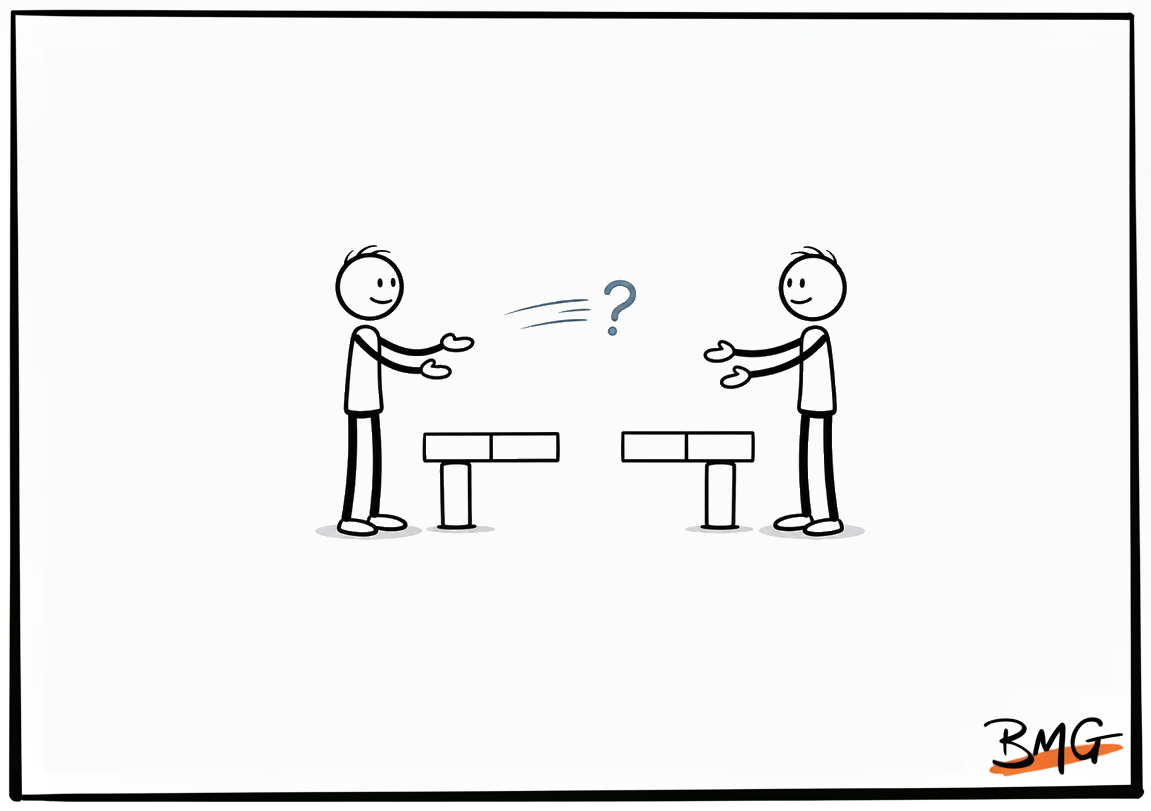
The body usually moves before the words do.
A person leans back a little. Their face tightens, or the answer arrives more carefully than the one before it. A few seconds ago, the conversation felt shared. Now something is being managed.
I know this sequence because I've caused it.
The question is often, annoyingly, quite good. Open. Relevant. Entirely free of advice wearing any kind of hat. The sort of question you could print on a coaching card without causing concern.
And I've asked it too soon.
Nothing dramatic happens. There is rarely a small alarm on the table marked Coach Has Moved Too Quickly, although that would be useful. The conversation simply becomes less available. The person is still answering me, but they're no longer quite thinking with me.
For a long time, my response was to improve the question. Perhaps it needed to be shorter, softer or more incisive. So I'd try another version, which is a little like noticing that somebody didn't enjoy the first knock at the door and responding with a more accomplished one.
What I missed was that the problem had stopped being the question. The room had changed, and I was carrying on as though it hadn't.
The Same Words Arrive Differently
Coaching can become rather enchanted by questions. We collect them, rank them and occasionally discuss a particularly good one as if it has independent powers. Ask ‘What is the real challenge here for you?’, leave seven seconds of silence, and insight will emerge from behind the filing cabinet.
But a question never arrives alone. It arrives through a relationship, after whatever has just happened, carrying the tone and intention of the person asking it.
From somebody I trust, ‘What are you avoiding?’ may feel like careful challenge. From a leader who has barely listened to me, it may feel like a character judgement with a question mark at the end. The wording hasn't changed. Everything around it has.
There's evidence behind this. A meta-analysis covering 27 coaching samples found a moderate, consistent association between the quality of the working alliance and coaching outcomes. It doesn't prove that a warm relationship makes every question useful, or give us a reliable number of empathetic minutes to complete before challenging somebody. It supports a simpler point: the relationship isn't the packaging around the technique. It changes what the technique is.
Context changes it too. If somebody has just received difficult news, been embarrassed in front of colleagues or discovered that a decision affecting their role was made without them, reflection may not be the first useful destination. They may need the leader to acknowledge what happened. They may need information, a decision, an apology or simply a minute in which nobody tries to make the experience productive.
The question might be useful later. Later is doing quite a lot of work in that sentence.
I think of a binding relationship as accumulated evidence. Evidence that I'm paying attention to the person rather than performing a technique upon them. Evidence that challenge isn't punishment. Evidence that they can correct my reading without damaging the relationship.
Some of that takes time. Some of it is built, or weakened, in the few seconds after I notice the body move.
A quick pause
If this is helpful, my free guide goes deeper, and the newsletter brings ideas like this twice a week.
My book, High-Fidelity Leadership, explores these same themes in more depth, with practical frameworks for standards, clarity, and the conversations that leaders avoid for too long.
The Shift Is Not A Translation
That physical change matters to me. The body often shifts before the person has found words for what changed, and an experienced leader learns to notice the small withdrawal, the sudden stillness or the smile that arrived in the wrong place.
The danger begins when noticing turns into knowing.
Research led by Lisa Feldman Barrett has challenged the comforting idea that facial movements form a universal codebook for emotion. A furrowed brow doesn't reliably mean one thing and a tightened mouth another. Context, culture and the individual matter.
In other words, the shift is information. My interpretation is a guess.
That sounds obvious, yet observation acquires confidence remarkably quickly. They folded their arms, so they're defensive. Perhaps. They may also be cold, comfortable or wondering why a coach has become unusually interested in their elbows.
So the useful move is to name less than I think I know.
‘Something shifted just then. Have I moved us too quickly?’
Or:
‘That question didn't seem to land well. What happened for you?’
Or simply:
‘We don't have to stay with this now.’
These aren't cleverer questions. Their value is that they make my uncertainty visible. They return the right of interpretation to the person whose face and body I'm observing, which seems only fair.
They may tell me the question was fine and they were thinking. They may say I missed the point, pressed too hard or asked for reflection when what they needed was for me to recognise that something genuinely unfair had happened. That answer can bruise the coaching ego a little, particularly when I was quietly pleased with the question, but it gives the conversation somewhere honest to go.
What The Moment Needs First
When a sound question is badly timed, the answer isn't always more empathy. Empathy can become another vague instruction to be nicer, and people don't necessarily need soothing. The harder task is to notice what this particular moment is asking of the leader.
Sometimes it's acknowledgement: ‘I can see why that has hit hard.’
Sometimes it's clarity: ‘Let me explain what has been decided and what hasn't.’
Sometimes it's accountability: ‘There's something I should have handled differently here.’
Sometimes it's containment: ‘We can stop. You don't have to make sense of this immediately.’
And sometimes the coaching question is exactly right. The relationship can carry it, the person wants the challenge and waiting would become a polite form of avoidance. Sensitivity isn't proved by never pressing, just as courage isn't proved by pressing every time.
I don't think there's a timing checklist that removes judgement. The International Coaching Federation talks about presence, trust and adapting to the person's experience, which gets closer to the work than any list of powerful questions. You have to remain in the conversation, notice its movement and be prepared to abandon the route you expected when the person in front of you needs something else.
That's harder than it sounds. A prepared question gives the leader a small sense of certainty. It offers something useful to do. Letting it go means accepting that we may have to sit beside something before we understand it, without rushing to convert discomfort into insight.
I still value good questions. A well-timed one can interrupt an old story, reveal a choice or let somebody hear what they've been avoiding. I'm simply less convinced that the quality of a question lives entirely in its words.
Now, when an answer suddenly becomes careful or somebody leans back, I try not to reach immediately for a better version of what I've just asked. I try to notice that the room has changed and own the possibility that I changed it.
Then I might ask, ‘Have I moved us too quickly?’
The difficult part comes next: allowing their answer, including no, to change what I do.
The body may have told me that something shifted. It can't tell me why. That belongs to the person in front of me.
The original question can wait. If it was genuinely good, it'll still be there when the conversation is ready for it.
The path to extraordinary is walked with a thousand small steps, you’re doing great!

Barry Marshall-Graham
Executive coach and leadership advisor
Get the Difficult Conversations Guide
A practical resource for leaders who want to say the thing that needs saying, without burning bridges or avoiding the moment.
Keep reading
31 August 2026
The Sentence They Nearly Said
A pause or changed expression may lead to the useful part of a conversation, but noticing it doesn't give the coach permission to decode it.
24 August 2026
You Cannot Coach Someone You Are Secretly Judging
Second-hand information may be useful, but once it becomes a character verdict it changes the leader’s listening, questions and tone.
10 August 2026
Whose Goal Is It Anyway?
A goal can be strategically sensible and still feel unowned. The answer is honest internalisation, not coaching somebody into believing it was their idea.
3 August 2026
The Leader Who Uses Coaching to Avoid Leading
Coaching can create room for another person to think, but it can also help a leader postpone the feedback, standard or decision that belongs to them.
27 July 2026
Advice Wearing a Hat
A coaching question can sound wonderfully curious while quietly steering somebody towards the answer their leader already prefers.
20 July 2026
The Emotional Cost of Being the Reliable One
Reliability earns trust, but it can also turn one capable leader into the place where unfinished work, uncertainty, and organisational risk accumulate.
13 July 2026
The Relief of Finally Saying the Thing
An overdue conversation occupies far more space than the words themselves. Relief begins when reality is finally allowed back into the room.
6 July 2026
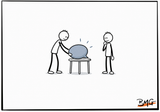
The Sideways Shove
Peer conflict cannot be solved with the Manager Card. Influence begins when leaders stop pushing across borders and repair the working relationship.
29 June 2026
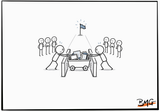
Clarity Under Pressure
Authority is tested when the room tightens. Clear leaders make reality, uncertainty, and the next decision visible without adding drama.
22 June 2026
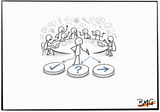
The No-Surprises Standard
No surprises is not a demand for perfect control. It is a leadership standard that makes risk visible while there is still time to act.