You Cannot Coach Someone You Are Secretly Judging
24 August 2026
Second-hand information may be useful, but once it becomes a character verdict it changes the leader’s listening, questions and tone.
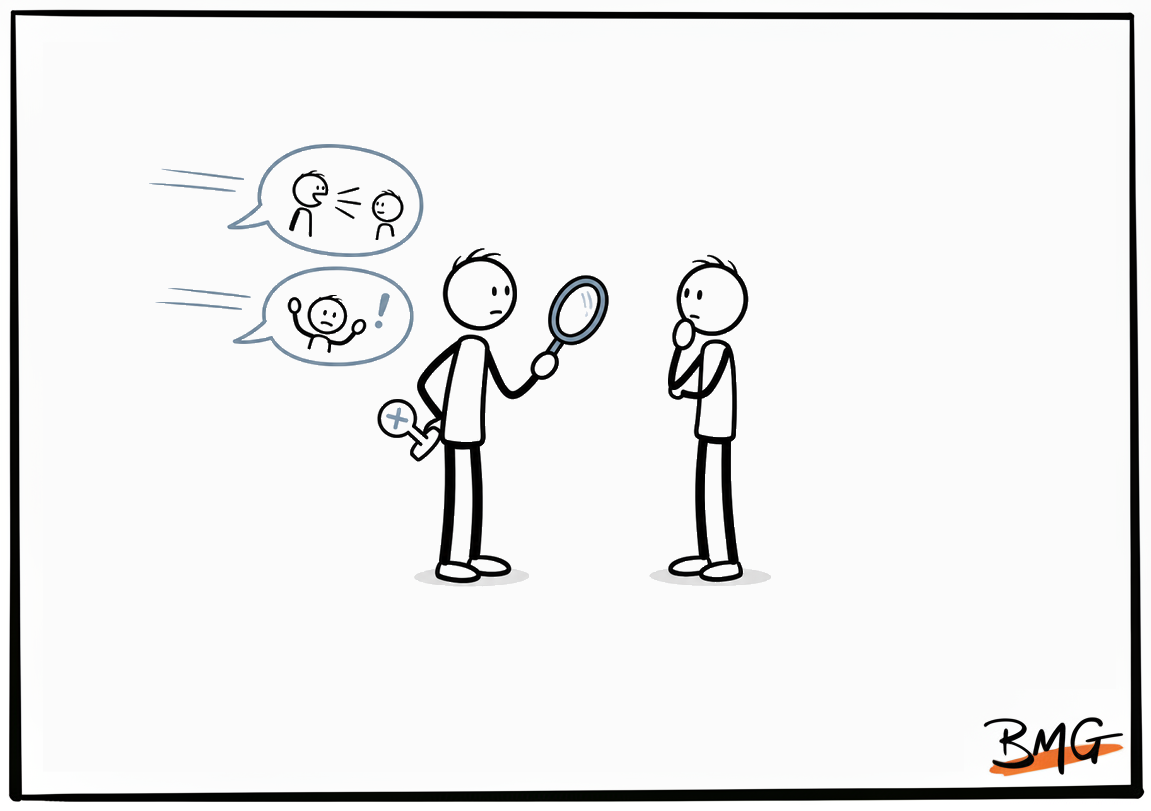
Before the person arrives, the room is already full.
They're difficult. Defensive. Not quite ready for the role. Very good technically, apparently, but hopeless with people.
There are examples. There are concerned looks. There is usually a little organisational archaeology, offered in the helpful tone of somebody saving me the trouble of discovering the person for myself.
By the time we meet, they haven't said a word and a complete supporting cast has already explained their character.
Then I ask my first question.
‘Talk me through what happened in that meeting.’
On paper, it's open. Calm. Entirely respectable. If somebody later reads the transcript, my coaching credentials will survive intact.
But the transcript won't record my tone.
My tone may say, I've heard about you. Let's see whether you confirm it.
I know this because I've heard it in my own voice.
Second- and third-hand information doesn't politely wait outside. It comes in with me, pulls up a chair and begins quietly marking the answers.
The question is open. The verdict isn't.
The Supporting Cast Gets To Work
Leaders need context. Other people's experience matters. A credible warning about conduct, risk or repeated performance shouldn't be ignored in a burst of theatrical open-mindedness.
Nor do I believe every first impression is an embarrassing cognitive error waiting to be corrected. Experience teaches us to notice patterns. Sometimes the early signal is right, and impressively so.
The difficulty is what happens next.
An observation becomes an explanation. The explanation becomes a personality word. Then the personality word begins doing unpaid administrative work across every piece of new evidence.
A missed deadline becomes unreliable. A challenge becomes negative. A guarded answer becomes defensive. Before long, always and never have joined the supporting cast and are carrying clipboards.
Once that happens, the judgement becomes almost impossible to disconfirm.
If the person pauses, they're evasive. If they answer quickly, they're glib. If they acknowledge a mistake, it proves the concern. If they challenge the account, well, that proves the defensiveness.
It's an impressively efficient system. Every road leads back to the conclusion I brought in with me.
Psychologists have studied this territory for decades through attribution and confirmation bias: how quickly we explain other people's behaviour through character, then notice the evidence that keeps the explanation alive. In leadership, the effect doesn't remain safely inside the leader's head. It changes opportunity, scrutiny, tone and the amount of benefit of the doubt available.
It can also help create the behaviour we expected.
Ask a person an apparently open question with judgement underneath it and they may become more careful. They may defend themselves, search for the approved answer or begin managing the version of them that seems to have arrived before they did.
That reaction looks remarkably like confirmation.
My tone helped produce the evidence, then congratulated itself for being right.
A quick pause
If this is helpful, my free guide goes deeper, and the newsletter brings ideas like this twice a week.
My book, High-Fidelity Leadership, explores these same themes in more depth, with practical frameworks for standards, clarity, and the conversations that leaders avoid for too long.
Tone Knows Before Words Do
I find tone harder to manage than language because it often reveals a conclusion I haven't yet admitted to myself.
Take the question:
‘What do you think happened?’
Asked with genuine curiosity, it creates room for information I don't have.
Asked with a slight edge, it means Explain yourself.
The words haven't changed. The conversation has.
This is where coaching technique can provide excellent camouflage. I can use an open question, leave the correct amount of silence and maintain a thoughtful expression while conducting what is, in effect, a small prosecution.
The person doesn't need coaching training to hear it.
Carl Rogers's work on positive regard remains useful here, even though a workplace conversation isn't therapy. I don't take positive regard to mean approving every behaviour, abandoning standards or assuming everybody has been tragically misunderstood. I take it as a discipline of remembering that the person is larger than the behaviour currently under examination.
That sounds simple until you're sitting opposite somebody you've been warned about.
If I can hold the possibility that there's more here, my questions change. I can still ask about the meeting, the missed result or the effect on other people. But I'm investigating what happened, not collecting exhibits for a character hearing.
The distinction isn't softness. It's accuracy.
Enter With Context, Not A Completed Story
I don't try to empty my mind before the conversation. Apart from being impossible, that could be irresponsible. The useful discipline is to separate three things that often arrive disguised as one fact:
What I've directly observed.
What other people have reported.
What I've concluded about the person.
Pulling them apart doesn't invalidate any of them. It simply prevents a report about behaviour from quietly becoming a permanent identity.
It also changes the language available to me.
Instead of pretending I know nothing, I can say:
‘I've heard concerns about how those meetings have been working. I don't want to assume I understand them without your view. Talk me through what happened from where you were sitting.’
That isn't neutral. It shouldn't be. It makes the information in the room visible while leaving one chair empty for the person's account.
Then I need to do the part that can't be performed through wording alone: remain capable of surprise.
What answer could genuinely change my view?
If the honest answer is none, this may still be an important conversation, but it isn't coaching. It may be feedback, investigation or a decision I need to communicate. Calling it coaching won't reopen an outcome I've already closed.
Keep The Verdict In Pencil
Time matters.
I think first impressions are useful and often right. I also think there's nearly always value below the surface that takes direct experience, information and several conversations to emerge.
Those beliefs can live together if the first impression remains provisional.
Provisional doesn't mean vague or endlessly forgiving. A leader may need to act today on the best evidence available. Keeping a verdict in pencil doesn't mean refusing to press harder when a pattern becomes clear. It means knowing what would cause you to revise it and allowing new evidence to reach the page.
Before a conversation with somebody about whom you've heard a great deal, take a blank sheet and write four unfinished lines:
- What I've directly observed is...
- What others have reported is...
- The conclusion I'm tempted to make is...
- The evidence that could change my view would be...
That final line is the uncomfortable one.
Then choose one question whose answer you genuinely don't know. Say it aloud before the meeting and listen for the leak in your tone. Are you asking the person to help you understand, or offering them an opportunity to confess to the conclusion you've already reached?
You don't need to discard the supporting cast. Some of them may have seen something important.
Just don't let them deliver all the lines.
When the person arrives, leave enough room for them to become more than the story that arrived first. The warning may prove right. Your first impression may survive every conversation that follows.
But let it survive evidence, not simply organise it.
The room was already full. Coaching begins when you notice who took the empty chair.
The path to extraordinary is walked with a thousand small steps, you’re doing great!

Barry Marshall-Graham
Executive coach and leadership advisor
Get the Difficult Conversations Guide
A practical resource for leaders who want to say the thing that needs saying, without burning bridges or avoiding the moment.
Keep reading
31 August 2026
The Sentence They Nearly Said
A pause or changed expression may lead to the useful part of a conversation, but noticing it doesn't give the coach permission to decode it.
17 August 2026
A Good Question Can Be Badly Timed
The wording may be excellent, but a coaching question can still arrive before the relationship or the moment is ready to carry it.
10 August 2026
Whose Goal Is It Anyway?
A goal can be strategically sensible and still feel unowned. The answer is honest internalisation, not coaching somebody into believing it was their idea.
3 August 2026
The Leader Who Uses Coaching to Avoid Leading
Coaching can create room for another person to think, but it can also help a leader postpone the feedback, standard or decision that belongs to them.
27 July 2026
Advice Wearing a Hat
A coaching question can sound wonderfully curious while quietly steering somebody towards the answer their leader already prefers.
20 July 2026
The Emotional Cost of Being the Reliable One
Reliability earns trust, but it can also turn one capable leader into the place where unfinished work, uncertainty, and organisational risk accumulate.
13 July 2026
The Relief of Finally Saying the Thing
An overdue conversation occupies far more space than the words themselves. Relief begins when reality is finally allowed back into the room.
6 July 2026
The Sideways Shove
Peer conflict cannot be solved with the Manager Card. Influence begins when leaders stop pushing across borders and repair the working relationship.
29 June 2026
Clarity Under Pressure
Authority is tested when the room tightens. Clear leaders make reality, uncertainty, and the next decision visible without adding drama.
22 June 2026
The No-Surprises Standard
No surprises is not a demand for perfect control. It is a leadership standard that makes risk visible while there is still time to act.