The Leader Who Uses Coaching to Avoid Leading
3 August 2026
Coaching can create room for another person to think, but it can also help a leader postpone the feedback, standard or decision that belongs to them.
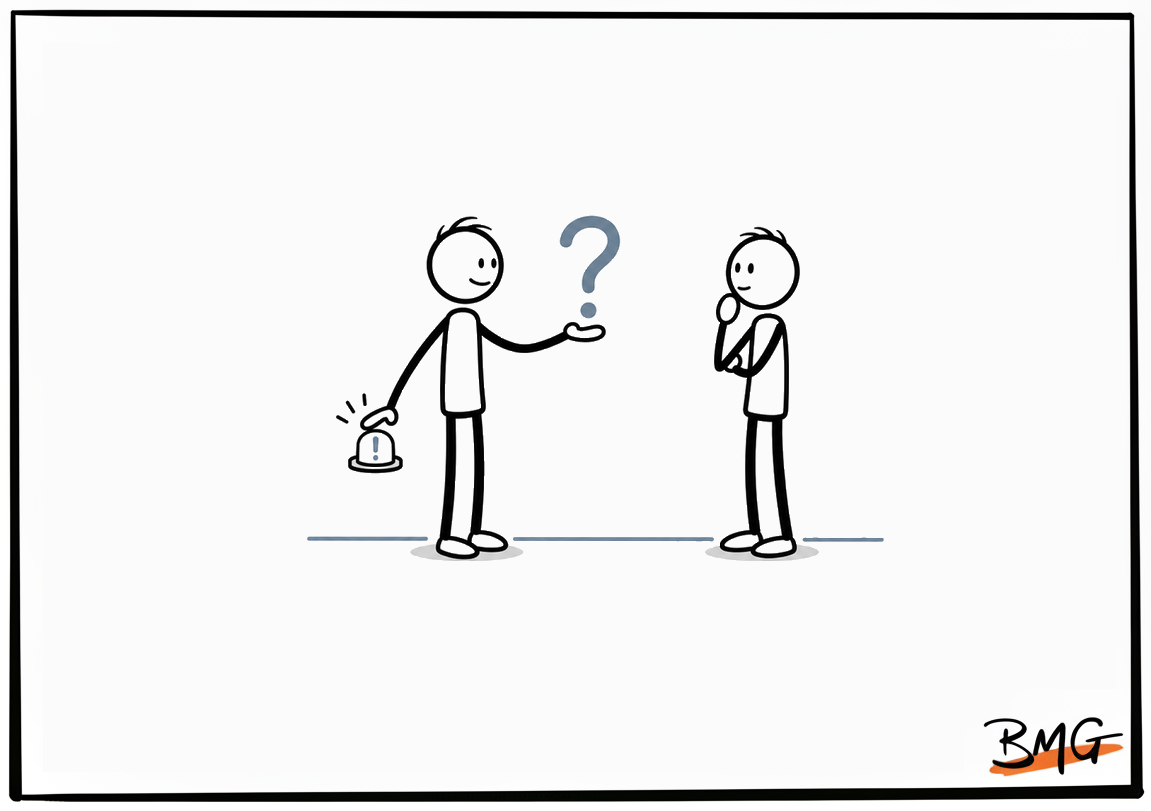
There is a feeling I know rather well. I know the button that needs pressing, and I can feel myself holding back from it.
Not because I'm unsure about the standard. Not because I need three more perspectives, a framework or a short listening tour. I know what needs to be said. I'm holding back because I know the person, I know what they're carrying and I know the conversation will be difficult.
So I coach.
I ask how they think things are going, what options they can see and what support would be useful. All perfectly respectable questions. I listen, I leave space, I probably look reassuringly thoughtful, and the one thing I don't do is say the thing I came into the room already knowing.
That isn't always coaching. Sometimes it's avoidance with excellent interpersonal skills.
I've done this when leaders were struggling with personal issues that had begun to bleed into their working lives. I could see why. I cared about them, sometimes quite deeply, and I didn't want to add to what was already difficult. My response was to become a little softer, although softer is one of those accommodating words that can hide quite a lot.
What it meant, in practice, was that I asked questions around the issue while the standard sat quietly in the corner waiting to be acknowledged.
The closer I was to the person, the harder it became. I don't think that was because the boundary had disappeared; if anything, I could see it more clearly. I knew which conversation belonged to me. Crossing the line just carried a greater emotional cost, and coaching gave me somewhere quite noble-looking to stand while I postponed paying it.
Care Changes The Conversation
I don't want to make empathy the villain here. Leaders who can see only output, deadlines and standards, while remaining entirely unmoved by the human being in front of them, aren't displaying admirable clarity. They're just easier to draw in an organisational chart.
Personal difficulty does affect working life. Bereavement, illness, relationship strain, caring responsibilities and the other things people carry don't wait politely at reception while we come to work. A good leader notices, makes room where they can and doesn't require somebody to pretend they're fine merely because the quarterly review has a fixed template.
The difficulty is that empathy has more than one possible effect. It can help me stay with another person's experience without rushing to make it smaller. It can also make me want to reduce my own discomfort, and one very efficient way to do that is to avoid adding clear feedback to an already painful situation.
From inside my head, both can feel like care.
That distinction has bothered me because it means good intent isn't enough. I may genuinely care about the person and still leave them without information they need. Worse, I may quietly change the standard for them without telling anybody, including them, then wonder why the issue becomes harder to recover later.
The rest of the team normally notices before long. They see the missed commitment, the behaviour that goes unaddressed or the work being redistributed. They may not know the personal context, nor should they, but they can see that gravity appears to work differently around one desk.
Compassion for one person can, if I'm not careful, become confusion for everybody else.
The Question Under The Question
The International Coaching Federation puts sensible emphasis on agreements, trust, listening and supporting another person's autonomy. Proper coaching gives somebody room to make sense of their situation and decide what they will do. It doesn't turn the coach into a remote-control device with better questions.
But a leader is not only a coach. Sometimes the leader holds information, accountability or a standard that can't be handed back across the table. Nobody can discover through reflection that a missed regulatory requirement was fine after all. Some parts of the conversation belong to the role.
That leaves me with a question underneath the coaching questions:
What am I hoping this question will save me from saying?
If the honest answer is nothing, good. There may be real value in slowing down and helping the person think. Their personal situation may have narrowed their view of the choices available, and a thoughtful conversation can return some agency when life has made everything feel rather fixed.
If the answer is the standard, the effect on the team or the decision I've already made, I probably don't need a more elegant coaching question. I need to lead.
That doesn't require becoming cold halfway through a sentence. I can say, ‘I know you're carrying a great deal, and I want us to talk honestly about what support is possible. I also need to be clear about the impact this is having and what the role requires.’
Both things can be true in the same breath. The difficulty in somebody's life is real, and the effect at work is real. Support may need to change. Timeframes may need to move. Duties may need to be adjusted. The standard may remain exactly where it is.
Clarity doesn't decide those things in advance. It simply stops pretending the second half of the conversation will vanish if the first half is compassionate enough.
A quick pause
If this is helpful, my free guide goes deeper, and the newsletter brings ideas like this twice a week.
My book, High-Fidelity Leadership, explores these same themes in more depth, with practical frameworks for standards, clarity, and the conversations that leaders avoid for too long.
Coaching After Clarity
One reason leaders avoid being direct is that we imagine clarity ends the coaching conversation. Once I've named the problem or set the boundary, surely I've moved into Manager Mode, where I must now provide a laminated action plan and stand over it with a clipboard.
I don't think it works like that.
Clear leadership can create the ground for useful coaching. Once the person knows what isn't negotiable, there may be a great deal that genuinely belongs to them:
‘Given what you're dealing with, what support would make the biggest difference?’
‘What can you commit to, and where do we need a different arrangement?’
‘How do you want to speak with the team about what they need to know?’
‘What would help you decide whether this role is workable at the moment?’
Those questions aren't a softer substitute for the standard. They're an honest return of agency within a boundary that has already been named.
And sometimes the answer will be uncomfortable. The person may not be able to meet what the role currently needs. A temporary change may be possible, or it may not. Leadership occasionally involves reaching a decision that no well-phrased question can make pleasant, which is probably why we're so attracted to the questions in the first place.
The Closer They Are
I'm still thinking about closeness, because that's where the theory becomes noticeably less tidy.
The more I know about somebody's life, the more context I have and the more humane my response can be. I also have more to lose. I may fear damaging the relationship, appearing disloyal or becoming one more person asking something from them when they're already depleted. If I've supported them for years, direct feedback can feel like a withdrawal of care even when it isn't.
There is no private test that removes that difficulty. Am I avoiding this? can be answered rather creatively by a capable leader who would prefer another fortnight. I know this because capable leaders, myself included, can produce a strategic rationale for almost any delay if given a quiet room and access to PowerPoint.
What helps is making the ownership explicit. What part of this belongs to them to think through, and what part belongs to me to name or decide? What support can I honestly offer? What am I allowing to continue because the alternative would make me uncomfortable?
And perhaps the hardest one: if I weren't close to this person, would I still be handling the issue in the same way?
The answer doesn't dictate the action. It does reveal whether closeness has begun silently editing the leadership standard.
Your Small Steps
Think of one conversation you've been circling. Not every delayed conversation is avoidance, and you don't need to charge into it this afternoon waving a standard, but notice whether you already know the sentence you've been trying not to say.
Before asking another coaching question, write down three things separately:
- What is happening for the person that deserves care and understanding?
- What feedback, standard or decision belongs to you as the leader?
- Once that is clear, what genuinely remains theirs to think through and choose?
Then try holding the first two in the same conversation. Acknowledge what they're carrying without using it to smuggle the leadership issue out of the room. Say the necessary thing cleanly, then coach around the agency that is still real.
I'm not sure this ever becomes easy, particularly with people we care about. Perhaps easy is the wrong ambition. The better aim is to notice when compassion has become cover, press the button we already know is ours, and stay human while we do it.
The path to extraordinary is walked with a thousand small steps, you’re doing great!

Barry Marshall-Graham
Executive coach and leadership advisor
Get the Difficult Conversations Guide
A practical resource for leaders who want to say the thing that needs saying, without burning bridges or avoiding the moment.
Keep reading
31 August 2026
The Sentence They Nearly Said
A pause or changed expression may lead to the useful part of a conversation, but noticing it doesn't give the coach permission to decode it.

24 August 2026
You Cannot Coach Someone You Are Secretly Judging
Second-hand information may be useful, but once it becomes a character verdict it changes the leader’s listening, questions and tone.
17 August 2026
A Good Question Can Be Badly Timed
The wording may be excellent, but a coaching question can still arrive before the relationship or the moment is ready to carry it.
10 August 2026
Whose Goal Is It Anyway?
A goal can be strategically sensible and still feel unowned. The answer is honest internalisation, not coaching somebody into believing it was their idea.
27 July 2026
Advice Wearing a Hat
A coaching question can sound wonderfully curious while quietly steering somebody towards the answer their leader already prefers.
20 July 2026
The Emotional Cost of Being the Reliable One
Reliability earns trust, but it can also turn one capable leader into the place where unfinished work, uncertainty, and organisational risk accumulate.
13 July 2026
The Relief of Finally Saying the Thing
An overdue conversation occupies far more space than the words themselves. Relief begins when reality is finally allowed back into the room.

6 July 2026
The Sideways Shove
Peer conflict cannot be solved with the Manager Card. Influence begins when leaders stop pushing across borders and repair the working relationship.

29 June 2026
Clarity Under Pressure
Authority is tested when the room tightens. Clear leaders make reality, uncertainty, and the next decision visible without adding drama.
22 June 2026
The No-Surprises Standard
No surprises is not a demand for perfect control. It is a leadership standard that makes risk visible while there is still time to act.