Advice Wearing a Hat
27 July 2026
A coaching question can sound wonderfully curious while quietly steering somebody towards the answer their leader already prefers.
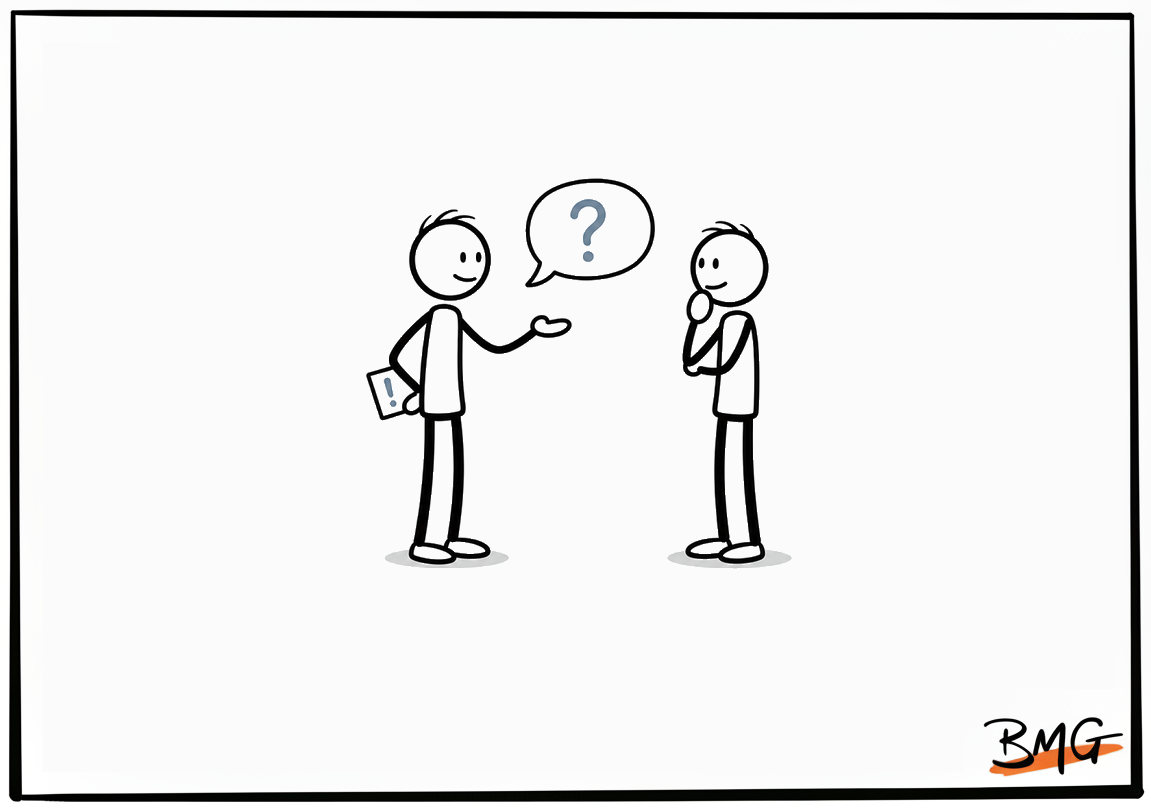
I've been thinking about a question I use quite a lot: ‘What do you think?’
It's a good question, sensible, open and reassuringly coach-like. And sometimes I'm not asking it at all.
Sometimes I already know what I think they should do. I've reached the answer while they're still describing the problem, possibly before they've reached the end of the first sentence, and I ask ‘What do you think?’ because I know I should be curious. Then I wait, with what I imagine is an encouraging expression, for them to find their way to my answer.
If they head in a different direction, I help. ‘Yes, although have you considered...?’
There it is. Advice wearing a hat.
This is slightly awkward to admit because I coach people, I write about curiosity, and I've spent a fair amount of time telling leaders to tame what Michael Bungay Stanier calls the Advice Monster. You'd hope I might have cracked it by now. I haven't, I've just made it more polite.
That might be worse, actually. Blunt advice is at least honest, whereas a leading question makes the other person do the administrative work of discovering what I've already decided.
They normally know, too. People are remarkably good at hearing the answer hidden inside a question, particularly when the person asking it controls their pay, priorities or performance review. They may nod and follow the breadcrumbs, which can look like insight from my side of the table.
It may simply be obedience with better lighting.
The distinction I'm trying to learn isn't between asking questions and giving advice. Advice can be useful and, sometimes, it's exactly what leadership requires. If the building is on fire, ‘What options are available to you?’ is unlikely to improve the evacuation plan.
I'm more interested in whether I'm willing to be changed by the answer. That sounds rather grand for an ordinary 1:1, but I think it holds. When I ask a genuine question, I don't know exactly where the answer will take us. I may have a view, quite a strong one, but there's still room for the other person's information, judgement and experience to alter mine.
When I ask a disguised question, the destination is fixed. I'm just hoping they'll drive there so I don't have to admit I've taken the wheel.
I recognise this because I've done it. I've sat listening to somebody explain a stakeholder problem while rehearsing a three-step answer in my head. I knew the politics, I knew the person involved and I was, in my own estimation, about to be extremely useful. Then I delivered the answer, and the energy went out of the conversation.
For a while I treated that as their failure to act on good advice. Eventually I had to consider a less flattering possibility: I'd stopped listening before they'd stopped speaking. The plan was mine, the ownership was mine and, rather mysteriously, the motivation to carry it out hadn't transferred with the PowerPoint-quality explanation.
This is the part of coaching I find most interesting now. Good questions matter, of course. The International Coaching Federation talks about open questions, active listening and creating enough space for somebody to develop their own awareness, all of which makes sense. But a technically good question can still be asked with a closed mind.
You can ask ‘What else?’ while silently thinking please say Finance. You can ask ‘What is the real challenge here for you?’ in the tone of a person who'd quite like the real challenge to hurry up because there's another meeting at half past. You can even remain silent while making it abundantly clear that the silence has a correct answer.
The technique can't rescue the intent.
So I'm experimenting with a small test. Before I ask a question, I try to ask myself another one: Am I willing for their answer to change what happens next?
If I am, I can ask and listen. Properly. That usually means one question rather than a small questionnaire delivered without breathing, then enough silence for the other person to get beyond the answer they think a senior leader wants to hear.
If I'm not willing, it doesn't automatically make me a terrible coach or a table-thumping manager. It may simply mean I need to be direct: ‘I have a view I need to share.’ Or, ‘This decision belongs to me.’ Perhaps, ‘There's a standard here that isn't negotiable.’
Those sentences can be kinder than twenty minutes of pretend discovery.
There's a third option I like too: ‘Would it help to think this through, or would you like my view?’
It isn't a perfect question. The other person may still tell the boss what they think the boss wants, because power doesn't disappear when we use a warm tone, but at least the modes are on the table. We're not pretending coaching is always the answer, or that experience must be locked in a cupboard until somebody guesses it.
I suspect the Advice Monster never goes away. Perhaps that isn't the goal. The useful work is noticing when it's taken over, especially when it's learnt the language of coaching and become much harder to spot.
Your Small Steps
In your next 1:1, notice whether you've started preparing your answer while the other person is still speaking. You don't need to judge it or perform a sudden display of Olympic listening. Just notice.
Before the next question leaves your mouth, try the private test: Am I willing for their answer to change what happens next? If you are, ask it and leave a little more room than feels comfortable. If you aren't, say what mode you're in and be direct about the view, decision or standard you need to bring.
And if either route could genuinely help, ask them. ‘Would you like to think this through, or would my view be useful?’ It isn't magic, but it is considerably more honest than sending someone on a guided tour of a conclusion you've already reached.
So yes, I'll keep asking ‘What do you think?’ The question I need just before it, though, is the one that makes the difference: Am I ready to hear something I didn't already know?
The path to extraordinary is walked with a thousand small steps, you’re doing great!

Barry Marshall-Graham
Executive coach and leadership advisor
Get the Difficult Conversations Guide
A practical resource for leaders who want to say the thing that needs saying, without burning bridges or avoiding the moment.
Keep reading
10 August 2026
Whose Goal Is It Anyway?
A goal can be strategically sensible and still feel unowned. The answer is honest internalisation, not coaching somebody into believing it was their idea.
3 August 2026
The Leader Who Uses Coaching to Avoid Leading
Coaching can create room for another person to think, but it can also help a leader postpone the feedback, standard or decision that belongs to them.
20 July 2026
The Emotional Cost of Being the Reliable One
Reliability earns trust, but it can also turn one capable leader into the place where unfinished work, uncertainty, and organisational risk accumulate.
13 July 2026
The Relief of Finally Saying the Thing
An overdue conversation occupies far more space than the words themselves. Relief begins when reality is finally allowed back into the room.
6 July 2026
The Sideways Shove
Peer conflict cannot be solved with the Manager Card. Influence begins when leaders stop pushing across borders and repair the working relationship.
29 June 2026
Clarity Under Pressure
Authority is tested when the room tightens. Clear leaders make reality, uncertainty, and the next decision visible without adding drama.
22 June 2026
The No-Surprises Standard
No surprises is not a demand for perfect control. It is a leadership standard that makes risk visible while there is still time to act.
15 June 2026
When A Promise Breaks Twice
A broken promise is not only a missed deadline. When it repeats, it changes how much trust the team can safely place in a commitment.
8 June 2026
The C+ Deck: How Good Enough Becomes The New Standard
Good enough work from capable people is seductive because it almost passes. That is exactly why leaders must address it early.
1 June 2026
Before You Call It Drift
Before naming underperformance, leaders need to check whether the system made success clear, possible, and properly supported.
