The Sideways Shove
6 July 2026
Peer conflict cannot be solved with the Manager Card. Influence begins when leaders stop pushing across borders and repair the working relationship.
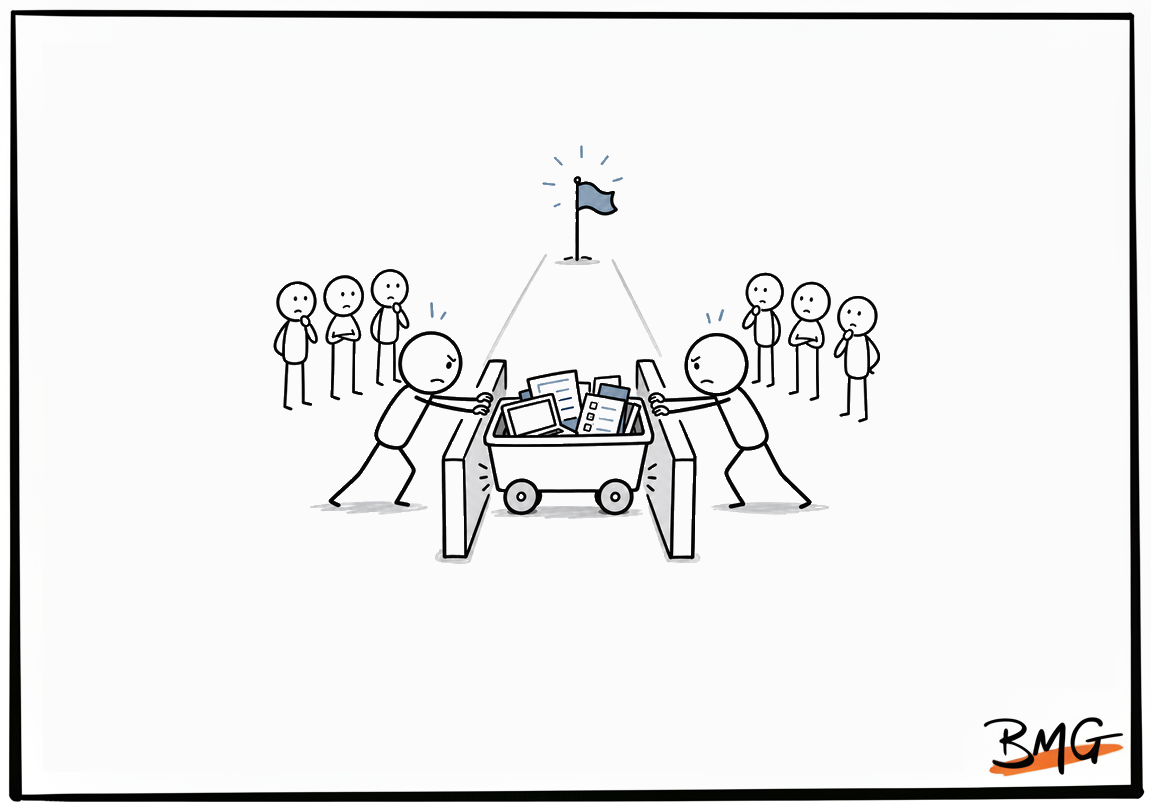
There is a particular kind of meeting tension that only exists between peers.
You ask for a date. They hear a demand.
They question your plan. You hear disrespect.
Someone sighs, somebody makes a dry comment, and the room becomes aware that the conversation is no longer only about the work.
Neither of you reports to the other. Neither of you can settle the issue by making a managerial decision. You need their help, they need yours, and both teams are watching to see who gives ground.
This is the Sideways Shove.
It begins as operational friction and quickly becomes a contest over territory, credit, resources, or status. The more each leader pushes, the more the other braces. Before long, the project is stuck between two capable people who are each convinced the other is the problem.
Influence is not the same as authority.
When you cannot use the Manager Card, you have to enrol the person you are tempted to defeat.
The Theatrical Exhale
Picture a standard cross-functional meeting.
Product needs the final campaign assets by the 14th. The Product Director says this plainly, with the date on the project plan behind them.
The Marketing Director pauses.
Then comes the exhale.
It is not a quiet breath. It is a long, world-weary release of air designed to tell the room that Product has, once again, asked for something unreasonable.
If the specification stopped changing every three days, we might have a chance of hitting one of these dates. We will see what we can do.
The room goes still.
The Product Director feels the heat in their neck. Their team is on the call. They want to defend the four specification changes, explain that two were caused by Marketing, and remind everyone about the missed assets last quarter.
Instead, they make a brittle joke and move to the next slide.
The meeting continues. The conversation does not.
Afterwards, both leaders perform the second act. Product complains that Marketing is a blocker. Marketing tells its team that Product treats them like an internal service desk. Requests become more formal. People start copying additional leaders for visibility. Short calls are replaced with long ticket trails.
The friction becomes part of the operating model.
The Horizontal Gap
Vertical leadership has a final lever. If you manage the person, you can set the standard, clarify ownership, and make a decision when discussion has run its course.
Peer leadership is different.
Your title may carry weight, but it does not give you the right to run another leader's department. You can make a request. You can explain the consequence. You can escalate if the system remains blocked. You cannot assume compliance simply because your project matters to you.
This is the horizontal gap.
Both leaders have legitimate commitments. Both are accountable to different people. Both believe their priorities protect the business. The Product Director sees a launch that needs assets. The Marketing Director sees ten competing requests, a stretched team, and another department changing its mind after the work begins.
When this context remains hidden, the argument attaches itself to the date.
The date becomes a proxy for a more difficult conversation:
Do you respect my team's workload?
Do you see me as a partner?
Will your success become my unrecognised labour?
Why should your priority outrank the commitments my boss measures me against?
Those questions rarely appear on the agenda.
They still sit in the room.
Three Hidden Currencies
Peer friction often gathers around one of three currencies.
The first is territory.
The other leader believes you are making decisions that belong to their function. Your useful suggestion sounds like an attempt to run their team. Your request for a standard sounds like a judgement on their competence.
The second is credit.
One function appears to own the visible success while another carries the invisible labour. The project may be described as a Product launch, but Marketing, Operations, or Customer Success knows it will absorb much of the delivery burden. Resentment grows when recognition and effort travel in different directions.
The third is resources.
Your project may be the centre of your week and number eleven on theirs. They are not necessarily obstructive. They may be protecting commitments that affect their own customers, measures, and reputation.
The Sideways Shove happens when leaders try to resolve these currencies with louder operational arguments.
They send the spreadsheet again. They restate the date. They point at governance. The real concern remains untouched, so the resistance returns in another form.
The Public Thread Trap
Digital work makes peer friction easier to start and harder to repair.
A blunt message arrives in a shared Teams channel:
We cannot keep accommodating last-minute Product changes.
You feel the immediate need to answer publicly. Your team has seen the criticism. Silence feels like surrender.
So you type a careful demolition of the claim. You list the dates, explain the changes, and add enough professionalism to make the hostility deniable.
The other leader replies.
Soon, two departments are watching their leaders litigate the relationship line by line.
Do not do this.
Peer influence is usually built in private, even when the friction was performed in public.
The moment you feel the heat in your neck, stop writing. Move the issue to a call. A thread preserves every defensive sentence and removes the human information that might soften it: tone, fatigue, uncertainty, or the possibility that one of you has misunderstood the other.
A direct message is enough:
I think this is getting harder in the thread. Can we take ten minutes and work out what is underneath it?
You can return to the public channel later with the aligned decision. That is the part the teams need to see.
The Traps That Feel Like Leadership
The first trap is parental escalation.
You go to the shared boss and ask them to make the other leader cooperate. Sometimes escalation is necessary. Used too early, it tells the boss that you have not been able to attempt a direct reset and tells the peer that you chose pressure over relationship.
The second is triangulation.
You talk about the person to everyone except the person. The conversations provide relief and validation. They also build a corridor coalition. By the time the feedback returns to your peer, it has lost its context and gained an edge.
The third is the paper-trail cold war.
Calls stop. Emails become formal. Senior people are copied in. Phrases such as as per my previous email signal that the relationship has moved from collaboration to evidence preservation.
The fourth is the professionalism shield.
You tell yourself that competent adults should not need to talk about the atmosphere between them. They should simply deliver.
This sounds mature. It ignores the operating cost of human friction. If you dread seeing a peer's name in the calendar, if both teams read hostility into every message, or if people avoid asking each other for help, the relationship is already affecting the work.
The atmosphere is not separate from performance.
It is part of the system producing it.
A quick pause
If this is helpful, my free guide goes deeper, and the newsletter brings ideas like this twice a week.
My book, High-Fidelity Leadership, explores these same themes in more depth, with practical frameworks for standards, clarity, and the conversations that leaders avoid for too long.
The Status Audit
Before you confront a peer, check your own intent.
Ask:
Am I trying to be right, or am I trying to be effective?
Being right can become a very lonely victory. You win the date, secure the executive intervention, and leave the project dependent on a peer who now feels undermined.
Then perform a perspective flip.
Your view may be that they are cynical, slow, and blocking the launch.
Their view may be that you are demanding, careless with their capacity, and willing to make promises that their team has to fulfil.
The fuller reality may be that the organisation has under-resourced both teams and left two leaders to absorb the contradiction.
The perspective flip does not require you to agree with their behaviour. It gives you a more useful place to begin. You can name the impact without building the entire conversation around a villain.
The Accountability Pivot
The goal is to move from adversaries to partners.
That begins by finding a goal larger than either department. The customer, the launch, the service, or the business outcome must become more important than proving which function has been more reasonable.
Before the conversation, write down four things:
- the observation, using a specific behaviour
- the story you are telling yourself about it
- the business impact
- the shared goal
For example:
The observation: the deadlines conversation has included public sighs and sideways comments.
The story: Marketing thinks Product is incompetent.
The impact: both teams are becoming defensive and slower to share risk.
The shared goal: a launch customers can trust and both teams can support.
Notice that the story is included but not presented as a fact. You own it as your interpretation.
That makes the opening cleaner:
Could we talk about how our teams are working together? I have noticed that the deadline conversations have become tense, and I have found myself getting defensive. I do not think that is helping either team. We both need this launch to work. From your perspective, what is making the collaboration harder than it needs to be?
This is the vulnerability drop.
You name your contribution without surrendering the issue. That makes it safer for the other person to describe their world without first having to defeat your accusation.
Repairing The Relationship In Public
The repair conversation happens in private.
The repaired relationship needs to become visible in public.
If the two leaders have spent weeks signalling conflict in front of their teams, one quiet coffee will not change the operating atmosphere. People need evidence that the border has reopened.
That might sound like:
Amira and I spoke yesterday about the hand-off. We have agreed a simpler approval route, and I want to support her point about giving Marketing a stable brief before work starts.
Or:
Product has a real date constraint here. We are going to protect it by agreeing the scope on Wednesday rather than changing requests through the week.
The point is not to perform friendship.
It is to stop the teams fighting a proxy war on behalf of leaders who have already moved on.
When Direct Influence Is Not Enough
Influence does not mean endless patience.
Some peers remain obstructive. Some power imbalances make a direct challenge risky. Some patterns affect customers, people, or compliance and need formal visibility.
Use a two-attempt rule.
Attempt one is private and curious. Name the friction, seek their view, and reset the working norm.
Attempt two is direct. Name the repeated behaviour, the business impact, and the concrete commitment required.
If the pattern continues, escalate through the appropriate route with neutral evidence. You are no longer asking a senior leader to referee your first disagreement. You are protecting the system after reasonable direct attempts have failed.
That sequence matters.
It keeps escalation clean.
Personal Reflection
Early in my career, I led Engineering alongside a peer who led Architecture.
I saw myself as the person trying to move the product forward. I saw them as the person who could produce seventeen reasons every new idea would fail. Instead of having the direct peer conversation, I went to our CTO and complained that Architecture had become the Department of No.
The CTO applied pressure. The feature moved forward.
I won the decision and damaged the relationship.
For months afterwards, the Architecture lead did the minimum required. The early warnings stopped. Risks they might once have shared arrived later, after they had become harder to solve. I had used authority borrowed from above to win a peer conflict, and the price was a long reduction in influence.
It took several awkward lunches and a fair amount of humble pie to rebuild the trust.
The lesson stayed with me: if you use power to defeat a peer, the visible decision may hide the larger loss.
Reflection Prompts
Which peer makes me prepare for battle before the meeting begins?
What territory, credit, or resource pressure may be sitting underneath our operational argument?
Am I talking directly to the person, or mainly talking about them?
Where have our teams started fighting the conflict on our behalf?
What contribution to the friction can I name without abandoning the standard?
What shared outcome is more important than either department winning?
Final Thought
The Sideways Shove cannot be solved by pushing harder.
Peer influence begins when you stop treating the other leader as an obstacle and make the working relationship part of the work. Name the tension privately. Own your contribution. Find the shared outcome. Make the repair visible to the teams.
You may still disagree.
The difference is that disagreement no longer has to become a border war.
The path to extraordinary is walked with a thousand small steps, you’re doing great!
Your Small Steps
How do I open a difficult conversation with a peer?
Begin with the working relationship and a specific observation. Avoid opening with a verdict on their intent or competence.
Small Step: Try: I have a sense our teams are hitting some friction. Could we talk about what is making the collaboration harder than it needs to be?
What if the conflict started in a public thread?
Move the disagreement to a call before defending every point. Return to the thread afterwards with the aligned decision or next step.
Small Step: Write: I think this is getting harder in the thread. Can we take ten minutes and resolve it directly?
Am I allowed to defend my team?
Yes, but defence should not become a proxy war. Protect the team by improving the working agreement and addressing specific behaviour, not by attacking the other department.
Small Step: Name one impact on the work without making a claim about the other leader's character.
When should I escalate?
Escalate when direct attempts have failed, when the power imbalance makes a direct route unsafe, or when the risk requires formal visibility. Bring neutral evidence and the outcome you need.
Small Step: Record the behaviour, impact, two direct attempts, and unresolved commitment before escalating.
What if they say everything is fine?
Do not argue about their view of the atmosphere. Return to the observable business impact: missed dates, reduced communication, duplicated work, or slower decisions.
Small Step: Use: I am glad it feels fine from your side. The impact I can see is...
How do I stop our teams taking sides?
Repair in private, then align in public. Both teams need to hear the leaders recognise each other's constraints and support the new agreement.
Small Step: Open the next joint meeting by stating one thing you and your peer have agreed.
What is the perspective flip?
It is the discipline of describing how the situation may look from the other leader's position. It does not make their behaviour acceptable. It makes your intervention more informed.
Small Step: Write two sentences before the conversation: My view is... Their view may be...
How do I build influence before the next crisis?
Do not wait for a live conflict. Short, regular relationship checks make it easier to raise tension before both teams become involved.
Small Step: Ask one important peer for a fifteen-minute coffee with one question: How are we doing, and how can I make your life easier?

Barry Marshall-Graham
Executive coach and leadership advisor
Get the Difficult Conversations Guide
A practical resource for leaders who want to say the thing that needs saying, without burning bridges or avoiding the moment.
Keep reading
31 August 2026
The Sentence They Nearly Said
A pause or changed expression may lead to the useful part of a conversation, but noticing it doesn't give the coach permission to decode it.
24 August 2026
You Cannot Coach Someone You Are Secretly Judging
Second-hand information may be useful, but once it becomes a character verdict it changes the leader’s listening, questions and tone.
17 August 2026
A Good Question Can Be Badly Timed
The wording may be excellent, but a coaching question can still arrive before the relationship or the moment is ready to carry it.
10 August 2026
Whose Goal Is It Anyway?
A goal can be strategically sensible and still feel unowned. The answer is honest internalisation, not coaching somebody into believing it was their idea.
3 August 2026
The Leader Who Uses Coaching to Avoid Leading
Coaching can create room for another person to think, but it can also help a leader postpone the feedback, standard or decision that belongs to them.
27 July 2026
Advice Wearing a Hat
A coaching question can sound wonderfully curious while quietly steering somebody towards the answer their leader already prefers.
20 July 2026
The Emotional Cost of Being the Reliable One
Reliability earns trust, but it can also turn one capable leader into the place where unfinished work, uncertainty, and organisational risk accumulate.
13 July 2026
The Relief of Finally Saying the Thing
An overdue conversation occupies far more space than the words themselves. Relief begins when reality is finally allowed back into the room.
29 June 2026
Clarity Under Pressure
Authority is tested when the room tightens. Clear leaders make reality, uncertainty, and the next decision visible without adding drama.
22 June 2026
The No-Surprises Standard
No surprises is not a demand for perfect control. It is a leadership standard that makes risk visible while there is still time to act.