Whose Goal Is It Anyway?
10 August 2026
A goal can be strategically sensible and still feel unowned. The answer is honest internalisation, not coaching somebody into believing it was their idea.
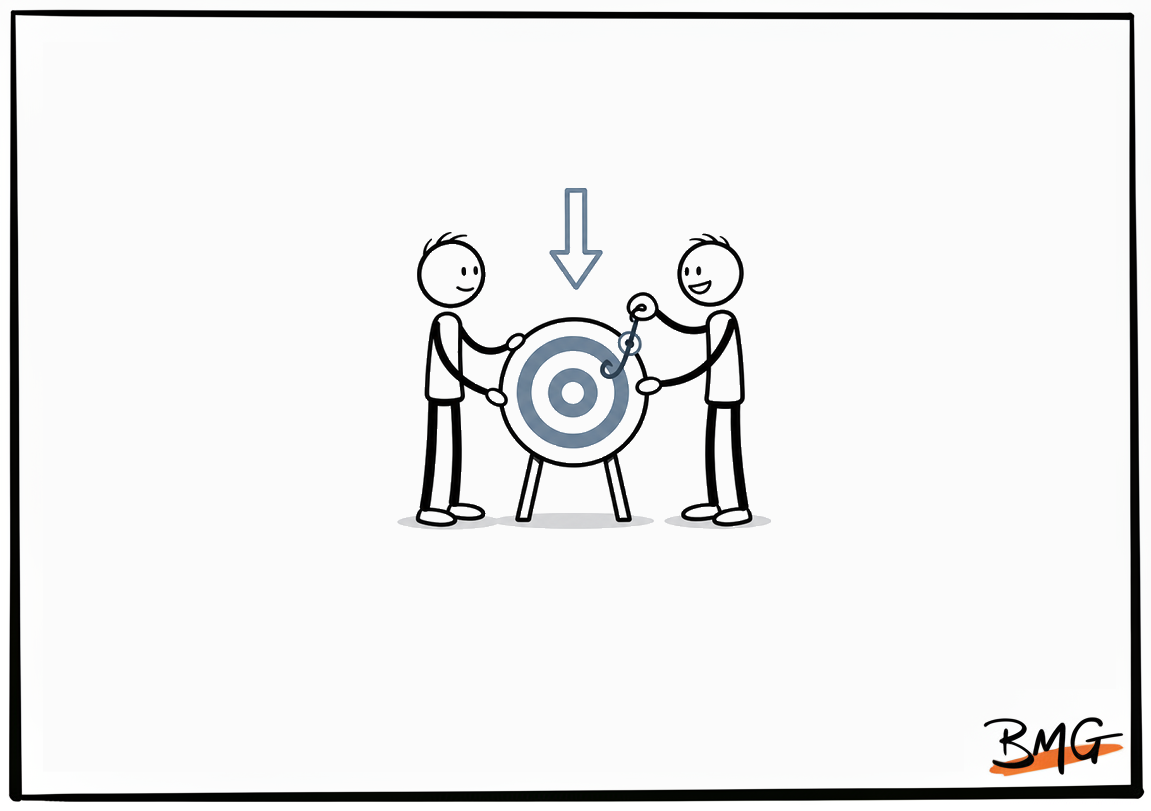
I started this piece with an opinion I was reasonably comfortable with.
Organisational objectives are often handed down through several layers of leadership, and by the time they reach the person expected to deliver them, they can feel rather remote from the work that person believes matters. The objective is valid because it came from above, urgent because it arrived in a coloured box and apparently motivating because somebody added the word ambitious.
The leader looks at it and thinks, Fine. But it isn't mine.
I've seen what happens next. Sometimes there's open conflict, although more often the resistance is quieter. Progress becomes oddly difficult. Other priorities keep winning. The objective survives every planning meeting and somehow fails to appear in the actual week. We normally call this procrastination or lack of ownership, which is neat, but it doesn't explain where the missing energy went.
My view was that a good leader or coach helps the person find their own hook, perhaps by asking questions that lead them towards believing the idea was theirs.
Then I wrote that sentence down.
It looked worse on paper.
The Difference Between Ownership And A Clever Illusion
There is nothing wrong with influence. Leadership contains influence in the same way meetings contain somebody saying, ‘You're on mute.’ It is part of the arrangement. A leader helps people see context they may not have, connects work to a larger outcome and challenges a narrow interpretation of what matters.
Coaching questions can help. ‘What part of this matters to your team?’ ‘Where does it connect with the problem you've been trying to solve?’ ‘What would good look like if you shaped the approach?’ These may open something real.
But if my private purpose is to make you believe my objective was your idea, we're back in familiar territory. The question has an answer hidden inside it, and the conversation will continue until you find it. That isn't ownership. It's compliance with some light craft work around the edges.
This bothered me because it runs very close to the habit I wrote about in Advice Wearing a Hat. I can't argue that leaders should stop disguising advice as curiosity, then use curiosity to disguise where an objective came from. Well, I can, obviously. Human beings are capable of holding two contradictory leadership philosophies before breakfast. It just doesn't make the second one honest.
So I went back to the motivation research, particularly Self-Determination Theory, developed over many years by Edward Deci, Richard Ryan and others. I had lazily remembered it as intrinsic motivation good, extrinsic motivation bad, which is both catchy and not quite what the theory says.
The more useful idea is that externally introduced goals can be taken in to different degrees. I may do something because I'm being watched, rewarded or threatened. I may do it because failing would make me feel guilty. Or I may come to see its value, connect it with something I care about and choose to give it genuine effort, even though I didn't originate it.
That last distinction matters. Autonomy doesn't mean I invented the goal or had complete freedom to reject it. It means I can act with a meaningful sense of willingness rather than feeling wholly controlled from outside.
In ordinary organisational life, that's quite a relief. Most leaders don't get to choose every objective. There are customer commitments, financial constraints, regulatory requirements and strategic decisions made elsewhere. If ownership required authorship, large organisations would have to operate as several thousand interesting hobbies.
An external goal can become genuinely valued. It just can't be smuggled into somebody's identity and then presented back to them as their own discovery.
A quick pause
If this is helpful, my free guide goes deeper, and the newsletter brings ideas like this twice a week.
My book, High-Fidelity Leadership, explores these same themes in more depth, with practical frameworks for standards, clarity, and the conversations that leaders avoid for too long.
Three Conversations We Often Muddle Together
The first conversation is about the constraint.
‘This objective has been set. I know you didn't choose it, and I don't want to pretend you did.’
That may sound less motivational than the usual launch language, but it removes a surprising amount of wasted effort. The person no longer has to perform enthusiasm while the leader performs consultation. Everybody knows which part of the situation is fixed.
The second conversation is about sense-making. What is the objective trying to achieve? What information sits behind it? Where does the person agree, disagree or simply not understand? A goal is difficult to internalise when its rationale is because the slide says so, and leaders sometimes underestimate how much context disappeared as the objective travelled down the organisation.
This is where questions can do honest work. Not questions designed to produce the approved answer, but questions that expose the person's actual relationship with the goal.
‘What makes sense to you here, and what doesn't?’
‘What do you think this is trying to solve?’
‘What concerns you about giving it priority?’
The answer may be that the goal conflicts with another commitment, rests on a faulty assumption or asks the team to optimise something that will damage the wider result. If we're only listening for the personal hook, we'll miss useful organisational intelligence.
Then comes the third conversation: where is the real agency?
The destination may be fixed while the route isn't. The person may be able to shape the method, sequence, measures, team involvement or trade-offs. They may connect the goal with a standard they care about, a customer problem they recognise or a capability they want the team to build. That connection is personalisation, but it isn't trickery. Nobody has rewritten the origin story.
I think this is what I was reaching for when I said a good leader helps somebody believe the idea was theirs. The useful part wasn't the belief. It was the search for a reason and an approach the person could genuinely choose.
The research has made me less comfortable with the phrase and more precise about the job.
When The Hook Isn't There
There is an inconvenient possibility in all of this: sometimes the person won't find a meaningful hook.
They may understand the rationale and still disagree. They may accept that the organisation needs the outcome without feeling personally energised by it. They may do competent, professional work because it is part of the role, which is a perfectly respectable form of motivation even if it won't improve the mood of a strategy away day.
Leaders can make this worse by demanding emotional ownership as well as delivery. It isn't enough for the objective to be completed; the person must apparently glow while discussing it. We begin coaching the attitude, looking for the question that will turn obligation into inspiration, when a more adult agreement might be: ‘You don't have to love this. I do need to know whether you can commit to delivering it well.’
That answer matters. If the person can't commit, there is a real leadership issue to work through. If they can, the conversation can move towards what support, discretion and clarity will help. We don't need to invent passion where professional commitment will do.
There is also a warning for the leader. If every handed-down objective requires a lengthy motivational rescue operation, the problem may not sit with the people receiving it. The organisation may be producing too many goals, hiding trade-offs or mistaking announcement for alignment. A coaching question is not going to repair a system that asks everybody to make twelve priorities feel personal at once.
I haven't abandoned the idea that leaders help people find their own connection with a goal. I have changed my mind about what good looks like.
It isn't getting somebody to say ‘This was my idea all along.’ It is being honest about where the objective came from, making room for genuine disagreement, explaining the rationale and then finding the part they can actually choose. Perhaps they identify with its value. Perhaps they shape a route they believe in. Perhaps they simply make a clear professional commitment without pretending it completes them as a person.
The question is no longer ‘How do I get them to own this?’
It is ‘What could they honestly choose within what has already been decided?’
That may produce less theatrical enthusiasm. I suspect it produces rather more real ownership.
The path to extraordinary is walked with a thousand small steps, you’re doing great!

Barry Marshall-Graham
Executive coach and leadership advisor
Get the Difficult Conversations Guide
A practical resource for leaders who want to say the thing that needs saying, without burning bridges or avoiding the moment.
Keep reading
31 August 2026
The Sentence They Nearly Said
A pause or changed expression may lead to the useful part of a conversation, but noticing it doesn't give the coach permission to decode it.
24 August 2026
You Cannot Coach Someone You Are Secretly Judging
Second-hand information may be useful, but once it becomes a character verdict it changes the leader’s listening, questions and tone.
17 August 2026
A Good Question Can Be Badly Timed
The wording may be excellent, but a coaching question can still arrive before the relationship or the moment is ready to carry it.
3 August 2026
The Leader Who Uses Coaching to Avoid Leading
Coaching can create room for another person to think, but it can also help a leader postpone the feedback, standard or decision that belongs to them.
27 July 2026
Advice Wearing a Hat
A coaching question can sound wonderfully curious while quietly steering somebody towards the answer their leader already prefers.
20 July 2026
The Emotional Cost of Being the Reliable One
Reliability earns trust, but it can also turn one capable leader into the place where unfinished work, uncertainty, and organisational risk accumulate.

13 July 2026
The Relief of Finally Saying the Thing
An overdue conversation occupies far more space than the words themselves. Relief begins when reality is finally allowed back into the room.

6 July 2026
The Sideways Shove
Peer conflict cannot be solved with the Manager Card. Influence begins when leaders stop pushing across borders and repair the working relationship.

29 June 2026
Clarity Under Pressure
Authority is tested when the room tightens. Clear leaders make reality, uncertainty, and the next decision visible without adding drama.
22 June 2026
The No-Surprises Standard
No surprises is not a demand for perfect control. It is a leadership standard that makes risk visible while there is still time to act.