The Relief of Finally Saying the Thing
13 July 2026
An overdue conversation occupies far more space than the words themselves. Relief begins when reality is finally allowed back into the room.
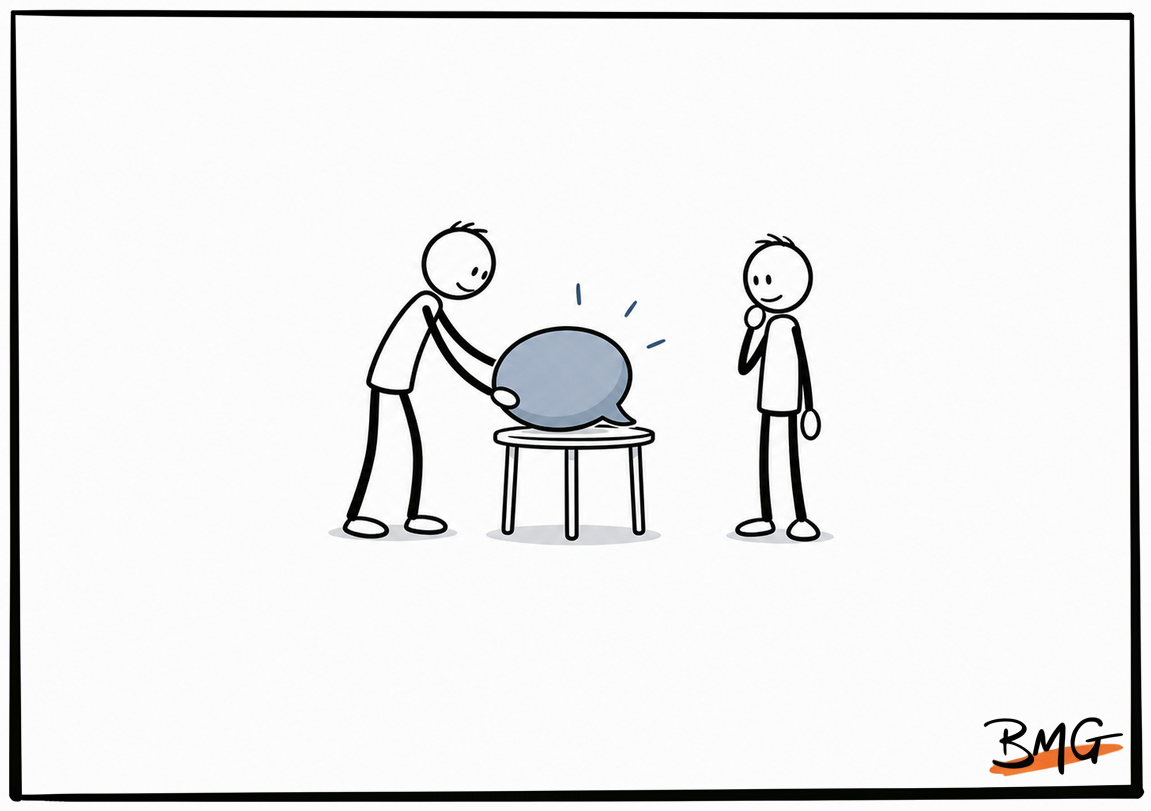
You know the conversation needs to happen.
It may be about a standard that has slipped, a promise that keeps moving, a working relationship that has become strained, or a decision everyone is carefully walking around. You have probably rehearsed the opening sentence more than once. You may even have chosen the right moment, then watched it pass.
The conversation itself might take twenty minutes.
Avoiding it can occupy twenty hours.
It appears while you are making coffee, driving home, trying to listen to somebody you care about, or waking at 3.17 in the morning with a sharper version of the sentence you should have used yesterday. The words remain unsaid, but the conversation is already happening. It is simply happening inside one person's head, where nobody else can clarify, respond, or help change the situation.
That private rehearsal feels like preparation. For a while, it may be. Then something shifts. You are no longer preparing to act.... you are paying emotional rent on a conversation you have not begun.
The Conversation Before The Conversation
An avoided conversation develops a life of its own.
You replay the evidence. You anticipate resistance. You construct a careful case, then imagine the other person dismantling it. You soften the opening because you do not want to sound unfair. Later, you sharpen it because you are angry with yourself for being too soft. Each rehearsal produces another possible branch, and each branch requires another answer.
Nothing in the real relationship has changed, but your internal version of the relationship becomes increasingly tense.
This is one reason an overdue conversation can feel harder with every passing day. You are no longer walking into a single exchange. You are walking in carrying all the imaginary exchanges that preceded it. The other person may arrive knowing almost none of this. They see an ordinary meeting request. You arrive with a week's worth of private argument already in your body.
The effect is easy to recognise. Your shoulders tighten when their name appears. A neutral message sounds loaded. You start collecting small pieces of supporting evidence that would normally pass without notice. The mind is trying to make the eventual conversation safer by removing uncertainty.
It can't.
People remain unpredictable. Tone cannot be fully controlled. Even a fair observation can be heard defensively. Waiting for a version of the conversation with no emotional risk means waiting for something that does not exist.
Readiness Is Not Certainty
Leaders often tell themselves they need to be ready.
That sounds responsible. Difficult conversations deserve care. Facts matter. Timing matters. Power, wellbeing, employment process, and the seriousness of the issue all matter. Rushing in to discharge your own frustration is not courageous leadership.
The trouble is that readiness quietly becomes a demand for certainty.
You want to know exactly how the person will react. You want enough evidence that they cannot disagree. You want the right language, the right room, the right mood, and enough time to complete the whole matter neatly. If any variable remains uncertain, postponement can be presented as judgement.
Readiness has a more modest standard. You understand the concern well enough to describe it fairly. You can distinguish what you observed from the story you have built around it. You know why the matter deserves attention. You can enter willing to hear something that may change your view.
That is often enough to begin.
Certainty is closed. Readiness is curious.
Certainty arrives to deliver a conclusion. Readiness arrives to put reality on the table and examine it with another person. The distinction matters because many overdue conversations are delayed by the belief that you must solve everything before you are allowed to say anything.
Sometimes the first useful act is simply ending the pretence that nothing is happening.
A Tuesday That Became Heavier Than It Needed To Be
Consider a familiar workplace moment.
A senior manager has noticed that one of their team leads has become increasingly dismissive in cross-functional meetings. Nothing is dramatic enough to trigger a formal response. It is a raised eyebrow, a clipped interruption, a private joke after somebody presents an awkward risk. Each incident is small. Together, they are changing the room.
On Tuesday morning, it happens again. A project manager pauses halfway through an update after being interrupted. Two people look down at their laptops. The team lead smiles and says, ‘I am only trying to keep us focused’.
The senior manager feels the moment. They could ask for ten minutes after the meeting. Instead, they tell themselves the team lead is under pressure and today is not the day.
By lunchtime, the manager has replayed the exchange twice. In the afternoon, they draft a message and delete it. At home, they explain only half the story to their partner because recounting the whole thing feels exhausting. On Wednesday, another meeting arrives. The manager is now watching the team lead closely, which changes their own tone. They are shorter, less generous, and more prepared for conflict.
The cost is already spreading.
The project manager has learnt that the interruption will pass without comment. The team lead has received no information that their behaviour is landing badly. The senior manager is carrying resentment towards somebody who has not yet been given a clean chance to respond. The next conversation will now have to work through the original behaviour and the emotional residue created by delay.
None of this means the manager should have staged a public confrontation. It means silence was not neutral. A private conversation on Tuesday would not guarantee a comfortable outcome. It would give reality somewhere to go.
Why Relief Arrives Before Resolution
Something interesting often happens when the conversation finally begins.
The problem is not instantly solved. The other person may disagree. They may need time. You may discover context you did not know. There may be another, more formal step later.
Yet the internal pressure often falls almost immediately.
This relief can seem strange because the external uncertainty has not disappeared. What has changed is the split between what you know and what you are willing to acknowledge. Before the conversation, you are living in two realities. In one, the issue is present and occupies your attention. In the other, the working relationship continues as though nothing needs saying.
Speaking brings those realities closer together.
The mind no longer needs to keep the issue alive through constant rehearsal. You have placed it where it belongs, between the people who can do something with it. Responsibility is shared again. Even a difficult response is real information, and real information is usually easier to work with than an imagined future rehearsed alone.
This is why the first feeling after an overdue conversation is sometimes physical. A longer breath. Lower shoulders. An appetite returning. The ability to read an email without scanning it for hidden meaning.
Relief is not proof that you were right.
It is often proof that you have stopped making your nervous system hold an organisational problem in private.
A quick pause
If this is helpful, my free guide goes deeper, and the newsletter brings ideas like this twice a week.
My book, High-Fidelity Leadership, explores these same themes in more depth, with practical frameworks for standards, clarity, and the conversations that leaders avoid for too long.
The Hidden Distortion Of Delay
Delay does more than prolong discomfort. It changes the person who eventually enters the conversation.
When you repeatedly swallow a concern, you may become less fair. The early version of the issue might have been specific and workable. After three weeks of private frustration, the concern begins to gather every related disappointment. One missed handover becomes evidence of a general attitude. One difficult exchange becomes a judgement about character.
By the time you speak, your words may sound disproportionate because they contain history the other person did not know was being recorded.
Delay can also produce false kindness. You tell yourself you are protecting the person from discomfort, while becoming colder around them. Your sentences shorten. Warmth leaves the relationship. You stop offering opportunities because you no longer trust the outcome. They experience the consequences of a judgement they have never heard.
That is a hard form of leadership to live under. The standard has changed, but only one person knows it.
There is another distortion. Avoidance encourages rescue. Rather than naming the concern, you work around it. You rewrite the paper, attend the meeting, chase the dependency, or absorb the awkward stakeholder. The work survives, so the need for conversation appears to recede. In reality, the system has learnt that your private effort will protect it from the cost of staying the same.
The eventual conversation becomes harder because the evidence has been hidden by your own competence.
Early words are usually cleaner words. They have less resentment attached. They leave more dignity available. They also give the other person more time to change before the pattern becomes part of how everyone understands them.
The Conversation Is Not A Performance
Part of the fear comes from treating the conversation as a test of leadership.
You imagine that a good leader will say the perfect thing, remain entirely calm, handle every objection, and leave with a clear agreement. If the exchange becomes awkward, emotional, or inconclusive, you have somehow failed.
Real conversations are rarely that tidy.
You may stumble over the opening. You may need to pause. The other person may say something that exposes a weak assumption. You may have to acknowledge that your timing was poor or your contribution to the pattern was larger than you realised.
None of that makes the conversation useless.
The aim is not to perform fearlessness. It is to make the issue discussable without cruelty or theatre. That is a lower bar than perfection and a higher bar than avoidance.
Senior leaders can find this especially difficult because their words carry weight. They know that a badly handled sentence can travel. Caution is appropriate. But caution should improve the quality of the conversation, not remove the conversation from the calendar indefinitely.
If the issue is serious enough to involve formal performance, conduct, legal, medical, safeguarding, or protected matters, use the proper professional process. Supportive candour is not a substitute for expertise or organisational safeguards. For ordinary leadership friction, however, the perfect process is often another hiding place.
What Changes When Reality Returns
Once the issue is spoken, several things become possible.
The other person can provide context. You may learn that the apparently dismissive team lead is reacting to repeated last-minute changes nobody has acknowledged. That does not erase the impact of their behaviour. It gives you a fuller problem to solve.
They can also take responsibility. Many people know something is off before a leader names it. The conversation may confirm a concern they have been carrying themselves. What felt to you like delivering bad news may feel to them like receiving a clear route out of ambiguity.
The relationship can become more honest. This does not always mean warmer. Sometimes the honest outcome is a clearer boundary, a changed role, or a recognition that trust needs rebuilding. Honesty reduces the energy spent maintaining a false surface.
Most importantly, you regain choice.
Avoidance narrows the world. You monitor, compensate, rehearse, and hope. A real conversation creates options: clarify, support, reset, escalate, reconsider, or agree to observe what happens next. Not every option is pleasant, but they are available in reality rather than imagination.
Personal Reflection
I know the temptation to wait until I can control the whole exchange.
I have rehearsed conversations in the car, edited them in the shower, and carried them into evenings where my attention should have been elsewhere. The rehearsal can feel productive because the words become more polished. Often, what I was really polishing was my defence against being misunderstood.
The conversations that brought the most relief were not always the ones that went smoothly. Relief came from no longer pretending. The issue had moved from private worry into a shared reality, and I could respond to what actually happened rather than to the hundred versions I had imagined.
I have also learnt that postponement changes my tone. I may believe I am preserving kindness, but unspoken frustration leaks. It appears in a shorter reply, a lower level of trust, or the quiet decision to stop involving somebody. If I am going to change how I work with a person, they deserve the chance to understand why.
The conversation does not have to prove my view. It has to make the truth available to both of us.
Reflection Prompts
Which conversation is occupying more mental space than the issue itself requires?
What am I calling preparation that has become rehearsal without action?
How has my behaviour towards this person already changed?
What do I know, and what story have I added?
What might become possible once the issue is shared rather than privately carried?
Final Thought
The relief of finally saying the thing does not come from winning the conversation.
It comes from ending the split between what you can see and what you are willing to acknowledge. You stop asking one mind and one body to contain a problem that belongs in a relationship, a team, or a proper organisational process.
You do not need to know the ending before you begin. You need enough care to be fair, enough clarity to be specific, and enough willingness to let reality answer back.
The path to extraordinary is walked with a thousand small steps, you’re doing great!
Your Small Steps
How do I know whether I am preparing or avoiding?
Preparation improves the quality of an action that has a date. Avoidance keeps producing more thought without creating a moment to speak.
Small Step: If you have already rehearsed the conversation twice, put a sensible date in the diary.
What if I am still angry?
Do not use the conversation to discharge anger. Give yourself enough time to regulate, separate facts from interpretation, and decide what outcome matters.
Small Step: Write the observation in one sentence without adjectives about the person.
What if I have misunderstood the situation?
That is possible. A fair conversation leaves room for information that changes your view. You can name what you observed without claiming to know the whole explanation.
Small Step: Write one question you genuinely do not know the answer to.
Should I wait for a better moment?
Timing matters, particularly when somebody is distressed or the setting is public. A better moment should be identifiable, not imaginary.
Small Step: Choose the next private, unhurried window rather than waiting for a perfect mood.
What if they become defensive?
Defensiveness does not automatically mean the conversation was wrong. Slow down, listen, and return to the specific issue rather than escalating into a contest over character.
Small Step: Plan a pause you can use: ‘I can see this has landed strongly. Let us slow it down’.
Do I need all the evidence before I speak?
You need enough evidence to raise a fair concern. Waiting until the case is unanswerable often means waiting until the damage is much larger.
Small Step: Identify the two clearest observations and leave weaker supporting material out.
What if this is a formal or sensitive matter?
Use the correct organisational, HR, legal, medical, or safeguarding route. A direct leadership conversation should not bypass professional protection or due process.
Small Step: Check the appropriate policy or seek qualified advice before arranging the conversation.
What can I do today?
Stop trying to complete the conversation in your head. Your immediate task is to create a fair beginning and a proper setting.
Small Step: Send the meeting invitation before returning to the script for the thirteenth time.

Barry Marshall-Graham
Executive coach and leadership advisor
Get the Difficult Conversations Guide
A practical resource for leaders who want to say the thing that needs saying, without burning bridges or avoiding the moment.
Keep reading
10 August 2026
Whose Goal Is It Anyway?
A goal can be strategically sensible and still feel unowned. The answer is honest internalisation, not coaching somebody into believing it was their idea.
3 August 2026
The Leader Who Uses Coaching to Avoid Leading
Coaching can create room for another person to think, but it can also help a leader postpone the feedback, standard or decision that belongs to them.
27 July 2026
Advice Wearing a Hat
A coaching question can sound wonderfully curious while quietly steering somebody towards the answer their leader already prefers.
20 July 2026
The Emotional Cost of Being the Reliable One
Reliability earns trust, but it can also turn one capable leader into the place where unfinished work, uncertainty, and organisational risk accumulate.
6 July 2026
The Sideways Shove
Peer conflict cannot be solved with the Manager Card. Influence begins when leaders stop pushing across borders and repair the working relationship.
29 June 2026
Clarity Under Pressure
Authority is tested when the room tightens. Clear leaders make reality, uncertainty, and the next decision visible without adding drama.
22 June 2026
The No-Surprises Standard
No surprises is not a demand for perfect control. It is a leadership standard that makes risk visible while there is still time to act.
15 June 2026
When A Promise Breaks Twice
A broken promise is not only a missed deadline. When it repeats, it changes how much trust the team can safely place in a commitment.
8 June 2026
The C+ Deck: How Good Enough Becomes The New Standard
Good enough work from capable people is seductive because it almost passes. That is exactly why leaders must address it early.
1 June 2026
Before You Call It Drift
Before naming underperformance, leaders need to check whether the system made success clear, possible, and properly supported.
