The Emotional Cost of Being the Reliable One
20 July 2026
Reliability earns trust, but it can also turn one capable leader into the place where unfinished work, uncertainty, and organisational risk accumulate.
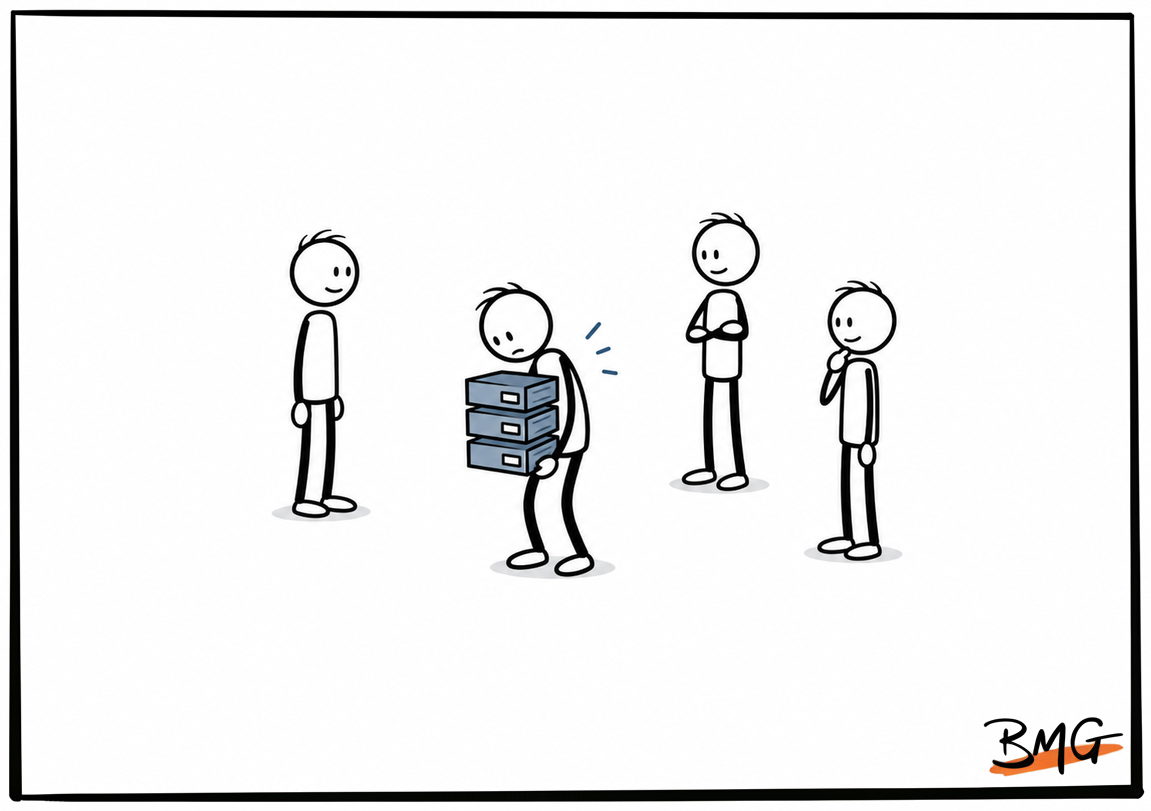
If you are the reliable one, people relax when you enter the room.
You remember what was agreed. You notice the dependency nobody has mentioned. You send the note, check the number, call the stakeholder, and catch the small inconsistency before it becomes a visible problem.
This earns trust.
It also creates a particular kind of loneliness.
Everybody else experiences your reliability as reassurance. You experience it as a growing list of things that must not be allowed to fail.
The praise can make the pattern difficult to question. You are dependable. Safe hands. Unflappable under pressure. The person who gets things over the line. These are good qualities, and they may be central to how you became successful.
Then, almost without anyone deciding it, reliability becomes an organisational location.
Uncertainty flows towards you. Loose ends find you. Other people's confidence begins to depend on your private vigilance. The work looks well controlled from the outside because the cost of controlling it is being paid inside one person.
The Role Beneath The Role
Every job has an official description and an unofficial one.
The official role might be Chief Technology Officer, Operations Director, Head of Product, programme lead, or team manager. The unofficial role is harder to see. It might be the person who translates conflict, remembers the history, senses when an executive is losing confidence, or knows which commitment needs chasing before Friday.
This unofficial work is rarely assigned. It accumulates around the person who proves willing and able to carry it.
At first, that can feel satisfying. Competence creates agency. You can see how to prevent the mistake, so you do. You know the stakeholder needs reassurance, so you call. The organisation rewards the visible stability, and your identity becomes closely linked to being useful.
The difficulty appears when the work stops being chosen.
You cannot leave a loose thread because you know where it leads. You cannot ignore the missed signal because you will be held responsible when it becomes an incident. You cannot let somebody struggle because helping them will be quicker, kinder, and safer for everyone involved.
Reliability has moved from a strength you use to a condition you maintain.
The Private Control Room
Picture a weekly programme review.
Eight people attend. The status is amber, but the slides are calm. The project lead says the supplier date is holding. Finance says the revised forecast will be ready on Thursday. Product says the final decision is waiting for one customer input.
The executive sponsor asks whether there is anything they should worry about.
Everyone looks towards the programme director.
The director says, ‘We have a few moving parts, but we are on top of them’.
The room relaxes.
What the room cannot see is the director's private control system. They have already messaged the supplier twice, checked Finance's assumptions, and arranged a separate call with the customer because Product's owner has not made contact. Their calendar contains three small meetings created solely to prevent other people's commitments from colliding.
The programme is under control because the director is acting as its second nervous system.
After the meeting, somebody says, ‘I do not know how you keep all this in your head’. It is intended as admiration.
The director smiles.
Inside, the sentence lands as a warning.
Reliability And Dependency Are Different
A reliable leader creates confidence through sound judgement, clear commitments, early signals, and consistent follow-through.
A depended-upon leader creates confidence because everybody assumes they will catch whatever the system misses.
Those can look identical in a good week.
The difference appears when the leader steps away. In a reliable system, information still moves, decisions still have owners, and risk becomes visible without one person's intervention. In a dependency system, people pause. Meetings are postponed. Small decisions accumulate. The team waits for the person who usually closes the gap.
This distinction matters because organisations often reward the second pattern as exceptional leadership. The leader is praised for being indispensable while the system becomes increasingly unable to operate without them.
Indispensability feels like security. It is often fragility wearing a compliment.
The reliable person may also help create that fragility. This is uncomfortable to acknowledge. Their speed makes delegation feel inefficient. Their standards make unfinished work hard to tolerate. Their knowledge allows them to solve in five minutes what would take somebody else an hour.
So they step in.
Each intervention protects the immediate outcome. It also removes a small opportunity for somebody else to experience consequence, exercise judgement, or build credibility. The leader becomes more necessary with every rescue.
The Emotional Contract Nobody Signed
Once you are known as the reliable one, an emotional contract forms around you.
You will remain calm.
You will know what to do.
You will not add your worry to the room.
You will absorb the uncertainty and return something organised.
Nobody may say these things aloud. You can still feel them.
The contract makes it harder to admit overload because your value is associated with capacity. Asking for help can feel like contradicting the identity that earned everyone's trust. You may worry that if people see how much effort the stability requires, their confidence will fall.
There is pride in this, but there can also be fear.
If I am no longer the person who can carry everything, who am I in this system? If I stop catching the falling work, will people decide I have become less committed? If something fails after I chose not to intervene, will I be blamed for seeing the risk and leaving it alone?
These are not trivial concerns. Some organisations really do reward silent carrying and punish visible limits. A leader cannot fix that culture through personal boundaries alone. Still, the emotional contract becomes stronger when it remains unnamed, even to yourself.
You begin performing ease.
The performance protects other people from the cost of their dependence. They see a capable leader handling a demanding role. They do not see the evening review, the Sunday message, or the background scan that keeps asking what everyone else may have forgotten.
A quick pause
If this is helpful, my free guide goes deeper, and the newsletter brings ideas like this twice a week.
My book, High-Fidelity Leadership, explores these same themes in more depth, with practical frameworks for standards, clarity, and the conversations that leaders avoid for too long.
The Cost Arrives In Quiet Ways
The reliable one does not always collapse dramatically.
The cost often appears as a narrowing.
You become less patient with people who need time to think. You stop explaining because doing it yourself is faster. You feel a flash of irritation when somebody asks a question whose answer they could have found. Small requests feel larger because they arrive on top of a load nobody else can see.
You may also lose the ability to rest cleanly. Time away becomes remote monitoring with better scenery. You check messages to reduce uncertainty, then tell yourself the reduced uncertainty proves checking was sensible.
Success brings less satisfaction. Preventing failure becomes normal, while any visible mistake feels personal. The emotional range of the role shrinks to vigilance and relief.
There is a relationship cost too. When you repeatedly carry what others have left, resentment grows beside usefulness. You may care deeply about the team and still feel angry that they can relax because you do not. That resentment can be difficult to admit because nobody explicitly forced you to intervene.
The most painful part is that your work may remain invisible precisely because it succeeds.
The incident does not happen. The executive does not become alarmed. The customer does not complain. There is no clean event to point towards. Only you know how many times the system nearly required a consequence and was quietly saved from one.
When Help Becomes Concealment
Helping is part of leadership. The answer is not to become detached, watch people fail, or turn every request into a lesson about ownership.
The useful question is what your help makes visible and what it conceals.
If you help somebody understand a risk, make a decision, or learn a process, the system may become stronger. If you repeatedly complete the work without returning visibility to the owner, the system may become more dependent while appearing healthy.
This is especially common with high-stakes work. The leader tells themselves the deadline is too important for development. That may be true today. The problem is that every deadline becomes too important, so capability is never built under real conditions.
There is always a reason to rescue this one.
The same pattern affects organisational truth. When a leader privately compensates for weak ownership, senior stakeholders see a functioning system. Resourcing decisions, performance judgements, and delivery expectations are made using false evidence. The hidden labour becomes the organisation's assumed capacity.
Your competence can accidentally teach the system that the current design works.
That is a high price for keeping everything tidy.
The First Change Is Visibility
The reliable one often jumps from carrying everything to imagining they must drop everything.
There is a middle ground.
Begin by making the hidden load visible to yourself. List the work you officially own, the work you have agreed to support, and the work you are quietly preventing from failing. The third category is usually where the emotional weight lives.
Then notice the triggers. Which people, meetings, or types of risk make you intervene automatically? What do you believe will happen if you do not? Which consequences are genuinely unacceptable, and which are simply uncomfortable?
This is not an instruction to abandon responsibility. It is an attempt to see the system accurately.
Visibility also means allowing the organisation to encounter clean information. If a deadline depends on your unplanned weekend, the status is not green. If a team can deliver only because you are performing a second role invisibly, the operating model is not fully staffed. If a decision waits for you because nobody else has the authority or confidence to make it, that is design data.
Reliable leadership should improve the truth available to the system.
It should not require one person to make reality look easier than it is.
Letting Other People Become Reliable
Trusting others is not a feeling you wait for. It develops through evidence.
The reliable leader may need to tolerate a period where the work is done differently, more slowly, or with more visible uncertainty. This can feel irresponsible when you can already see the cleaner route.
There are limits. Safety, legal, financial, customer, and people risks may require closer control. The key is to distinguish between protecting the organisation and protecting yourself from the discomfort of watching somebody else learn.
If you always step in before the ownership becomes real, you never discover what the person would have done.
They do not discover it either.
Sometimes they will surprise you. Sometimes the weakness will become visible and require a proper response. Both outcomes are more useful than permanent dependence disguised as smooth delivery.
The goal is not to become less reliable. It is to stop making reliability mean that every unfinished thing belongs to you.
Personal Reflection
I have often been rewarded for seeing the whole board.
It is satisfying to connect the pieces, anticipate the problem, and prevent unnecessary drama. I also know how easily that strength can become an excuse to stay at the centre. If I can solve the problem quickly, handing it back feels inefficient. If I can see a risk others have missed, leaving it with them feels careless.
Over time, I have had to ask a less flattering question: am I protecting the outcome, or protecting my identity as the person who protects the outcome?
There have been periods when I looked calm and capable while privately feeling resentful that everything seemed to find me. The resentment was real. So was my contribution to the pattern. I had trained people to expect that I would close the gap because, repeatedly, I did.
The healthier moments began with visibility. Naming what I was carrying, allowing a status to reflect the real conditions, and giving somebody else enough space to become credible. That did not always make the work immediately smoother. It made the system more honest.
Reflection Prompts
What does everybody relax about because they assume I will handle it?
Which part of my workload exists only because I do not trust the system to catch it?
Where has being helpful prevented somebody else from becoming dependable?
What would become visible if I stopped performing ease?
Which responsibility could remain with its owner this week without creating unacceptable risk?
Final Thought
Reliability should be a source of trust, not a private sentence.
You can remain thoughtful, committed, and alert without becoming the place where every loose end comes to live. The deeper contribution is not catching everything forever. It is helping to build a system where truth travels, ownership holds, and other people have the chance to become reliable too.
The question is not whether you can carry it.
You probably can.
The question is what the organisation is learning while you do.
The path to extraordinary is walked with a thousand small steps, you’re doing great!
Your Small Steps
How do I know whether people rely on me too much?
Notice what happens when you are unavailable. Dependency appears when decisions pause, ownership blurs, or people wait for you to notice what they already know.
Small Step: Review the last day you took off and list what still came back to you.
Is being indispensable really a problem?
It may feel valuable, but it creates risk for you and the organisation. A strong leader should matter greatly without being the only route through which work can move.
Small Step: Identify one decision that needs a credible second owner.
What if the team genuinely is not ready?
Then the capability gap needs to be visible and addressed. Quietly covering it prevents the organisation from understanding the support, development, or change required.
Small Step: Name the specific capability that is missing rather than absorbing its work indefinitely.
How do I stop rescuing without letting something important fail?
Use proportion. Protect unacceptable risks while leaving ordinary ownership and manageable consequences with the person responsible.
Small Step: Choose one low-risk responsibility you will support without taking over.
Why do I feel guilty when I step back?
Your identity may be closely linked to usefulness. Guilt does not automatically mean you are neglecting the work. It may mean you are changing an old emotional contract.
Small Step: Write down what responsible support looks like before the next request arrives.
What if my organisation expects constant availability?
Treat that as cultural and operating data, not only as a personal resilience problem. Some expectations need explicit discussion, role clarity, or formal support.
Small Step: Record the repeated out-of-hours demands and the business condition creating them.
How can I make hidden work visible without sounding resentful?
Describe the operating reality and its consequences. Focus on capacity, ownership, risk, and sustainability rather than on whether others appreciate you enough.
Small Step: Translate one invisible task into its hours, purpose, and current owner.
What can I change this week?
Do not attempt a dramatic withdrawal. Let one responsibility remain visible and owned by the person or role it belongs to.
Small Step: When the next loose end appears, ask who owns it before deciding how you will help.

Barry Marshall-Graham
Executive coach and leadership advisor
Get the Difficult Conversations Guide
A practical resource for leaders who want to say the thing that needs saying, without burning bridges or avoiding the moment.
Keep reading
10 August 2026
Whose Goal Is It Anyway?
A goal can be strategically sensible and still feel unowned. The answer is honest internalisation, not coaching somebody into believing it was their idea.
3 August 2026
The Leader Who Uses Coaching to Avoid Leading
Coaching can create room for another person to think, but it can also help a leader postpone the feedback, standard or decision that belongs to them.
27 July 2026
Advice Wearing a Hat
A coaching question can sound wonderfully curious while quietly steering somebody towards the answer their leader already prefers.
13 July 2026
The Relief of Finally Saying the Thing
An overdue conversation occupies far more space than the words themselves. Relief begins when reality is finally allowed back into the room.
6 July 2026
The Sideways Shove
Peer conflict cannot be solved with the Manager Card. Influence begins when leaders stop pushing across borders and repair the working relationship.
29 June 2026
Clarity Under Pressure
Authority is tested when the room tightens. Clear leaders make reality, uncertainty, and the next decision visible without adding drama.
22 June 2026
The No-Surprises Standard
No surprises is not a demand for perfect control. It is a leadership standard that makes risk visible while there is still time to act.
15 June 2026
When A Promise Breaks Twice
A broken promise is not only a missed deadline. When it repeats, it changes how much trust the team can safely place in a commitment.
8 June 2026
The C+ Deck: How Good Enough Becomes The New Standard
Good enough work from capable people is seductive because it almost passes. That is exactly why leaders must address it early.
1 June 2026
Before You Call It Drift
Before naming underperformance, leaders need to check whether the system made success clear, possible, and properly supported.
