Clarity Under Pressure
29 June 2026
Authority is tested when the room tightens. Clear leaders make reality, uncertainty, and the next decision visible without adding drama.
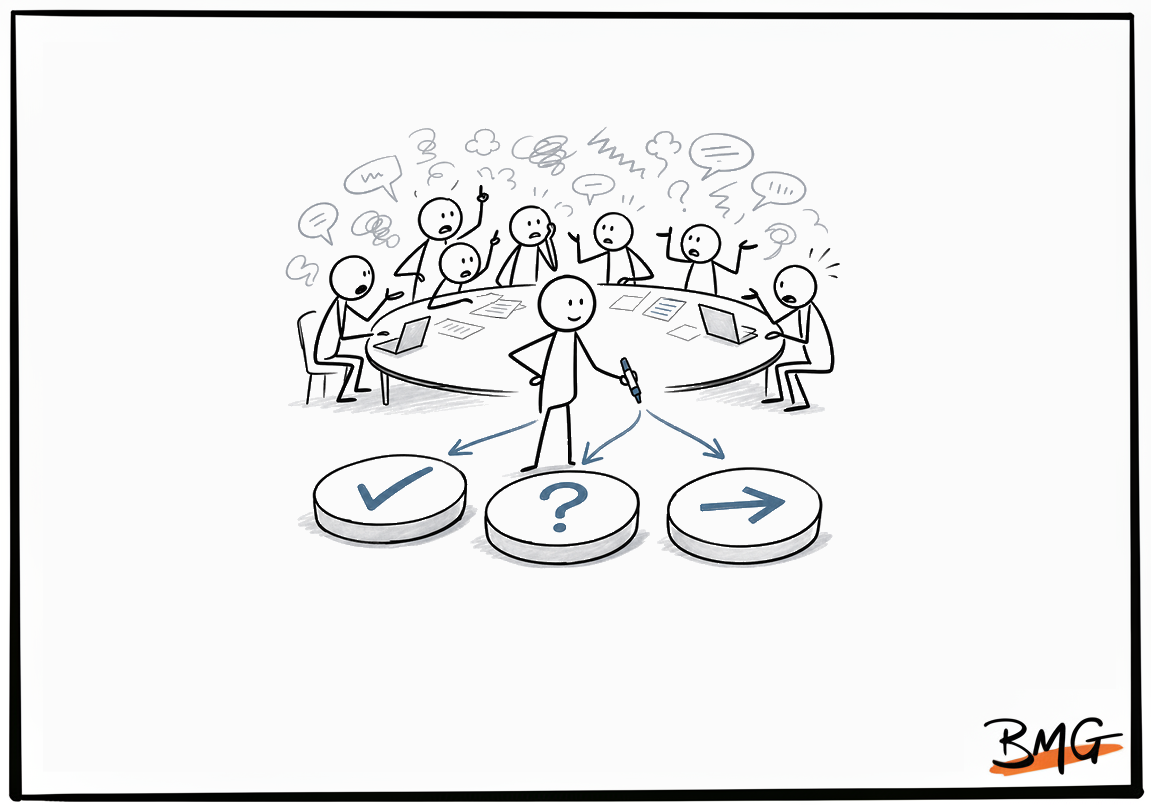
Pressure changes the sound of a room.
People speak faster. Updates become longer and somehow less informative. Someone reaches for certainty they do not have. Someone else disappears into detail. The person with the most senior title feels an invisible demand to say something decisive, even when the evidence is still moving.
This is where authority is usually misunderstood.
We tend to picture authority as confidence, speed, or command. We notice the firm voice, the quick answer, the person who can bring a wandering conversation to a stop. Those things can help. They can also create the appearance of leadership while leaving the room no clearer than it was before.
Real authority becomes visible when the pressure rises and the leader refuses to add fog.
They tell people what is known. They name what is uncertain. They make the decision that can be made now, then give the unresolved part an owner and a return point. They do not borrow certainty from the future to make themselves look composed in the present.
That is clarity under pressure.
The Problem
Most leadership pressure is not dramatic. It arrives through accumulation.
A client date is wobbling. A senior stakeholder wants an answer. Two teams disagree about the cause. The figures are incomplete. The calendar is full, patience is thin, and everyone knows the next sentence will shape what happens after the meeting.
In that moment, the room is asking the leader to reduce uncertainty.
The trap is trying to remove uncertainty altogether.
You cannot always do that. Sometimes the evidence is not ready. Sometimes the choice carries a real trade-off. Sometimes every available route has a cost. Pretending otherwise may settle the room for ten minutes, but it pushes the uncertainty downstream, where it usually returns as rework, surprise, or a broken promise.
This is why pressured teams can look decisive while remaining directionless. They produce confident language, extra actions, and urgent meetings. What they do not produce is a clean account of reality.
The cost is human as well as operational.
People leave the meeting unsure what was actually decided. They replay the conversation on the train home. They message each other privately to compare interpretations. The most dependable person quietly starts compensating for the ambiguity, while the person with the title believes they created alignment.
Pressure did not create that confusion.
It exposed it.
The Reframe
Authority is not having all the answers.
Authority is helping a group stay in contact with reality when reality is uncomfortable.
That distinction matters because the need to look certain is one of the fastest ways to weaken a decision. It encourages leaders to close questions too early, flatten genuine disagreement, and convert assumptions into promises before anyone has tested them.
A clear leader does something more disciplined. They separate three things:
- what we know
- what we do not yet know
- what we will do next
That may sound basic. Under pressure, it is surprisingly rare.
The first category grounds the room. The second prevents false confidence. The third stops uncertainty becoming an excuse for drift.
Together, they create a form of authority that people can trust. The leader is not performing omniscience. They are making the situation legible.
There is another important distinction here. Clarity is not bluntness.
Bluntness often releases the speaker's frustration. Clarity serves the listener's understanding. A blunt leader may say, This is a mess. Fix it by Friday. A clear leader is more likely to say, The customer promise is now at risk. We have two unresolved dependencies. I want one owner for each by noon, then we will decide whether Friday remains credible.
The second version has a firmer effect because it gives the room something usable.
A Tuesday Morning Decision
I have seen this pattern play out in rooms where every person was capable and every person was under strain.
It is Tuesday morning. A programme review has already overrun. The release is due in ten days. The Head of Delivery says the date is still possible. Engineering says the technical work can be finished, provided the test environment holds. Operations says they have not yet seen a support plan. The commercial lead has promised the customer an update by lunchtime.
The managing director looks around the table and asks, Are we launching or not?
Silence.
Someone begins explaining the test sequence. Someone else interrupts with the customer history. The delivery lead says they are cautiously confident. Operations folds their arms. The commercial lead checks the clock.
This is the point where a leader can easily make the wrong kind of decisive move. They can choose a date to end the discomfort. They can demand that everyone pull together. They can schedule another review and call that progress.
Or they can clear the room.
Here is what I think we know. The build can be ready. The support model and test environment are still conditions, so the launch is not yet safe. We will not confirm the date to the customer at lunchtime. Priya owns the test decision by three. Dan owns the support decision by four. We meet at four-thirty and make the launch call with those two facts in the room.
Nothing magical happened.
The uncertainty was still real. The customer still needed managing. The work still had to be done. Yet the emotional temperature changed because the room now knew the difference between a fact, a condition, and a decision.
That is what clarity does.
It returns pressure to its proper size.
Four Ways Leaders Add Noise
Pressure does not only reveal authority. It reveals the habits we use to protect ourselves.
The first is premature certainty.
This sounds like, We will make the date, when the honest sentence is, The date depends on two things we have not confirmed. The confident version may feel strong. It creates a promise the team must now rescue.
The second is explanatory flooding.
An anxious leader can give the room every detail they know, hoping volume will be mistaken for control. People hear history, context, caveats, and technical nuance, but they still do not know what they are meant to do when the call ends.
The third is urgency without priority.
Everything becomes critical. Everyone receives an action. Every problem gets a red label. The team works harder and makes poorer choices because the leader has transferred their anxiety into the system.
The fourth is the heroic answer.
The leader takes the problem away, rewrites the plan late at night, calls the customer themselves, or becomes the single point through which every decision must pass. It may save the immediate moment. It also teaches the team that pressure reduces their ownership and increases the leader's workload.
These habits have a common root. They are attempts to feel safer.
The leader wants to escape the silence, protect their credibility, or prevent disappointment. That is understandable. It is also why the pre-game matters. If you enter the room needing the conversation to prove that you are competent, your need will compete with the decision the room actually requires.
A quick pause
If this is helpful, my free guide goes deeper, and the newsletter brings ideas like this twice a week.
My book, High-Fidelity Leadership, explores these same themes in more depth, with practical frameworks for standards, clarity, and the conversations that leaders avoid for too long.
The Three-Part Clarity Move
When the room tightens, use a simple sequence.
1. State the reality
Start with the smallest set of facts that everyone needs.
The customer has not approved the revised scope.
Two milestones have moved.
We do not have evidence that the current plan protects quality.
Facts reduce argument because they give the conversation a shared floor. Keep interpretation separate. They do not care about the project is a story. They have not attended the last two decision meetings is an observation.
2. Name the uncertainty
Say what is unresolved and why it matters.
We do not yet know whether the dependency can be recovered by Friday. That means the external date is conditional.
This is often the sentence leaders avoid. They worry that naming uncertainty will make them look weak. In practice, hidden uncertainty is far more damaging. People can work with a named condition. They cannot plan around confidence that quietly depends on something nobody has said.
3. Set the next decision
Uncertainty needs a boundary.
Who will find out what? By when? What decision will be made when the information arrives? What happens if it does not arrive?
Maya will confirm supplier capacity by two. At two-thirty we will either protect the full scope or move the lower-priority items. If capacity is still unclear, we reduce scope.
That is authority in an operational form.
It gives the team movement without pretending the final answer already exists.
Supportive Candour Under Pressure
Clarity gets harder when the pressure is attached to a person.
The missed promise has an owner. The weak recommendation came from someone you respect. The difficult truth will disappoint a colleague who has worked hard. This is where leaders often choose between two poor options: soften the message until it disappears, or deliver it with enough force to make sure nobody misses it.
Supportive candour offers a cleaner route.
You can respect effort and still name the gap. You can understand the context and still protect the standard. You can acknowledge uncertainty without abandoning responsibility.
Try:
I can see how much work has gone into this. I also do not think the recommendation is safe enough for the decision we are being asked to make.
Or:
I know the circumstances have moved. The commitment still needs resetting because other people are planning around it.
The tone is calm. The message is complete.
The goal is not to make pressure disappear. It is to stop pressure deciding how you speak.
The Decision Gate
Some situations stay difficult because nobody has defined the point at which persistence becomes a new decision.
Teams keep investing. Leaders keep hoping. Projects collect another month, another sprint, another round of goodwill. Every individual extension can be defended. Taken together, they become a commitment with no boundary.
A decision gate creates that boundary.
It says:
- this is the outcome we are trying to create
- this is the evidence we need to see
- this is the date on which we will review it
- these are the choices available if the evidence is not there
This is particularly important when the work matters deeply. Personal investment can make clean judgement harder. The more time, care, and identity you have placed into something, the easier it is to treat a decision about the work as a judgement on you.
It is not.
Changing the level of investment, changing the route, or stopping a piece of work does not erase what you learned or what you built. It means the next investment is being made with current evidence rather than historic hope.
Pressure asks, How can I keep this alive?
Clarity asks, What would justify the next unit of time, money, or attention?
That question can feel severe. It is often a kindness. It protects commitment from becoming an endless claim on the future.
Personal Reflection
I know the temptation to make a room feel better before it becomes clearer.
I have filled silence with explanation. I have given a confident answer because the pause felt too exposed. I have taken work away and fixed it myself because the direct conversation seemed slower than simply getting the job done.
Each time, there was a short reward. The meeting moved on. The tension dropped. I felt useful.
The bill arrived later.
Someone had a different understanding of the decision. A promise had become firmer than the evidence allowed. I was carrying work that should have remained with its owner. What looked like authority in the room had created fragility outside it.
I have also learned that clarity can be emotionally uncomfortable without being dramatic. Sometimes the clearest sentence is, I do not know yet. Sometimes it is, This is no longer a sensible use of our time. Sometimes it is, We are going to continue, but only until this evidence point.
Those sentences do not make me feel powerful.
They make the work more honest.
Reflection Prompts
Where am I using confident language to cover a condition I have not named?
Which meeting leaves people with activity but no clear decision?
What fact, uncertainty, and next move does my team need from me now?
Where has urgency become a substitute for priority?
Which investment needs a decision gate rather than another hopeful extension?
How does my tone change when I feel my credibility is under pressure?
Final Thought
Authority is easiest to imitate when the room is calm.
Pressure reveals the difference. The clearest leader is rarely the person who produces the fastest certainty. It is the person who helps everyone see reality, uncertainty, and the next decision without adding fear or theatre.
You do not need to know everything.
You do need to make the next honest move visible.
Your Small Steps
What should I say when I do not have the answer?
Say what you know, what remains uncertain, and when the answer will become a decision. That is more useful than either guessing or disappearing into caveats.
Small Step: Use this line: Here is what we know, here is what we are still testing, and here is when we will decide.
How do I sound clear without sounding harsh?
Keep the message specific and useful. Name the fact, the impact, and the required next move. Harshness usually enters when frustration is allowed to stand in for precision.
Small Step: Remove one judgement word from your next difficult message and replace it with an observable fact.
What if the room wants a yes or no immediately?
Explain which missing fact makes the answer unsafe. Then create the shortest credible route to that fact, with an owner and a return time.
Small Step: Name the decision condition in one sentence before agreeing to a date.
How do I stop over-explaining under pressure?
Pause before you give context. Start with the decision the room needs. Add only the detail that changes that decision.
Small Step: Write your first sentence before the meeting: The decision we need today is...
What is a decision gate?
It is an agreed point at which evidence is reviewed and the next investment is chosen. It prevents temporary extensions becoming open-ended commitments.
Small Step: For one live piece of work, set an outcome, evidence threshold, review date, and two possible decisions.
Does naming uncertainty reduce confidence?
Vague uncertainty can. Specific uncertainty usually increases trust because people can see what the plan depends on and how it will be resolved.
Small Step: Replace We should be fine with We are confident if...
How do I avoid becoming the hero who takes everything away?
Return ownership with a clear checkpoint. Your role is to create the conditions for a good decision, not to absorb every difficult task.
Small Step: Ask, What will you own, and when will you bring the recommendation back?
What if clarity disappoints people?
Disappointment is not proof that the message was wrong. People can handle a difficult truth more easily than a hopeful promise that later collapses.
Small Step: Name the disappointment without withdrawing the decision: I know this is not the answer you wanted. It is still the honest answer from the evidence we have.

Barry Marshall-Graham
Executive coach and leadership advisor
Get the Difficult Conversations Guide
A practical resource for leaders who want to say the thing that needs saying, without burning bridges or avoiding the moment.
Keep reading
31 August 2026
The Sentence They Nearly Said
A pause or changed expression may lead to the useful part of a conversation, but noticing it doesn't give the coach permission to decode it.
24 August 2026
You Cannot Coach Someone You Are Secretly Judging
Second-hand information may be useful, but once it becomes a character verdict it changes the leader’s listening, questions and tone.
17 August 2026
A Good Question Can Be Badly Timed
The wording may be excellent, but a coaching question can still arrive before the relationship or the moment is ready to carry it.
10 August 2026
Whose Goal Is It Anyway?
A goal can be strategically sensible and still feel unowned. The answer is honest internalisation, not coaching somebody into believing it was their idea.
3 August 2026
The Leader Who Uses Coaching to Avoid Leading
Coaching can create room for another person to think, but it can also help a leader postpone the feedback, standard or decision that belongs to them.
27 July 2026
Advice Wearing a Hat
A coaching question can sound wonderfully curious while quietly steering somebody towards the answer their leader already prefers.
20 July 2026
The Emotional Cost of Being the Reliable One
Reliability earns trust, but it can also turn one capable leader into the place where unfinished work, uncertainty, and organisational risk accumulate.
13 July 2026
The Relief of Finally Saying the Thing
An overdue conversation occupies far more space than the words themselves. Relief begins when reality is finally allowed back into the room.
6 July 2026
The Sideways Shove
Peer conflict cannot be solved with the Manager Card. Influence begins when leaders stop pushing across borders and repair the working relationship.
22 June 2026
The No-Surprises Standard
No surprises is not a demand for perfect control. It is a leadership standard that makes risk visible while there is still time to act.