Rest Is Not a Reward for Finishing Everything
14 September 2026
A proper break doesn't solve every leadership problem, but it can reveal the habits, dependencies and noise that constant availability keeps hidden.
Rest Is Not a Reward for Finishing Everything
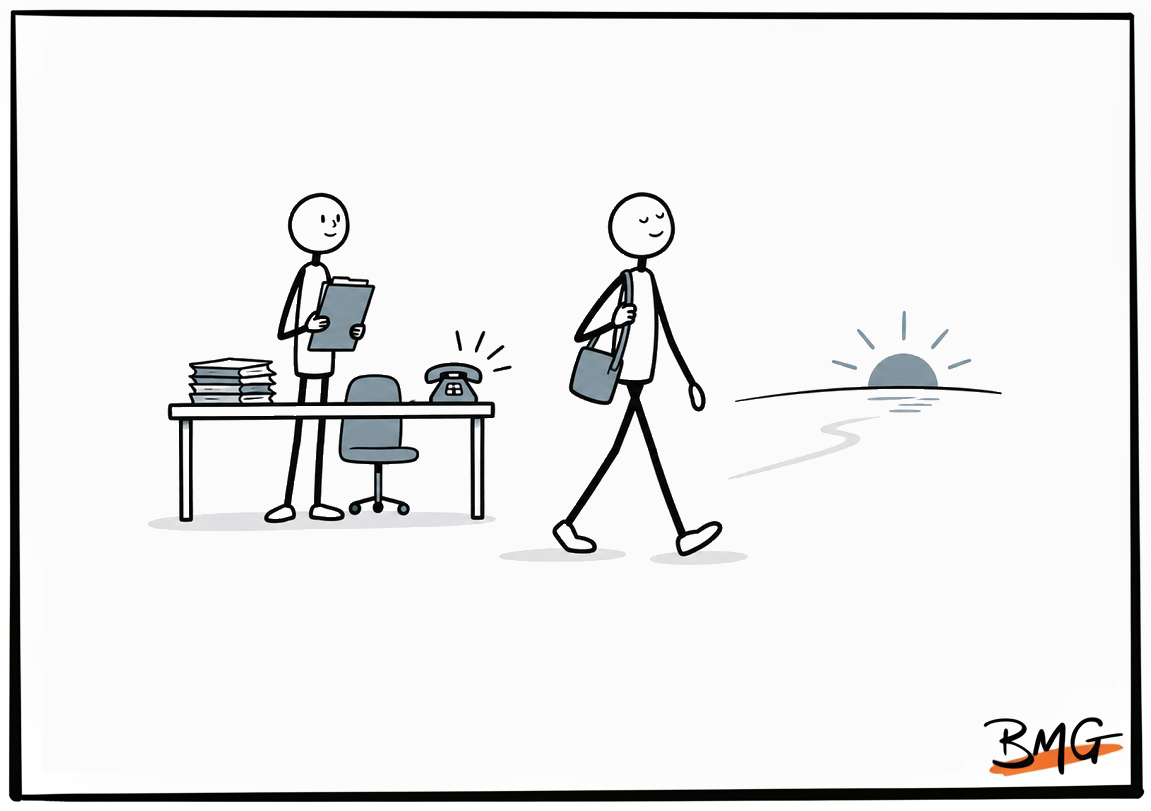
I've just taken a proper break.
I don't mean the sort in which you take your laptop because you might need it, check messages in the morning because it only takes a minute, and then congratulate yourself for working from somewhere with better weather. Properly away. Properly unavailable. Properly focused on family and my own well-being.
I found it surprisingly difficult to permit.
There was still work to do... (there is always work to do). There were things that were not quite finished, decisions that could have been made a little earlier and emails that would, in all likelihood, have survived without my immediate attention but had become quite good at suggesting otherwise.
This is the promise many leaders make to themselves: I’ll take a break when things calm down.
It usually arrives while they are looking at a diary that has become a sort of community landfill. Meetings are layered on meetings, somebody needs a decision before lunch and a message marked "quick one" is now entering is second hour.
Of course, things don't calm down. There is always another decision, another person who needs something, another issue presenting itself as urgent because it has arrived late. The list doesn't finish... it changes shape.
So rest becomes a reward, deferred until some imaginary point at which the work is complete, your inbox is empty and everybody is happy. For most leaders, that point doesn't arrive.
The Small Virtue Of Being Needed
There is a little status attached to being permanently needed. We may not say it out loud, but many of us know the feeling. Someone checks before deciding. A problem appears in our inbox. We're copied in because, apparently, the whole thing would be safer with our name sitting quietly at the top of the thread (or very often, someone thinks is some kind of mystic queue-jumping pass).
At first, it can feel like evidence of usefulness.
Sometimes it is. Leadership does involve judgement, responsibility and being present when it matters. I'm not arguing for an elaborate form of absence in which people are left to discover, by trial and error, whether you still work there.
But! There is a difference between being needed for the decisions that genuinely require you and becoming the person through whom every small piece of work must pass. One is responsibility. The other can become a habit, shared by the leader and the team, in which nobody quite trusts themselves to move without the leader's blessing.
The sad fact is that as the leader, you very often help create it.
We answer too quickly. We quietly repair work rather than returning it. We turn a question into an answer before the other person has had time to think. We say we're saving time, and in that moment perhaps we are. Over time, we're teaching people where the thinking lives.
Then, when we try to step away, the system reflects the lesson back to us.
The reason your phone feels indispensable because we have trained the work to wait for it.
A Break Is Not A Test Your Team Must Pass
There is an unhelpful version of this idea that says a proper holiday is a leadership test. Go away for two weeks and see whether everything collapses. If it does, you have failed to delegate.
I don't find that especially useful.
Most teams are operating with real pressures, imperfect handovers, changes in people and work that can't simply be put in a drawer because somebody has finally taken leave. A difficult week while you're away isn't proof that the team is weak or that you should have stayed.
It is information.
If people need you for every decision, that may point to unclear ownership. If they hesitate because they don't know what good looks like, that may point to a standard that lives more in your head than in the work. If the same question keeps returning, it may be a sign that the process has been relying on your memory rather than a shared rhythm.
None of this means you cancel the break and return to the rescue. It means you notice the pattern when you come back, and decide what is worth changing.
That, to me, is the distinction. A proper break isn't abandoning responsibility. It's refusing to confuse your permanent availability with responsible leadership.
A quick pause
If this is helpful, my free guide goes deeper, and the newsletter brings ideas like this twice a week.
My book, High-Fidelity Leadership, explores these same themes in more depth, with practical frameworks for standards, clarity, and the conversations that leaders avoid for too long.
The Part We Don't Notice When We're Too Close
Recovery research is rather less glamorous than the language we sometimes use around it. It doesn't suggest that a week away repairs a poorly designed organisation, makes an unreasonable workload reasonable or resolves the difficult conversation you've been avoiding since March.
It does support a simpler point: people need opportunities to recover from the demands that have been pulling at them. One important part of that is psychological detachment, the ability to stop carrying work around in your head for a while.
That is harder than putting on an out-of-office message.
You can be physically elsewhere and still be standing in the meeting room, rehearsing the thing you should have said or wondering whether the project has gone quiet for a worrying reason. You can be on a beach while your mind is methodically opening old tabs.
I don't think the answer is to become very good at relaxation. That sounds like another task with a slightly nicer soundtrack. The better question is whether we've built a way of working that gives us any chance of leaving it.
Do people know who decides? Do they understand the standard? Is there a place for a risk to be raised before it becomes a crisis? Can somebody make a good enough call without waiting for the person who normally makes every call?
Those aren't holiday questions. They're leadership questions that a holiday can make more difficult to ignore.
What The Distance Reveals
Distance doesn't always provide a grand insight. Sometimes it provides a slightly better night's sleep and the welcome discovery that nobody required your thoughts on a Tuesday afternoon. That's not nothing.
It can also make some things clearer.
What didn't need your attention after all? What was genuinely waiting for you, rather than merely appearing in your line of sight? Where did somebody step up when there was room to do so? What piece of work has been taking up more space in your mind than it deserves?
And perhaps the least comfortable question: where have you made yourself necessary because it is easier than changing the system around you?
I ask that carefully. Leaders are often carrying a great deal, and sometimes there is no neat organisational redesign waiting on the other side of a difficult fortnight but it is worth noticing the moments when our helpfulness has become a way of keeping control, or when our reliability has quietly relieved other people of theirs.
There is a cost to that. The leader becomes tired. The team becomes cautious. The work slows down around the very person everyone assumes is making it move faster.
Rest Before The Work Is Finished
We understand maintenance everywhere else. We service the things we depend on. We build in redundancy. We don't run a system at its absolute limit and call it a sign of commitment.
Yet leaders are often expected to operate continuously, as though the person doing the role has no need for recovery. Then we wonder why people become brittle, short-tempered, indecisive or oddly detached from the people sitting in front of them.
I don't think rest makes somebody virtuous. Nor is a break a universal answer to exhaustion, bad management or work that needs to change. Sometimes the right action is to address the workload, ask for help, set a boundary or have the difficult conversation we've been postponing.
But rest isn't the reward for accomplishing all of that perfectly.
It's part of having enough judgement to see what needs doing next.
The work will still be there when you return. Some of it will turn out to matter. Some of it will have resolved without you. A few things may need a proper conversation, and perhaps you will now have the energy to have it.
The break I have just taken was about rest. What comes next is a different kind of boundary.
I'm stepping back from regular public activity for a while to complete the final polish and publishing work on High-Fidelity Leadership. It's close enough now to deserve proper attention, rather than being squeezed between work, coaching, posts, emails and the useful-looking noise of constant presence.
This isn't a disappearance, and it isn't an attempt to be mysterious. My book won't be ready until it's ready, and I won't pretend otherwise... but I'll return when I have something real to share.
For now, I'm choosing fewer visible things and one important piece of work done properly.
That seems a better use of leadership than proving, once again, that you were never allowed to leave.
The path to extraordinary is walked with a thousand small steps, you’re doing great!

Barry Marshall-Graham
Executive coach and leadership advisor
Get the Difficult Conversations Guide
A practical resource for leaders who want to say the thing that needs saying, without burning bridges or avoiding the moment.
Keep reading
31 August 2026
The Sentence They Nearly Said
A pause or changed expression may lead to the useful part of a conversation, but noticing it doesn't give the coach permission to decode it.
24 August 2026
You Cannot Coach Someone You Are Secretly Judging
Second-hand information may be useful, but once it becomes a character verdict it changes the leader’s listening, questions and tone.
17 August 2026
A Good Question Can Be Badly Timed
The wording may be excellent, but a coaching question can still arrive before the relationship or the moment is ready to carry it.
10 August 2026
Whose Goal Is It Anyway?
A goal can be strategically sensible and still feel unowned. The answer is honest internalisation, not coaching somebody into believing it was their idea.
3 August 2026
The Leader Who Uses Coaching to Avoid Leading
Coaching can create room for another person to think, but it can also help a leader postpone the feedback, standard or decision that belongs to them.
27 July 2026
Advice Wearing a Hat
A coaching question can sound wonderfully curious while quietly steering somebody towards the answer their leader already prefers.
20 July 2026
The Emotional Cost of Being the Reliable One
Reliability earns trust, but it can also turn one capable leader into the place where unfinished work, uncertainty, and organisational risk accumulate.
13 July 2026
The Relief of Finally Saying the Thing
An overdue conversation occupies far more space than the words themselves. Relief begins when reality is finally allowed back into the room.
6 July 2026
The Sideways Shove
Peer conflict cannot be solved with the Manager Card. Influence begins when leaders stop pushing across borders and repair the working relationship.
29 June 2026
Clarity Under Pressure
Authority is tested when the room tightens. Clear leaders make reality, uncertainty, and the next decision visible without adding drama.