Before You Call It Drift
1 June 2026
Before naming underperformance, leaders need to check whether the system made success clear, possible, and properly supported.
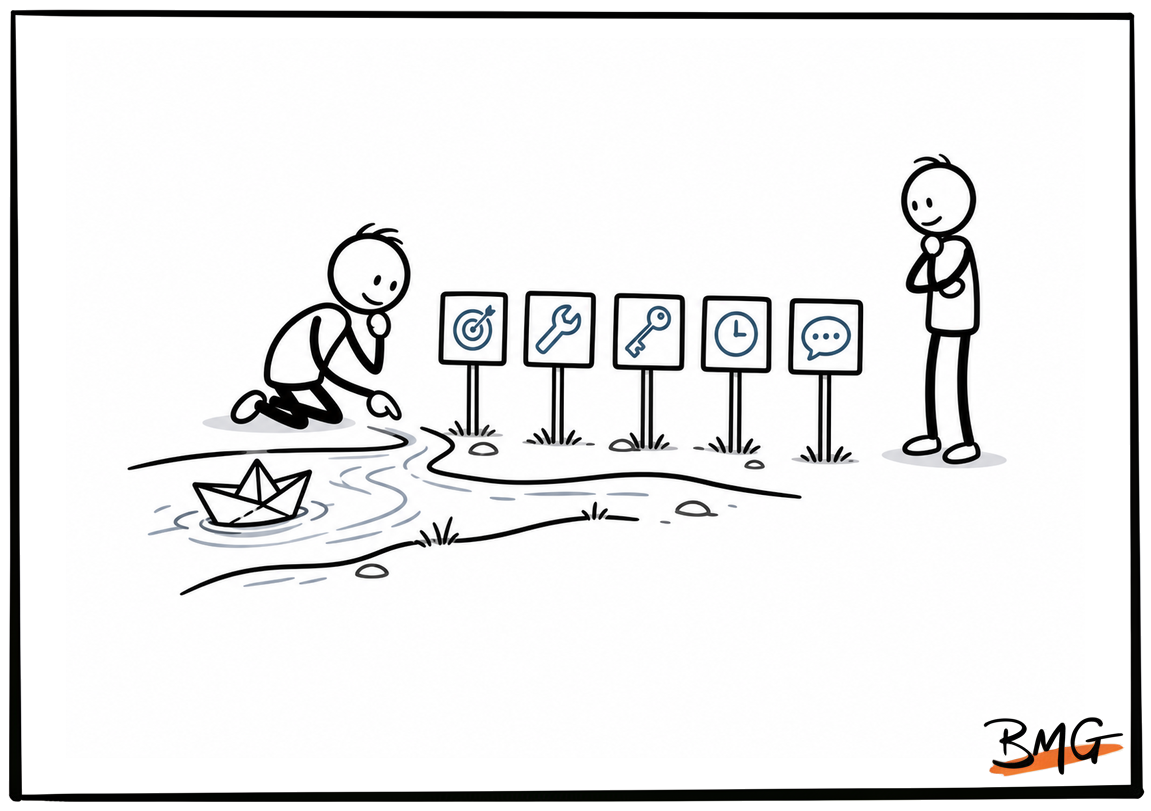
Before you call something drift, check whether you have made success possible.
That sentence sounds simple. It is also one of the most useful protections against poor leadership conversations.
When a team member starts missing the mark, the temptation is to move quickly to character. They are coasting. They have lost focus. They are not taking ownership. They are not senior enough. They need to step up. Some of those interpretations may eventually prove true, but they are not the place to begin.
Begin with the system.
Has the expectation been made explicit? Did they have the tools, context, authority, time, and access required to succeed? Was the workload feasible, or did the organisation quietly create an impossible job and then call the struggle a performance issue? Was good defined clearly enough, or was the person expected to infer it from a half-remembered conversation three weeks ago?
These questions matter because underperformance is not always personal drift. Sometimes it is a management gap wearing the clothes of a people problem.
That does not mean leaders should avoid difficult conversations. It means they should enter them cleanly. If you have not checked the operating conditions, your feedback may be accurate and unfair at the same time.
High-fidelity leadership is direct. It is also responsible.
The Problem
Leaders often wait too long to address underperformance, then arrive with too much certainty.
They have watched the pattern for weeks. The work is late or incomplete. The updates are vague. The person who used to be reliable now needs chasing. The team has started compensating quietly. By the time the leader speaks, the private story has hardened.
The danger is that hardened stories make poor questions.
Instead of asking, what is happening here?, the leader asks a question that already contains the answer. Why are you not taking ownership? Why has your quality dropped? Why do I keep having to chase this? These may sound like questions, but they often land as verdicts.
Sometimes the verdict is deserved. Sometimes the leader has missed something important.
The person may be working with unclear priorities. They may have inherited a broken process. They may be waiting on a dependency they do not have the authority to move. They may be trying to satisfy three stakeholders who have given conflicting definitions of success. They may be overloaded and embarrassed to say so. They may also be avoiding responsibility.
You do not know which until you check.
This is not softness. It is accuracy.
The Reframe
The drift conversation should begin as a diagnostic, not a sentencing.
That does not mean you speak vaguely. It means you hold two truths at once. The current pattern cannot continue, and you may not yet fully understand what is driving it. That combination gives you a stronger conversation than either blunt accusation or over-soft concern.
The opening can be clear:
I want to talk about a pattern I am seeing. The last two handovers have needed significant rework, and the dates have moved twice. Before we decide what needs to change, I want to understand what is getting in the way.
That sentence names the issue. It does not diagnose the person.
This matters because people can engage with facts more easily than labels. If you say, you are not taking ownership, the conversation is likely to become a debate about identity. If you say, this action has moved twice without a clear next step or owner, the conversation has somewhere practical to go.
The reframe is not to lower the standard. It is to raise the quality of diagnosis.
When leaders check the system first, they earn the right to be clearer about the behaviour. If the expectation was vague, tighten it. If the support was missing, provide it. If the workload was impossible, renegotiate it. If those conditions are in place and the pattern continues, the conversation can become more direct without becoming unfair.
Supportive candour starts with clean facts.
A Recognisable Workplace Moment
It is Monday morning and the weekly planning call has the tired energy of a team that is pretending the backlog is more stable than it is.
Alex, one of your team leads, gives an update on the reporting migration. The work was due last Friday. It now looks like Wednesday, possibly Thursday. The phrase a few moving parts appears three times. You feel your shoulders tighten because this is not the first slippage. Two other people have already started building contingency plans around Alex's uncertainty.
Your private story starts quickly.
Alex is drifting.
Alex is avoiding the hard bit.
Alex needs to get a grip.
Then you notice something in the notes. The reporting migration depends on input from Finance, but the Finance owner changed two weeks ago. Product has also added a late requirement. The original date was set before either issue was visible. Alex may still be managing the work poorly, but the conditions are not clean.
This is the leadership fork in the road.
One path is frustration with a script. We need you to take ownership and stop letting this slip.
The other path is diagnosis with a standard. This has moved twice now, and we need to stop the date drifting. I also want to separate the real blockers from the ownership piece. What is outside your control, what is inside it, and what commitment can we make from here?
The second version is more demanding, not less. It refuses to let either person hide. The team member cannot simply point to complexity. The leader cannot simply point to attitude. Together, they have to sort the work into facts, blockers, ownership, and next commitments.
That is where the useful conversation lives.
A quick pause
If this is helpful, my free guide goes deeper, and the newsletter brings ideas like this twice a week.
My book, High-Fidelity Leadership, explores these same themes in more depth, with practical frameworks for standards, clarity, and the conversations that leaders avoid for too long.
The Five Checks
Before you name drift, run five checks.
First, expectation. Was the outcome explicit enough that a reasonable person could know what good looked like? Many leaders think they have been clear because the outcome is obvious to them. Obvious to you is not the same as explicit to the team.
Second, capability. Does the person have the skill, context, and judgement required for this work? If the answer is no, the conversation may be about development, not drift. That still matters, but it changes the tone and the support required.
Third, authority. Are they being asked to own an outcome without the authority to move the dependencies? This is common in matrix organisations. A person can look passive when they are actually under-powered.
Fourth, capacity. Is the workload feasible? Leaders sometimes create impossible conditions, then get irritated when people operate with visible strain. Capacity does not excuse poor ownership, but it may explain why the pattern is appearing.
Fifth, feedback history. Have you already named the issue, or has the person been expected to read your disappointment through silence, shorter messages, and subtle changes in tone?
These checks do not let people off the hook.
They put the hook in the right place.
If the system is unclear, fix the system. If support is missing, provide it. If authority is mismatched, renegotiate it. If expectations were clear and the person still avoids ownership, then say so. The clarity becomes stronger because the diagnosis is cleaner.
What Leaders Get Wrong
The most common mistake is to confuse compassion with lowering the bar.
Leaders hear check the system first and worry that it sounds too soft. They imagine endless excuses, diffuse accountability, and conversations where nobody owns anything because everything is contextual. That is not the point.
The point is to remove bad ambiguity.
Once the real conditions are named, the standard can become sharper. You might say: Given the dependency with Finance, the date needs to move. Given the repeated lack of a clear owner, the ownership standard also needs to change. From now on, when a dependency blocks you, I expect you to name the blocker, the ask, and the escalation path within twenty-four hours.
That is much stronger than a vague step up conversation.
Another mistake is to hold the system checks privately and never move to expectation. Some leaders become so aware of context that they lose the standard. They can explain every slip, empathise with every blocker, and understand every pressure, but the team still needs the work to land.
Understanding is not the same as accepting.
The leader's job is to understand enough to make the next commitment honest.
Personal Reflection
I have become increasingly wary of the phrase they just need to own it.
Sometimes it is true. There are moments when a person is genuinely avoiding responsibility and needs a clear reset. But the phrase can also become a shortcut that saves the leader from examining the conditions around the work. I have used versions of it myself when I was frustrated and wanted the issue to be simpler than it was.
The more useful question is usually: What would ownership look like in this system, with these dependencies, this authority, and this level of clarity?
That question often reveals the real problem. Sometimes the person needs to change their behaviour. Sometimes I need to change the way the work is framed. Often both are true.
The conversations that go best are the ones where I arrive with enough clarity to name the pattern and enough humility to test my assumptions. That is a better posture than certainty. It is also harder, because it requires me to give up the temporary relief of blaming a person before I have understood the system.
Reflection Prompts
Where have I labelled something drift before checking the operating conditions?
Have I made the expectation explicit enough for the person to succeed?
Is this person underperforming, under-supported, under-powered, overloaded, or avoiding ownership?
What part of this pattern belongs to the person, and what part belongs to the system I lead?
Where have I expected someone to read my disappointment instead of receiving clear feedback?
What standard can I reset after the diagnostic is cleaner?
Final Thought
Before you call it drift, check the ground underneath the person.
If the ground is unstable, stabilise it. If the expectation is unclear, define it. If the authority is missing, renegotiate it. If the support is absent, provide it. And if, after that, the pattern continues, have the direct conversation. It will be clearer, fairer, and harder to dismiss because you have done the work of diagnosis first.
The path to extraordinary is walked with a thousand small steps, you’re doing great!
Your Small Steps
What should I check before calling something drift?
Check expectation, capability, authority, capacity, and feedback history. These five checks help you separate a behavioural issue from a system or management gap.
Small Step: Write the five checks down before the conversation and give each one a simple yes, no, or unsure.
What if I realise I was not clear enough?
Own it without over-apologising. You can take responsibility for the lack of clarity and still set a firmer expectation from here.
Small Step: Say: I realise I was not explicit enough about what good needed to look like. Let me correct that now.
How do I avoid sounding accusatory?
Start with the observable pattern and ask what is getting in the way. Avoid labels such as lazy, passive, careless, or disengaged.
Small Step: Use: The pattern I am seeing is... Help me understand what is driving it.
What if they point to blockers outside their control?
Separate blocker ownership from outcome ownership. A real blocker may change the plan, but it should not remove the need to name the ask, escalation path, and next commitment.
Small Step: Ask: What is outside your control, what is inside it, and what escalation do you need from me?
What if capacity is genuinely the issue?
Then renegotiate the work honestly. Pretending capacity is fine when it is not creates false commitments and future blame.
Small Step: Ask them to identify what must stop, move, or be reduced for the commitment to become credible.
When should the conversation become more direct?
Once the operating conditions are clear and the pattern continues, directness is fair. You can say that the support is in place and the standard now needs to be met.
Small Step: Say: We have clarified the expectation and the support. The next thing I need to see is...
What if I have been compensating for them?
Name the compensation loop. If you have been fixing, polishing, chasing, or translating their work, the person may not fully understand the gap.
Small Step: Stop making the quiet fix once and turn it into a specific feedback conversation.
How do I make the next commitment honest?
Define the owner, the action, the date, and the review point. Honest commitments are observable. Vague commitments are invitations to drift.
Small Step: End the conversation with: Who owns what by when, and when will we review whether it worked?

Barry Marshall-Graham
Executive coach and leadership advisor
Get the Difficult Conversations Guide
A practical resource for leaders who want to say the thing that needs saying, without burning bridges or avoiding the moment.
Keep reading
31 August 2026
The Sentence They Nearly Said
A pause or changed expression may lead to the useful part of a conversation, but noticing it doesn't give the coach permission to decode it.
24 August 2026
You Cannot Coach Someone You Are Secretly Judging
Second-hand information may be useful, but once it becomes a character verdict it changes the leader’s listening, questions and tone.
17 August 2026
A Good Question Can Be Badly Timed
The wording may be excellent, but a coaching question can still arrive before the relationship or the moment is ready to carry it.
10 August 2026
Whose Goal Is It Anyway?
A goal can be strategically sensible and still feel unowned. The answer is honest internalisation, not coaching somebody into believing it was their idea.
3 August 2026
The Leader Who Uses Coaching to Avoid Leading
Coaching can create room for another person to think, but it can also help a leader postpone the feedback, standard or decision that belongs to them.
27 July 2026
Advice Wearing a Hat
A coaching question can sound wonderfully curious while quietly steering somebody towards the answer their leader already prefers.
20 July 2026
The Emotional Cost of Being the Reliable One
Reliability earns trust, but it can also turn one capable leader into the place where unfinished work, uncertainty, and organisational risk accumulate.
13 July 2026
The Relief of Finally Saying the Thing
An overdue conversation occupies far more space than the words themselves. Relief begins when reality is finally allowed back into the room.
6 July 2026
The Sideways Shove
Peer conflict cannot be solved with the Manager Card. Influence begins when leaders stop pushing across borders and repair the working relationship.
29 June 2026
Clarity Under Pressure
Authority is tested when the room tightens. Clear leaders make reality, uncertainty, and the next decision visible without adding drama.