When A Promise Breaks Twice
15 June 2026
A broken promise is not only a missed deadline. When it repeats, it changes how much trust the team can safely place in a commitment.
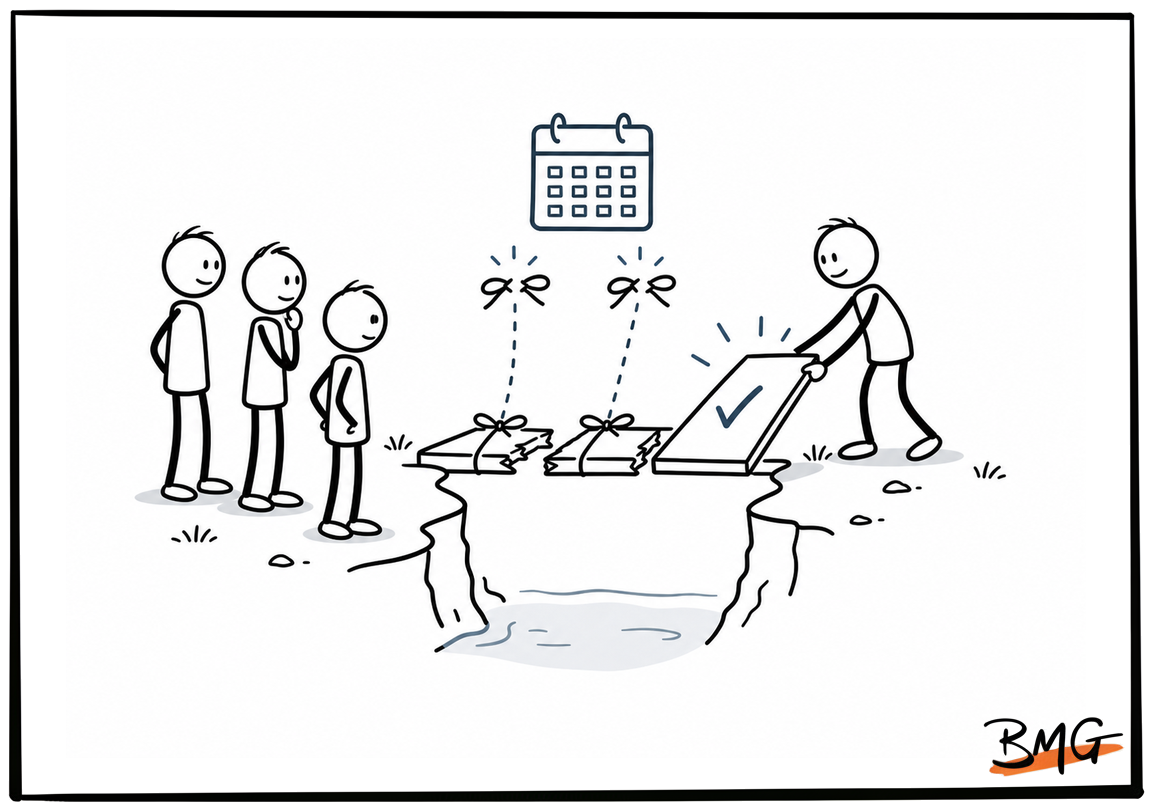
The first broken promise may be a mistake.
The second one is information.
That does not mean the person is careless, unreliable, or acting in bad faith. Life happens. Work changes. Dependencies move. People overestimate, underestimate, forget, freeze, or say yes too quickly because they want to be helpful.
But when a promise breaks twice, the leadership conversation has to change.
It is no longer only about the missed deadline, the delayed handover, or the action that did not happen. It is about whether the team can trust a commitment when it is made. That is a deeper issue than timing. Reliability is part of the operating fabric of a team. When it weakens, everyone starts building their own private safety systems.
They add buffer. They double-check. They create shadow trackers. They stop believing dates until they see the work. They ask for updates that should not need asking for. They route around the person, sometimes politely, sometimes resentfully.
This is how repeated broken promises become expensive.
The visible cost is delay.
The hidden cost is the collapse of confidence in the next commitment.
The Problem
Leaders often treat repeated broken promises as scheduling issues for too long.
The date moved, so they ask for a new date. The action slipped, so they ask for an update. The person apologises, offers a plausible explanation, and recommits. Everyone moves on because the meeting is already running late.
Then it happens again.
At that point, the issue is no longer only the thing that slipped. The issue is the reliability of the promise-making process. How is the person deciding what they can commit to? What do they do when a commitment becomes unsafe? When do they alert others? Do they understand the downstream cost of a missed promise, or do they treat it as a private inconvenience?
A broken promise rarely stays private.
Someone else planned around it. Someone else held a dependency. Someone else reassured a stakeholder. Someone else chose not to escalate because they believed the commitment. When that promise breaks, those people carry the awkwardness too.
This is why the conversation needs to happen earlier than many leaders want.
If reliability is not named, the team will solve it informally. That usually means lower trust, more checking, more meetings, and a culture where every commitment comes with a silent asterisk.
A Recognisable Workplace Moment
It is Friday at 3:15 PM. The steering group update goes out at 5:00 PM. Priya promised the revised implementation timeline by lunchtime. It has not arrived.
This is the second time.
The first time, there was a genuine dependency. Legal had not responded, and the change request was more complex than expected. You accepted the explanation because it sounded reasonable and because Priya is capable. You said, No problem, just make sure we have it by Friday lunch.
Now Friday lunch has passed.
You send a message: Any update on the timeline?
Fifteen minutes later, Priya replies: Sorry, nearly there. Just sanity-checking a couple of points.
You feel that familiar mix of irritation and concern. The content may arrive in time. You may still get the update out. But trust has shifted. The promise was not only to send a document. It was to protect everyone else from having to wonder.
You now have a choice.
You can take the file when it arrives, say thanks, and privately mark Priya as someone who needs chasing.
Or you can have the reliability conversation.
Not a dramatic one. Not a character attack. A clear conversation about what a promise means, what needs to happen when it becomes unsafe, and how the team will rebuild confidence from here.
The Reframe
Reliability is not the absence of slippage.
Reliable people still miss dates sometimes. They still get surprised by complexity. They still have bad weeks. What makes them reliable is not perfection. It is how they handle the moment a commitment becomes unsafe.
They tell people early. They name the risk. They renegotiate before the promise breaks. They do not make others discover the slippage by chasing. They understand that a commitment is part of a wider system, not a private intention.
That is the reframe.
The broken promise conversation should focus less on the apology and more on the promise process.
Many leaders stop at the apology because it feels polite. The person says sorry. They look sincere. The leader does not want to pile on. So the conversation ends at remorse, and the same pattern repeats because the operating behaviour has not changed.
Remorse is not a repair plan.
The repair plan needs to answer three questions:
What made the promise unsafe?
When did you know?
What will you do differently next time so others are not left guessing?
Those questions move the conversation from guilt to reliability.
The Conversation To Have
Start by separating intent from impact.
I am not questioning your intent. I do need to talk about the impact of this commitment moving twice.
That line matters because repeated broken promises often trigger identity defence. The person hears you are unreliable even when you are trying to say this pattern is making reliability harder for the team. If you can lower the identity threat without lowering the standard, the conversation has a better chance of becoming useful.
Then name the pattern:
You committed to the timeline by Wednesday, then by Friday lunchtime. Both moved, and each time the team had to chase or adjust around the delay.
Name the cost:
The impact is that people cannot plan confidently around your dates, even when the work eventually lands.
Ask the process question:
When did you first know Friday lunchtime was at risk?
Then reset the expectation:
From now on, if a commitment becomes unsafe, I need you to flag it early, name the reason, and propose a revised commitment before the deadline passes.
This is not complicated. It is also not always easy, because reliability conversations touch pride. People like to think of themselves as dependable. When you name a reliability pattern, you are touching something closer to identity than a single missed task.
That is why the tone needs to be calm and the facts need to be clean.
A quick pause
If this is helpful, my free guide goes deeper, and the newsletter brings ideas like this twice a week.
My book, High-Fidelity Leadership, explores these same themes in more depth, with practical frameworks for standards, clarity, and the conversations that leaders avoid for too long.
What Leaders Get Wrong
The first mistake is accepting apology as resolution.
An apology can be sincere and still leave the system unchanged. The person may feel bad and still not have a better way of making, monitoring, and renegotiating commitments. If you stop at sorry, you may get warmth without reliability.
The second mistake is overcompensating privately. Leaders start checking earlier, adding buffers, or assigning a shadow owner. That may protect the work in the short term, but it also teaches the person that reliability will be managed around them rather than with them.
The third mistake is making the next commitment too vague. Please keep me posted is not a reliability reset. It is a hope with polite wording. A stronger reset defines the trigger for escalation: If the date is at risk by more than twenty-four hours, tell me as soon as you know, with the new date and the decision you need.
The fourth mistake is failing to repair trust visibly enough. If other people have been affected, there may need to be a broader reset. Not a public shaming. A practical update: what changed, what the new commitment is, and how the risk will be managed.
Trust is rebuilt by repeated evidence.
That means the next promise matters more than the next apology.
The Morning After
After the conversation, do not hover.
Hovering feels like control and communicates distrust. Abandonment is not helpful either. The middle path is a clear review rhythm. Agree what the person will send, when they will send it, and what risk trigger requires earlier escalation.
Then let them meet the commitment.
This is how reliability is rebuilt: not through speeches, but through clean commitments kept in public view. The leader's job is to make the next evidence visible enough for trust to start returning.
If the next commitment is kept, say so. That update landed when agreed and gave the team what they needed. Thank you. This is not empty praise. It reinforces the repair behaviour.
If it slips again, the conversation escalates because the pattern has continued after a clear reset. At that point, the issue may be capability, judgement, capacity, or willingness. But now the ground is cleaner. You named the pattern, reset the expectation, and gave the person a fair chance to rebuild reliability.
Personal Reflection
I find broken promise conversations harder than quality conversations.
With quality, you can usually point to the work. With reliability, you are pointing to the space between words and action. That can feel more personal, even when you are trying to stay practical.
I have also noticed my own temptation to protect capable people from reliability feedback because I know they care. If someone is sincere, stretched, and apologetic, it can feel unkind to press the point. But sincerity does not remove the downstream cost. In some cases, the kindest thing is to help the person see that their good intent is not enough for the system to trust their commitments.
The best version of this conversation is not you broke trust and now I am disappointed. It is we need to repair the way commitments are made and protected here.
That gives the person something to do with the feedback.
Reflection Prompts
Where has a missed promise become a reliability pattern rather than a scheduling issue?
Whose work becomes harder when this commitment moves?
Am I accepting apology as resolution?
When did the person know the promise was unsafe, and what happened next?
What trigger should require earlier escalation next time?
What evidence would rebuild trust in the next commitment?
Final Thought
When a promise breaks twice, do not only ask for a new date.
Ask how the promise was made, when it became unsafe, and what will change before the next commitment is given. Reliability is not built by perfect people. It is built by people who know how to protect others from preventable surprise.
The path to extraordinary is walked with a thousand small steps, you’re doing great!
Your Small Steps
When does a missed deadline become a broken promise issue?
It becomes a broken promise issue when others planned around the commitment and the person did not renegotiate early enough. The key issue is not only timing. It is the reliability of the commitment.
Small Step: List who was affected by the missed commitment before you have the conversation.
What if the person had a good reason?
A good reason matters, but it does not remove the need to manage the promise. The conversation should include both the reason and the expectation for earlier signalling next time.
Small Step: Ask: When did you first know the commitment was at risk?
How do I avoid making it personal?
Separate intent from impact. Make clear that you are addressing the commitment pattern, not judging their character.
Small Step: Open with: I am not questioning your intent. I do need to talk about the impact of this commitment moving twice.
What should a reliability reset include?
It should include the pattern, the impact, the trigger for earlier escalation, and the next observable commitment. Without those, the conversation may end with apology rather than repair.
Small Step: Agree one clear trigger: If the date is at risk by more than X, you tell Y by Z.
What if I have started chasing them automatically?
That is a sign trust has already shifted. Chasing may protect the work, but it also hides the reliability conversation.
Small Step: Say: I notice I have started chasing this before the date. That tells me we need to reset how commitments are being managed.
Should the repair happen publicly?
The feedback conversation is usually private. The repair may need to be visible if others were affected. Visibility does not mean blame. It means the team can trust the new commitment.
Small Step: Ask the person to send a clear update naming the revised date, owner, and risk control.
What if the next promise breaks too?
If the pattern continues after a clear reset, the conversation needs to escalate. The issue may be capacity, capability, judgement, or willingness, but it should not remain vague.
Small Step: Document the agreed reset and review the next commitment against it.
How is trust rebuilt?
Trust is rebuilt through repeated evidence. A sincere apology helps, but kept commitments do the heavier work.
Small Step: When the next commitment is kept, acknowledge the behaviour specifically.

Barry Marshall-Graham
Executive coach and leadership advisor
Get the Difficult Conversations Guide
A practical resource for leaders who want to say the thing that needs saying, without burning bridges or avoiding the moment.
Keep reading
31 August 2026
The Sentence They Nearly Said
A pause or changed expression may lead to the useful part of a conversation, but noticing it doesn't give the coach permission to decode it.
24 August 2026
You Cannot Coach Someone You Are Secretly Judging
Second-hand information may be useful, but once it becomes a character verdict it changes the leader’s listening, questions and tone.
17 August 2026
A Good Question Can Be Badly Timed
The wording may be excellent, but a coaching question can still arrive before the relationship or the moment is ready to carry it.
10 August 2026
Whose Goal Is It Anyway?
A goal can be strategically sensible and still feel unowned. The answer is honest internalisation, not coaching somebody into believing it was their idea.
3 August 2026
The Leader Who Uses Coaching to Avoid Leading
Coaching can create room for another person to think, but it can also help a leader postpone the feedback, standard or decision that belongs to them.
27 July 2026
Advice Wearing a Hat
A coaching question can sound wonderfully curious while quietly steering somebody towards the answer their leader already prefers.
20 July 2026
The Emotional Cost of Being the Reliable One
Reliability earns trust, but it can also turn one capable leader into the place where unfinished work, uncertainty, and organisational risk accumulate.
13 July 2026
The Relief of Finally Saying the Thing
An overdue conversation occupies far more space than the words themselves. Relief begins when reality is finally allowed back into the room.
6 July 2026
The Sideways Shove
Peer conflict cannot be solved with the Manager Card. Influence begins when leaders stop pushing across borders and repair the working relationship.
29 June 2026
Clarity Under Pressure
Authority is tested when the room tightens. Clear leaders make reality, uncertainty, and the next decision visible without adding drama.