The Evidence Trap: When Proof Becomes Delay
18 May 2026
Leaders do not always need more evidence. Often they need to decide what signal is enough to ask a fair question before the fireball arrives.
There is a sentence that sounds responsible and often hides avoidance:
I just need a bit more evidence before I say anything.
Sometimes that sentence is exactly right. If the issue is sensitive, formal, legal, medical, personal, or potentially discriminatory, you absolutely need care, process, documentation, and the right advice. Leadership is not a licence to improvise around serious matters.
But in ordinary leadership work, that sentence can become a hiding place because the leader has never decided the proof threshold.
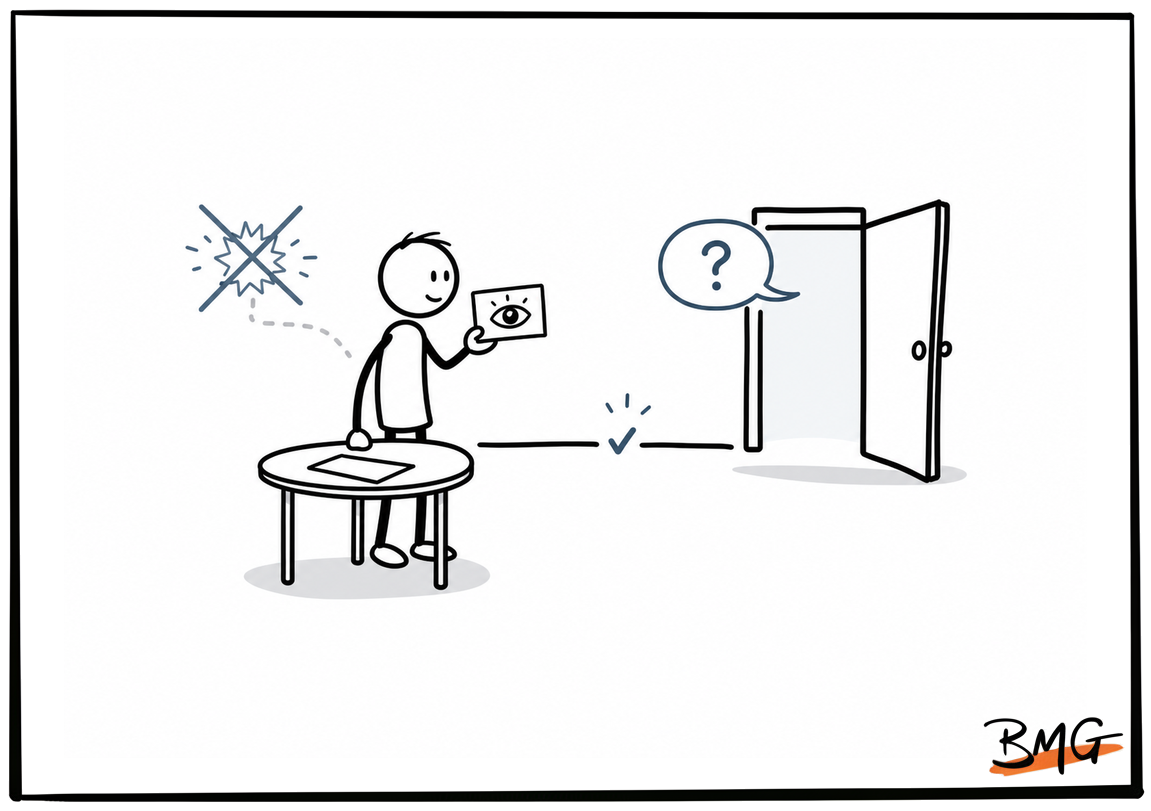
The proof threshold is the point at which a signal becomes enough to ask a fair question. Not enough to accuse. Not enough to deliver a verdict. Enough to bring reality into the room while the issue is still small enough to work with.
You have seen the missed deadline. You have noticed the quality dip. You heard the sarcastic comment in the meeting. You watched the project owner give the same vague update twice. You know enough to ask a clean question, but you tell yourself you need more data. One more example. One more meeting. One more week to see if the pattern resolves itself.
This is the evidence trap.
It happens when a leader raises the standard of proof so high that ordinary management signals are no longer enough to justify a conversation. Instead of deciding what signal would be enough to ask a clean question, the leader waits for the fireball: the undeniable incident, the public failure, the visible consequence that finally makes intervention feel socially safe.
The cost is predictable.
By the time the evidence feels undeniable, the issue is no longer small. The team has adapted around it. The person has been allowed to repeat the behaviour. The leader has built a private case file. The conversation now carries the weight of delay, frustration, and surprise.
Fairness matters. So does timing.
The mistake is confusing fairness with silence.
Fairness does not require you to wait until the other person can no longer disagree. It requires you to speak from what you can observe, leave room for what you do not know, and make the standard clear before the issue becomes a public problem.
What’s Really Happening
The evidence trap often begins with a good intention.
You do not want to overreact. You do not want to accuse someone unfairly. You do not want to mistake a bad week for a pattern, or a communication wobble for a character flaw. Those instincts are healthy. They slow down the part of leadership that can become punitive when it is tired, pressured, or embarrassed.
The problem comes when caution loses contact with reality.
In many workplaces, the leader does not need a court-ready case. They need enough specific observation to open a conversation. A conversation is not a verdict. It is not a prosecution. It is not a performance label stamped on someone's forehead. It is a way of bringing reality into the room while there is still room to respond.
That is why the proof threshold matters. If you do not decide it consciously, your discomfort will decide it for you. The threshold will keep moving away from you. One example will become two. Two will become a pattern. The pattern will become a private file. The private file will become frustration. By then, the conversation is no longer just about the work. It is carrying the emotional backlog created by delay.
This distinction matters because leaders often delay until the issue becomes impossible to misunderstand. They want the facts to be so clear that the other person cannot disagree. That desire is understandable, but it is also a trap. If you wait until disagreement is impossible, you have probably waited too long.
Most meaningful leadership conversations begin in the grey area.
That is why they require skill.
You are not saying, I have completed the investigation and reached a final conclusion. You are saying, I am noticing a pattern and I want to understand what is happening before it becomes heavier. The first is a judgement. The second is leadership.
The evidence trap is seductive because it lets you feel principled while postponing discomfort. It gives avoidance a clipboard.
The Fireball Fantasy
Many leaders are secretly waiting for the fireball.
The fireball is the event that removes ambiguity. The client complains. The deadline is missed publicly. The senior stakeholder forwards the frustrated email. The team member finally says the blunt thing in a room where everyone hears it. Now there is no debate. Now the leader can act without feeling difficult.
The fireball feels useful because it makes the conversation legitimate.
It is also a terrible operating model.
If you wait for the fireball, you outsource leadership timing to the problem. You allow the issue to choose when it becomes visible enough for you to intervene. That means the standard is no longer being managed by you. It is being managed by embarrassment, escalation, and accumulated damage.
In high-fidelity leadership, the aim is to catch signal before it becomes spectacle.
A missed commitment may only need a reset. A vague update may only need a sharper ownership question. A sarcastic aside may only need a calm interruption and a return to the standard. These are small moves. They are available early. They often prevent the future meeting where everyone wonders why nobody said anything sooner.
I have sat with leaders who could describe a pattern in painful detail and then insist they were still not sure they had enough evidence. The irony was obvious to everyone except them. They had enough evidence to lose sleep, enough evidence to warn a colleague privately, enough evidence to rewrite the work themselves, enough evidence to quietly adjust expectations, but somehow not enough evidence to speak directly.
That is the evidence trap at its most expensive.
The leader is already acting on the evidence. They are just acting indirectly.
A Recognisable Workplace Moment
It is Wednesday afternoon. A delivery review is running ten minutes over. The team is tired, and the project manager gives another careful update:
We’re waiting on a few inputs, but the team is across it.
You have heard this before. Last week it was procurement. The week before it was legal. The week before that it was a data dependency. Every update sounds plausible in isolation. None of them is dramatic enough to challenge on its own. But the cumulative effect is that the work keeps moving without moving.
You glance at the action log. The same line has appeared three times with slightly different wording. The owner is named, but ownership is not behaving like ownership. The update is an explanation, not a commitment.
There is a small moment where you can bring the pattern into the room.
I want to pause on this. We have had three versions of this blocker now. What exactly needs to happen next, who owns that move, and what date will tell us whether it has shifted?
That sentence is not an accusation. It is a standard.
But if you are in the evidence trap, your brain starts negotiating. Perhaps the dependencies really are complex. Perhaps the owner is doing more than you can see. Perhaps challenging now will look unfair. Perhaps the team will think you are getting impatient. Better to wait until the next update. Better to see what happens by Friday.
Friday arrives. The issue is still there.
Now you are irritated, which makes the conversation harder to hold cleanly. The facts have not only accumulated. So has your emotional charge.
This is the practical damage of the evidence trap. It turns early neutral questions into later loaded conversations.
A quick pause
If this is helpful, my free guide goes deeper, and the newsletter brings ideas like this twice a week.
My book, High-Fidelity Leadership, explores these same themes in more depth, with practical frameworks for standards, clarity, and the conversations that leaders avoid for too long.
The Reframe
The standard is not certainty. The standard is responsible clarity.
Responsible clarity means you do not guess intent, diagnose personality, exaggerate impact, or pretend you know the whole story. It also means you do not hide from an observable pattern simply because the other person might have context.
You can be specific and provisional at the same time.
That is a powerful combination. Specific means you name what you have seen. Provisional means you leave room for reality you do not yet know. Together, they let you open the conversation without overclaiming.
For example:
I have noticed the same action has moved twice without a clear next owner. I may be missing something, but I want to understand what is making it hard to land.
Or:
The last two client updates needed more rework than I would expect at this stage. Before I assume what is driving that, I want to talk through what good needs to look like from here.
These sentences are not weak. They are fair. They name the signal without pretending it is the whole story.
Leaders sometimes think fairness requires them to wait until they can present an airtight case. In practice, fairness often means speaking early enough that the other person has a genuine chance to respond, correct course, explain constraints, or ask for help before their reputation is quietly damaged.
Delayed clarity can feel kinder in the moment.
Early clarity is often kinder in the outcome.
What To Do Instead
A useful way out of the evidence trap is to separate three things: signal, story, and standard.
Signal is what you have observed. The action moved again. The update is vague. The deck needed rework. The tone in the meeting pulled the room downward.
Story is what you are tempted to conclude. They are coasting. They are avoiding ownership. They do not care. They are being political. They are not ready for the role.
Standard is what needs to be true going forward. Clear ownership. Better quality. Direct challenge in the room. Reliable commitments. No surprises.
Most poor conversations happen because leaders mix those three together. They take a signal, attach a story, and deliver it as if the story is fact. That is what makes people defensive and turns useful feedback into argument.
The cleaner move is to speak from signal and standard, then use curiosity to test the story.
Try this sequence:
Name the signal.
Name why it matters.
Ask what is happening.
Reset the standard.
Agree the next observable move.
That is enough. You do not need a dossier. You need a clean pattern and a constructive purpose.
There is also a self-management move. Before the conversation, ask yourself: What would I say if I were trying to help this stay small?
That question changes the posture. You are no longer trying to win a case. You are trying to prevent avoidable drift.
Personal Reflection
I understand the pull of the evidence trap because it flatters something I like in myself.
I value fairness. I do not want to be the person who jumps to conclusions, overstates a concern, or turns one difficult week into a permanent label. That instinct has saved me from plenty of poor conversations. It has also, at times, given me a very respectable reason to delay a conversation I already knew needed to happen.
The clue, for me, is when I start gathering evidence privately while behaving differently publicly. If I am already adjusting my trust, checking the work more closely, softening expectations, or warning myself not to rely on someone, then I am no longer neutral. I am acting on the evidence inside my head while withholding the conversation that might let the other person respond.
That is not fairness.
It is private judgement.
The better move is usually humbler and cleaner: name what I am seeing, admit what I do not yet know, and invite the other person into the truth while the issue is still small enough to work with.
Reflection Prompts
Where am I waiting for certainty when I already have a useful signal?
What evidence am I acting on privately but not naming directly?
Am I trying to be fair, or am I trying to avoid being disagreed with?
What is the observable pattern, without my story attached?
What standard needs to be reset before the issue becomes heavier?
Where would an early question be kinder than a delayed judgement?
Final Thought
The evidence trap is dangerous because it feels so reasonable. It lets leaders protect their self-image as fair, thoughtful, and measured while the team absorbs the cost of delayed clarity.
You do not need certainty to begin a responsible conversation. You need a specific signal, a clean intent, and enough humility to leave room for what you do not yet know. Speak while the issue is still small enough to be improved, not after it has become impossible to ignore.
The path to extraordinary is walked with a thousand small steps, you’re doing great!
Your Small Steps
What is the difference between evidence and a story?
Evidence is what you can observe or verify. A story is the meaning you attach to it. The deadline moved twice is evidence. They do not care is a story. Keep those separate and the conversation becomes much easier to hold fairly.
Small Step: Write two columns before the conversation: what I know and what I am assuming. Speak from the first column and test the second with curiosity.
How much evidence is enough for an ordinary leadership conversation?
Enough to be specific. You do not need certainty about motive, character, or future behaviour. You need a clear pattern, a material impact, or a gap between expectation and reality.
Small Step: Use this test: can I name one observable pattern and one reason it matters? If yes, you can probably open a conversation.
What if there might be a valid explanation?
There often is. That is why you speak provisionally rather than dramatically. A valid explanation may change the support required, but it does not remove the need to clarify the standard.
Small Step: Start with: I may be missing context, and I want to understand it. The pattern I am noticing is...
What if I am worried about sounding accusatory?
Avoid identity language and stay close to the work. Do not say they are unreliable, careless, political, or disengaged. Say what happened, what it affected, and what needs to be clearer next time.
Small Step: Remove adjectives from your opening sentence. Replace them with observable behaviour.
How do I know I am waiting for the fireball?
You are waiting for the fireball when you already see the pattern but secretly hope for a future incident that will make the conversation easier to justify. That is usually a sign the conversation is overdue.
Small Step: Ask yourself: What would I say now if I were trying to prevent the public failure rather than respond to it?
What if I raised something and it turned out I was wrong?
Then you can acknowledge it and adjust. A well-held conversation leaves room for new information. The risk of being partially wrong is often smaller than the risk of letting a real pattern drift.
Small Step: Use provisional language: This is what I am seeing. Help me understand what I may be missing.
What should I do if the issue is sensitive or formal?
Pause and follow the right process. If there are legal, HR, grievance, safeguarding, discrimination, health, or protected-characteristic concerns, do not rely on a general leadership script. Get appropriate advice and document carefully.
Small Step: Write down the facts and contact the relevant HR or policy owner before speaking informally.
How do I keep the conversation constructive?
Connect the signal to the standard. The purpose is not to prove a point. It is to help the person, the team, and the work return to clearer operating conditions.
Small Step: End by agreeing one visible next move: owner, action, date, or standard.

Barry Marshall-Graham
Executive coach and leadership advisor
Get the Difficult Conversations Guide
A practical resource for leaders who want to say the thing that needs saying, without burning bridges or avoiding the moment.
Keep reading
31 August 2026
The Sentence They Nearly Said
A pause or changed expression may lead to the useful part of a conversation, but noticing it doesn't give the coach permission to decode it.
24 August 2026
You Cannot Coach Someone You Are Secretly Judging
Second-hand information may be useful, but once it becomes a character verdict it changes the leader’s listening, questions and tone.
17 August 2026
A Good Question Can Be Badly Timed
The wording may be excellent, but a coaching question can still arrive before the relationship or the moment is ready to carry it.
10 August 2026
Whose Goal Is It Anyway?
A goal can be strategically sensible and still feel unowned. The answer is honest internalisation, not coaching somebody into believing it was their idea.
3 August 2026
The Leader Who Uses Coaching to Avoid Leading
Coaching can create room for another person to think, but it can also help a leader postpone the feedback, standard or decision that belongs to them.
27 July 2026
Advice Wearing a Hat
A coaching question can sound wonderfully curious while quietly steering somebody towards the answer their leader already prefers.
20 July 2026
The Emotional Cost of Being the Reliable One
Reliability earns trust, but it can also turn one capable leader into the place where unfinished work, uncertainty, and organisational risk accumulate.
13 July 2026
The Relief of Finally Saying the Thing
An overdue conversation occupies far more space than the words themselves. Relief begins when reality is finally allowed back into the room.
6 July 2026
The Sideways Shove
Peer conflict cannot be solved with the Manager Card. Influence begins when leaders stop pushing across borders and repair the working relationship.
29 June 2026
Clarity Under Pressure
Authority is tested when the room tightens. Clear leaders make reality, uncertainty, and the next decision visible without adding drama.