The No-Surprises Standard
22 June 2026
No surprises is not a demand for perfect control. It is a leadership standard that makes risk visible while there is still time to act.
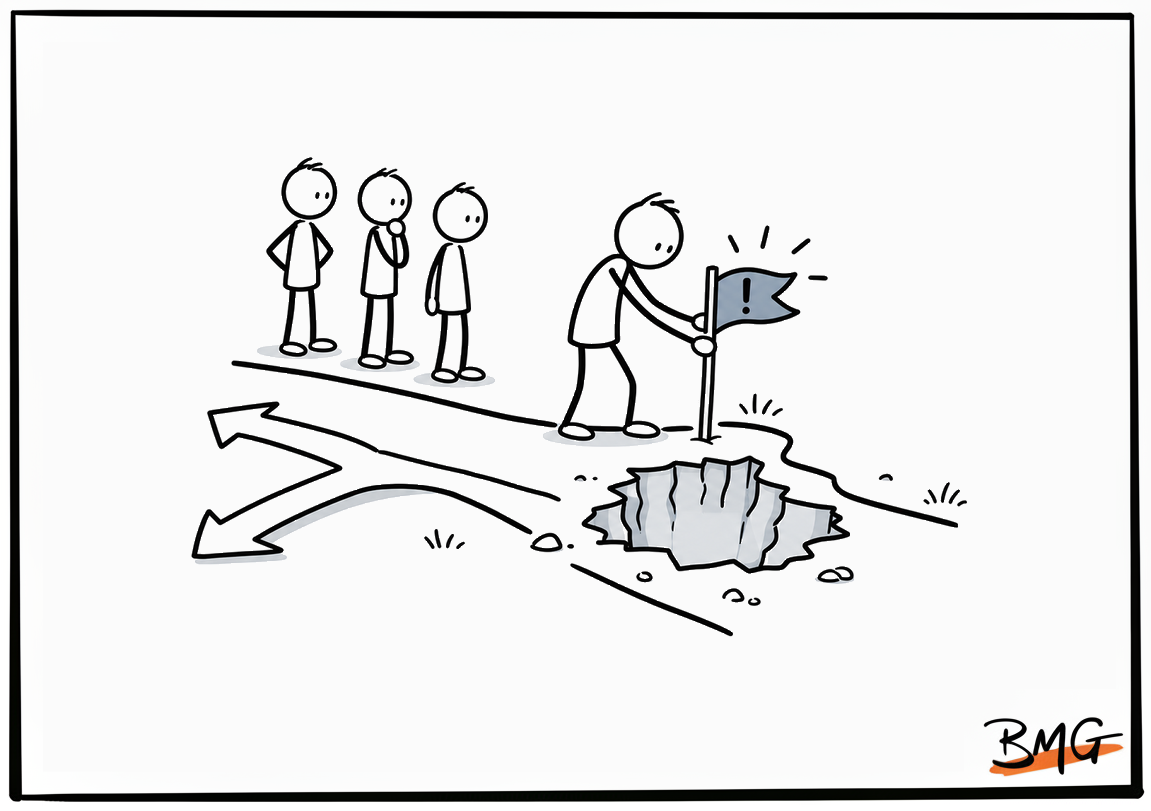
Most leaders say they want honesty.
Fewer build a system where early honesty feels safe, useful, and expected.
That gap is where surprise lives.
Not the harmless kind of surprise. Not the birthday cake in the meeting room or the unexpected bit of good news. I mean the professional surprise that lands too late for anyone to do much with it. The deadline that was already unsafe last week. The stakeholder who had been drifting for days. The quality issue that several people noticed privately but nobody put into the room. The decision that everyone thought someone else was holding.
By the time the leader hears about it, the issue is no longer only the issue.
It is also the delay in naming it.
That delay changes everything. A risk named early is workable. The same risk named late becomes a trust problem. People start asking why they did not know sooner, who else knew, what else is hidden, and whether the next update can be believed.
This is why no surprises is such an important leadership standard.
It is also why it is so often misunderstood.
No surprises does not mean nothing ever goes wrong. That is fantasy. Good teams still miss things. Strong people still get surprised by complexity. Plans still meet reality and need changing. No surprises means that when reality starts to move, the people who need to know hear about it early enough to think, decide, and act.
It is not a demand for perfect control.
It is a demand for timely truth.
The Problem
Many teams have learned to report confidence for too long.
The update sounds calm. The slide is green. The owner says they are working through the detail. Nobody wants to be dramatic. Nobody wants to look negative. Nobody wants to be the person who brings the awkward news before it is absolutely unavoidable.
So the risk stays slightly below the surface.
Privately, people know. They have seen the unanswered email. They have noticed the missing input. They have heard the stakeholder hesitation. They know the dependency is not moving as cleanly as the project plan suggests.
Publicly, the language remains soft.
We are broadly on track.
There are a few moving parts.
We should be okay.
Those lines are not always dishonest. Sometimes they are attempts to stay proportionate. But they can become a way of keeping risk vague until it hardens into consequence.
Then the surprise arrives.
The senior leader discovers that the decision is not ready. The client discovers that the date has moved. The team discovers that the dependency was never really confirmed. The person who was relying on the update discovers that the confidence was conditional, but nobody said what the conditions were.
This is the leadership cost.
Surprise compresses time. It removes options. It raises emotion. It turns a manageable risk into a credibility problem.
A Recognisable Workplace Moment
It is Tuesday morning. The implementation review is on Thursday. Aisha owns the customer migration plan.
For two weeks, the status has been green.
In the review, someone asks about the data-cleansing dependency. Aisha pauses for half a second longer than usual and says, We are still waiting on final confirmation from the regional team, but I think we are close.
That is the first sign.
The room moves on because there are twenty other items to cover.
On Wednesday afternoon, a message arrives. The regional team cannot confirm the data in time. The migration date is now at risk. The customer update is due first thing Thursday. The sponsor wants to know why this has only just surfaced.
Aisha is not lazy. She has been chasing the dependency. She did not want to raise noise before she knew whether the risk was real. She hoped it would resolve. She also knew the sponsor was tired of hearing about delays, so she tried to protect the room from uncertainty.
That is the trap.
She protected the room from uncertainty on Tuesday and delivered surprise on Wednesday.
The issue may still be solvable. The date may still be protected. But the leadership conversation has changed. It is now about the dependency and the reporting judgement. When did this become a risk? Who knew? What options disappeared because it was named too late?
No surprises would not have required Aisha to know the answer on Tuesday.
It would have required her to say:
The plan is still green, but there is one amber condition behind it. The regional data confirmation is not yet locked. If it is not confirmed by tomorrow at midday, the Thursday customer update becomes unsafe. My recommendation is that we prepare a holding line now and decide by midday whether to move the date.
That is a very different update.
It does not create panic. It creates visibility.
The Reframe
No surprises is not about pessimism.
It is about responsible timing.
Some leaders accidentally teach their teams to hide early risk because they react badly to it. They interrogate too quickly. They sigh. They make risk sound like failure. They reward the smooth update and punish the honest one. Then they are surprised when the team waits too long to bring awkward information forward.
If the first person to name risk gets treated as the problem, the team will learn to delay risk.
That does not mean leaders should accept vague escalation. Early truth still needs quality. A no-surprises standard is not an invitation to flood everyone with every possible concern. It is a discipline for making material risk visible at the right moment, with enough judgement attached.
The useful line is this:
Tell me when the promise becomes unsafe, not when it has already broken.
That line changes the conversation. It tells people that reliability is not pretending everything is fine until the evidence is undeniable. Reliability is noticing when a commitment has become conditional and making that condition visible.
The best teams do this without theatre.
They do not treat every uncertainty as an emergency. They do not create performative transparency where every worry becomes a meeting. They simply make risk legible early enough for the right people to decide.
That is the no-surprises standard.
What A Good Early Signal Includes
A useful early signal has four parts.
First, the commitment.
What promise, date, decision, or outcome is now at risk? Be specific. If the listener has to work out what you are referring to, the signal is already too vague.
Second, the trigger.
What changed? The dependency moved. The quality review found a gap. The stakeholder has not confirmed. The customer requirement is unclear. The team member is unavailable. Name the thing that made the promise less safe than it was.
Third, the consequence.
What happens if nothing changes? This is where many updates stay too soft. There are some challenges is not enough. A stronger version says, If this is not resolved by Wednesday at noon, we cannot credibly confirm the Friday date.
Fourth, the recommendation.
What do you think should happen next? Do not only bring anxiety upward. Bring judgement. You might recommend reducing scope, preparing a holding message, escalating to a stakeholder, moving a decision forward, or creating a checkpoint.
That structure protects the leader and the team.
It avoids two common extremes. One extreme is silence until the problem breaks. The other is unmanaged escalation, where people throw risk upward without doing any thinking. No surprises sits between those extremes. It says: bring the truth early, and bring enough shape that the next decision can be made.
A quick pause
If this is helpful, my free guide goes deeper, and the newsletter brings ideas like this twice a week.
My book, High-Fidelity Leadership, explores these same themes in more depth, with practical frameworks for standards, clarity, and the conversations that leaders avoid for too long.
The Leader's Role
The leader has two jobs.
The first is to set the standard.
Do not make people guess what counts as early enough. Say it clearly:
If a commitment becomes materially unsafe, I expect to hear before the deadline passes, with the reason, options, and your recommendation.
That sentence gives people permission and responsibility. It tells them that silence is not maturity. It also tells them that escalation should arrive with thought attached.
The second job is to respond well when the standard is used.
This is where many leaders damage the behaviour they say they want. Someone raises a risk early, and the leader reacts as if the risk itself is the offence. They ask ten defensive questions before acknowledging the signal. They make the person feel foolish for not having the answer already. They turn the early warning into a performance trial.
The team learns quickly.
Next time, the warning comes later.
A better first response is:
Thank you for naming it early. What are the options while we still have time?
That does not lower the bar. You can still ask hard questions. You can still challenge the judgement. You can still expect a better plan. But the first signal should teach the team that timely truth is useful, not dangerous.
The tone matters because standards are learned through reactions.
If you want fewer surprises, make early warning feel like leadership rather than failure.
The Difference Between Visibility And Noise
Some leaders resist no-surprises standards because they fear being copied into everything.
That fear is reasonable. A team that escalates every small uncertainty creates noise, dependency, and fatigue. The answer is not to abandon transparency. The answer is to define thresholds.
Not every issue needs senior attention.
The test is materiality.
Will this change a promise someone is relying on? Will it affect a customer, colleague, cost, date, standard, or decision? Will options disappear if we wait? Does someone outside the immediate team need to act differently because of this information?
If the answer is yes, the issue probably needs earlier visibility.
If the answer is no, the owner may simply need to manage it locally and keep it in their own risk log.
This distinction is important. No surprises is not a culture of constant broadcasting. It is a culture of mature judgement. The goal is not that everyone knows everything. The goal is that the right people know the material truth while they can still do something useful with it.
The No-Surprises Rhythm
One practical way to build this is to add a simple rhythm to live work.
In every weekly review, ask three questions:
What commitment is now less safe than it was last week?
What are we watching that could become material before the next review?
Who needs to know now, while options still exist?
Those questions are not complicated. Their value is that they normalise early truth. They make it acceptable to say, The date is still possible, but less safe. They give people language for conditional confidence.
That phrase is useful: conditional confidence.
It allows a team to stay calm without pretending certainty. You can say, We are confident if the dependency lands by Wednesday. That is clearer than green status with hidden anxiety. It helps the room know what to watch, what to protect, and when to decide.
Over time, the rhythm changes the team.
People stop confusing optimism with leadership. They stop treating warning signs as disloyalty. They become better at distinguishing normal friction from material risk. The updates get shorter because they get cleaner.
No surprises becomes less of a slogan and more of an operating habit.
Personal Reflection
I have had to learn that my reaction to early risk is part of the system.
It is easy to say, Just tell me sooner. It is harder to notice whether I make that easy in the moment. If someone brings me an awkward early warning and my first response is frustration, impatience, or forensic questioning, I may get the answer I want in that conversation and worse information next time.
That does not mean becoming soft on standards. It means being very precise about what I am rewarding.
If I reward smooth updates more than truthful ones, people will smooth the truth. If I reward heroics more than early escalation, people will wait until rescue is required. If I reward certainty more than judgement, people will hide the conditions behind their confidence.
The no-surprises standard asks something of the team, but it also asks something of the leader.
It asks whether I am willing to hear the early, incomplete truth while it is still useful.
Reflection Prompts
Where am I being surprised by information that someone probably saw earlier?
What signals do people delay because they are afraid of how the room will react?
Which current green status has an unspoken condition behind it?
What would count as materially unsafe in this piece of work?
Do my reactions make early warning easier or harder next time?
What threshold should require someone to tell me before the promise breaks?
Final Thought
No surprises is not a demand that nothing goes wrong.
It is a standard for how truth travels when something starts to go wrong. A risk named early gives people options. A risk named late creates doubt around the update, the owner, and the system that allowed silence to feel safer than visibility.
The mature team is not the team with no problems.
It is the team that can say, early and cleanly, This promise is becoming less safe, and here is what we recommend while there is still time.
The path to extraordinary is walked with a thousand small steps, you’re doing great!
Your Small Steps
What does "no surprises" really mean?
It means material truth travels early enough for the right people to act. It does not mean nothing ever goes wrong, and it does not mean every small concern needs to be broadcast.
Small Step: Choose one live commitment and write down what would make it materially unsafe.
How do I stop people treating risk as failure?
Start by changing your first response to early warning. If people get punished socially for naming risk, they will learn to wait until the risk is undeniable.
Small Step: Use this line next time someone flags risk early: Thank you for naming it early. What are the options while we still have time?
What should an early warning include?
It should include the commitment, the trigger, the consequence, and the recommendation. That keeps the signal useful instead of vague.
Small Step: Ask for four fields: promise, trigger, consequence, recommendation.
How do I avoid being copied into everything?
Define thresholds. Not every uncertainty needs escalation. Material issues are those that affect a customer, colleague, cost, date, standard, decision, or promise someone is relying on.
Small Step: Agree one threshold with your team: Tell me early when this changes a commitment someone else is planning around.
What if the person does not have a solution yet?
They may still need to signal the risk. Early visibility can be useful before the full solution exists, as long as they bring the best current options and recommendation.
Small Step: Ask: What do you recommend we do while we still have options?
How can I make this a team habit?
Add three questions to your weekly review: what is less safe, what could become material, and who needs to know now?
Small Step: Use those three questions in the next meeting instead of asking only whether everything is on track.
What is conditional confidence?
Conditional confidence means being clear about what your confidence depends on. It sounds like: We are confident if the dependency lands by Wednesday.
Small Step: Replace one vague green status with the condition that makes it green.
Why does late risk damage trust?
Late risk removes options and makes people question the update process. The issue may be understandable, but the delay in naming it can become the bigger problem.
Small Step: After a late surprise, ask: When was the first moment this became less safe?

Barry Marshall-Graham
Executive coach and leadership advisor
Get the Difficult Conversations Guide
A practical resource for leaders who want to say the thing that needs saying, without burning bridges or avoiding the moment.
Keep reading
31 August 2026
The Sentence They Nearly Said
A pause or changed expression may lead to the useful part of a conversation, but noticing it doesn't give the coach permission to decode it.
24 August 2026
You Cannot Coach Someone You Are Secretly Judging
Second-hand information may be useful, but once it becomes a character verdict it changes the leader’s listening, questions and tone.
17 August 2026
A Good Question Can Be Badly Timed
The wording may be excellent, but a coaching question can still arrive before the relationship or the moment is ready to carry it.
10 August 2026
Whose Goal Is It Anyway?
A goal can be strategically sensible and still feel unowned. The answer is honest internalisation, not coaching somebody into believing it was their idea.
3 August 2026
The Leader Who Uses Coaching to Avoid Leading
Coaching can create room for another person to think, but it can also help a leader postpone the feedback, standard or decision that belongs to them.
27 July 2026
Advice Wearing a Hat
A coaching question can sound wonderfully curious while quietly steering somebody towards the answer their leader already prefers.
20 July 2026
The Emotional Cost of Being the Reliable One
Reliability earns trust, but it can also turn one capable leader into the place where unfinished work, uncertainty, and organisational risk accumulate.
13 July 2026
The Relief of Finally Saying the Thing
An overdue conversation occupies far more space than the words themselves. Relief begins when reality is finally allowed back into the room.
6 July 2026
The Sideways Shove
Peer conflict cannot be solved with the Manager Card. Influence begins when leaders stop pushing across borders and repair the working relationship.
29 June 2026
Clarity Under Pressure
Authority is tested when the room tightens. Clear leaders make reality, uncertainty, and the next decision visible without adding drama.