The Tolerance Ledger: The Hidden Cost Paid By High Performers
25 May 2026
When leaders leave repeated exceptions unresolved, the cost is paid by the people still protecting the work. They notice the unfairness before anyone says it out loud.
Your most dependable people are usually the first to notice when exceptions become expensive.
Not because they are obsessed with rules. Not because they are waiting to catch someone out. They notice because they are often the ones paying the cost.
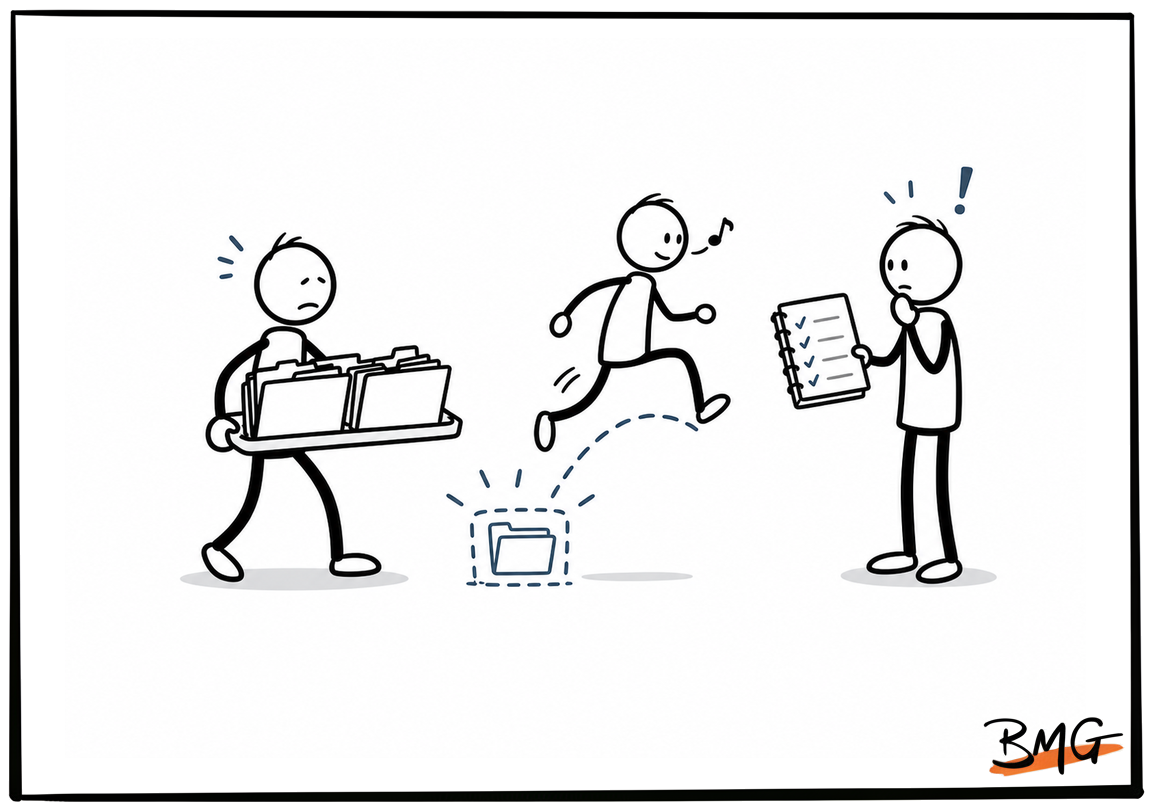
They may not say anything at first. In fact, they often won't. They will simply absorb the gap, adjust around it, and carry on delivering. They will pick up the extra check before the client meeting. They will stay ten minutes later to make sure the numbers are right. They will quietly correct the slide, chase the owner, or smooth the awkward moment after someone else drops the ball.
Then they will add a private mark to the tolerance ledger.
The tolerance ledger is not written down. There is no spreadsheet called work we are carrying because leadership has not named the gap. But teams keep one anyway. They notice what is corrected and what is excused. They notice who gets challenged and who gets worked around. They notice when excellence is expected from some people and merely hoped for from others.
This is where leadership silence becomes culturally expensive.
When a leader tolerates a small exception once, it may be reasonable. People have bad weeks. Work gets messy. Life happens. But when the same exception is tolerated repeatedly, the cost does not disappear. It moves. It lands on the person who checks the deck, fixes the handoff, stays late, absorbs the awkwardness, or protects the client from seeing the gap.
High performers do not need a speech to understand that.
They read the room.
What’s Really Happening
The real issue is not only that a standard has slipped.
The real issue is that somebody else is now subsidising the slip.
A missed follow-up may mean someone else chases the client. A poor-quality draft may mean someone else cleans the story. A sarcastic comment may mean someone else repairs the tone in the room. A repeated late arrival may mean someone else starts opening the meeting twice: once formally, and once again when the late person joins.
Every one of those accommodations might be defensible on its own. Taken together, they create a hidden economy of compensation.
In that economy, the strongest people are often charged first. They are trusted, capable, calm, and conscientious. They can be relied on to make the work look better than the system deserves. That is precisely why the pattern is dangerous. Their competence masks the leadership gap.
The tolerance ledger forms when the people carrying the compensation start tracking the unfairness privately.
It usually starts with small comments. Interesting that nobody picked that up. I suppose we are doing that again. I wouldn't get away with that. These comments might be made lightly, even jokingly, but they are rarely empty. They are early signs that fairness is being questioned.
Once fairness enters the conversation, the leadership problem has changed. You are no longer only dealing with the person whose behaviour or output slipped. You are dealing with the burden placed on everyone else who is still protecting the work.
That is the part leaders often underestimate.
The Human Cost Of Uneven Standards
Uneven standards create a particular kind of resentment because they make conscientious people feel used.
The person who checks the detail wonders why they are still the backstop. The team member who prepares properly watches someone else wing it and receive the same warm approval. The colleague who raises risks early sees another person hide the risk until it becomes unavoidable and still get protected by vague language about complexity.
These moments do not always produce open conflict. In many teams, they produce withdrawal.
People stop stretching. They stop volunteering. They stop doing the invisible extra care that used to protect quality. They still perform, but a quiet contract has changed. The team may not look broken from the outside. The dashboard may still be green. The meetings may still sound polite.
But something has cooled.
I have seen this happen in small ways that become large over time. A high performer sends a careful pre-read before every steering group. Another person arrives with loose thinking and apologises charmingly. The leader smiles, says it has been a busy week, and fills the gap in the room. The careful person says nothing. The following month, their pre-read is shorter. By the third month, they have stopped doing the extra synthesis entirely.
Nobody has resigned.
The relationship with effort has.
This is why leaders need to pay attention to the people who keep delivering without making noise. Their silence is not always satisfaction. Sometimes it is the early stage of disengagement dressed as professionalism.
A Recognisable Workplace Moment
It is 5:20 PM on a Tuesday. The client review is tomorrow. One of your strongest team members, Maya, sends you the latest pack with a short note: I have cleaned up the risk slide and added the missing dependency detail.
You know immediately what has happened.
The original owner sent a draft that was technically complete but not fit for the room. The risks were vague. The mitigation was optimistic. The dates were there, but the logic was weak. Maya has fixed it because she cares about the client, the team, and the quality of the work.
You type back: Thanks, this is really helpful.
That might be true. It is also incomplete.
The leadership moment is not only to thank Maya. It is to stop the pattern that made Maya's extra work necessary. If you only reward the rescue, you train the system to keep relying on rescuers. You may even make your best people complicit in hiding the standard slip, because their excellence protects the issue from being visible.
The next morning, the review goes well. Everyone relaxes. The original owner hears that the deck landed fine. Maya receives no visible acknowledgement for the save, because it would be awkward to name it now. You privately promise yourself you will deal with the quality issue next time.
Maya adds a mark to the ledger.
She does not need applause. She needs to know the standard means what leadership says it means.
A quick pause
If this is helpful, my free guide goes deeper, and the newsletter brings ideas like this twice a week.
My book, High-Fidelity Leadership, explores these same themes in more depth, with practical frameworks for standards, clarity, and the conversations that leaders avoid for too long.
The Reframe
The standard is not only held in the conversation with the person who slipped.
It is also held in the signal sent to the people who did not.
This is the reframe many leaders miss. They think the difficult conversation is primarily about the under-delivery in front of them. It is partly that. But it is also about protecting the psychological contract with the people who are still delivering well.
When you address a tolerated exception, you are not being dramatic. You are maintaining fairness. You are showing the team that quality is not optional, ownership is not selective, and the people who care will not be quietly punished for caring.
This does not mean every small slip requires a heavy conversation. It means repeated exceptions require visible leadership attention. The tone can be calm. The conversation can be private. The words can be humane. But the standard cannot remain imaginary.
There is a useful distinction here between grace and drift.
Grace says: This is not like you. Let’s understand what happened and support you back to the standard.
Drift says: This keeps happening, and we are all quietly learning to work around it.
Grace is human.
Drift is cultural.
Leaders need both warmth and memory. Warmth keeps you from turning every mistake into a character judgement. Memory keeps you from pretending repeated exceptions are isolated.
How To Read The Ledger Early
The tolerance ledger often shows up indirectly.
You may hear a small joke that lands with a sharper edge than usual. You may notice your most reliable person becoming less generous with their effort. You may see people asking for written confirmation on things they used to trust informally. You may find that meeting energy has changed: less challenge, less ownership, more cautious compliance.
Do not overinterpret every shift. People are complex. Work is seasonal. Energy changes for many reasons.
But do pay attention when dependable people start protecting themselves from a standard they no longer trust leadership to protect.
One practical move is to ask your high performers a better question. Not are you okay? That often gets a polite answer. Ask:
Where are we relying on good people to compensate for unclear standards?
Then listen without defending.
You may hear about rework, late handovers, sloppy preparation, poor meeting discipline, or one person whose behaviour is constantly excused because they deliver in other ways. The specifics will vary. The pattern is the same: the team is paying a tax that leadership has not yet named.
Once you hear it, resist the urge to make your high performer the solution. They have probably already been part of the solution for too long.
Your job is to move the standard back into the system.
Personal Reflection
I have a soft spot for people who rescue the work.
That instinct is useful, and dangerous. It is useful because those people often carry the care that keeps teams credible under pressure. It is dangerous because if I only feel gratitude, I may miss the leadership failure underneath the rescue.
I have had to learn to ask a harder question when someone saves the day: What did the system just avoid learning because this person cared enough to cover the gap?
That question is uncomfortable because it redirects attention from the heroics to the operating conditions. It asks whether the rescue was a one-off act of teamwork or a recurring compensation pattern. It asks whether I am praising excellence while silently allowing the cause of the extra load to continue.
Good people often make weak systems look better than they are.
That is precisely why leaders have to look past the rescue and ask what standard needs to be restored.
Reflection Prompts
Where are my strongest people quietly compensating for a repeated gap?
What exception has become easier to excuse than to address?
Who would reasonably think, "I would not get away with that"?
Where am I rewarding the rescue while avoiding the root conversation?
What lived standard is the team learning from my silence?
What act of grace has started to become drift?
Final Thought
High performers do not only listen to what leaders say about standards. They watch what leaders protect when standards become inconvenient.
If you want to keep their trust, do not make them carry the gap in silence. Thank the people who rescue the work, then lead the conversation that makes the rescue less necessary next time.
The path to extraordinary is walked with a thousand small steps, you’re doing great!
Your Small Steps
What is the tolerance ledger?
It is the informal record people keep of what leadership allows, excuses, corrects, and ignores. It shapes the real culture more than any stated value because it tells the team what happens under pressure.
Small Step: Ask yourself what your team has seen you tolerate three times in the last month.
Why do high performers notice first?
They are often closest to the consequences. They fix the gaps, absorb the rework, protect the client, or prepare properly while others drift. That proximity makes them sensitive to uneven standards.
Small Step: Speak with one trusted high performer and ask where the team is relying too much on compensation.
How do I avoid turning this into blame?
Focus on the pattern, not the person’s worth. The goal is to restore the standard, understand what is happening, and stop unfair load from building elsewhere.
Small Step: Use this opening: I want to look at a pattern that is creating extra work around the team.
What if the person who slipped had a genuine reason?
Then the conversation can include support. Genuine reasons do not remove the need to clarify how the standard will be protected next time.
Small Step: Ask: What support do you need, and what will be different in the next handover?
How do I know whether I am offering grace or allowing drift?
Grace is specific and bounded. Drift is vague and repeated. If the same exception keeps returning without a reset, it has probably moved beyond grace.
Small Step: Put a date on the reset: Let’s review this next Friday and check whether the new approach is working.
Should I acknowledge the person who rescued the work?
Yes, but do not stop there. Thanking the rescuer without addressing the cause can make the rescuer feel valued and used at the same time.
Small Step: Say privately: Thank you for catching this. I also want to make sure we do not keep relying on you to protect this gap.
What if naming the standard feels harsh?
Harshness usually comes from tone, exaggeration, or delayed frustration. A calm standard, named early, is often experienced as fairness by the wider team.
Small Step: Strip your message back to behaviour, impact, and future expectation.
What is one sign the ledger is becoming dangerous?
Watch for withdrawal from people who used to volunteer energy. If the conscientious people start doing only the visible minimum, they may be protecting themselves from an unfair system.
Small Step: Look for one place where discretionary effort has quietly disappeared and ask what changed.

Barry Marshall-Graham
Executive coach and leadership advisor
Get the Difficult Conversations Guide
A practical resource for leaders who want to say the thing that needs saying, without burning bridges or avoiding the moment.
Keep reading
31 August 2026
The Sentence They Nearly Said
A pause or changed expression may lead to the useful part of a conversation, but noticing it doesn't give the coach permission to decode it.
24 August 2026
You Cannot Coach Someone You Are Secretly Judging
Second-hand information may be useful, but once it becomes a character verdict it changes the leader’s listening, questions and tone.
17 August 2026
A Good Question Can Be Badly Timed
The wording may be excellent, but a coaching question can still arrive before the relationship or the moment is ready to carry it.
10 August 2026
Whose Goal Is It Anyway?
A goal can be strategically sensible and still feel unowned. The answer is honest internalisation, not coaching somebody into believing it was their idea.
3 August 2026
The Leader Who Uses Coaching to Avoid Leading
Coaching can create room for another person to think, but it can also help a leader postpone the feedback, standard or decision that belongs to them.
27 July 2026
Advice Wearing a Hat
A coaching question can sound wonderfully curious while quietly steering somebody towards the answer their leader already prefers.
20 July 2026
The Emotional Cost of Being the Reliable One
Reliability earns trust, but it can also turn one capable leader into the place where unfinished work, uncertainty, and organisational risk accumulate.
13 July 2026
The Relief of Finally Saying the Thing
An overdue conversation occupies far more space than the words themselves. Relief begins when reality is finally allowed back into the room.
6 July 2026
The Sideways Shove
Peer conflict cannot be solved with the Manager Card. Influence begins when leaders stop pushing across borders and repair the working relationship.
29 June 2026
Clarity Under Pressure
Authority is tested when the room tightens. Clear leaders make reality, uncertainty, and the next decision visible without adding drama.