The C+ Deck: How Good Enough Becomes The New Standard
8 June 2026
Good enough work from capable people is seductive because it almost passes. That is exactly why leaders must address it early.
The most dangerous quality slip is not the disaster.
The disaster gets attention. The broken deck, the angry client, the obvious error, the completely missed deadline. Nobody has to debate whether something went wrong. The conversation may be uncomfortable, but the facts are visible.
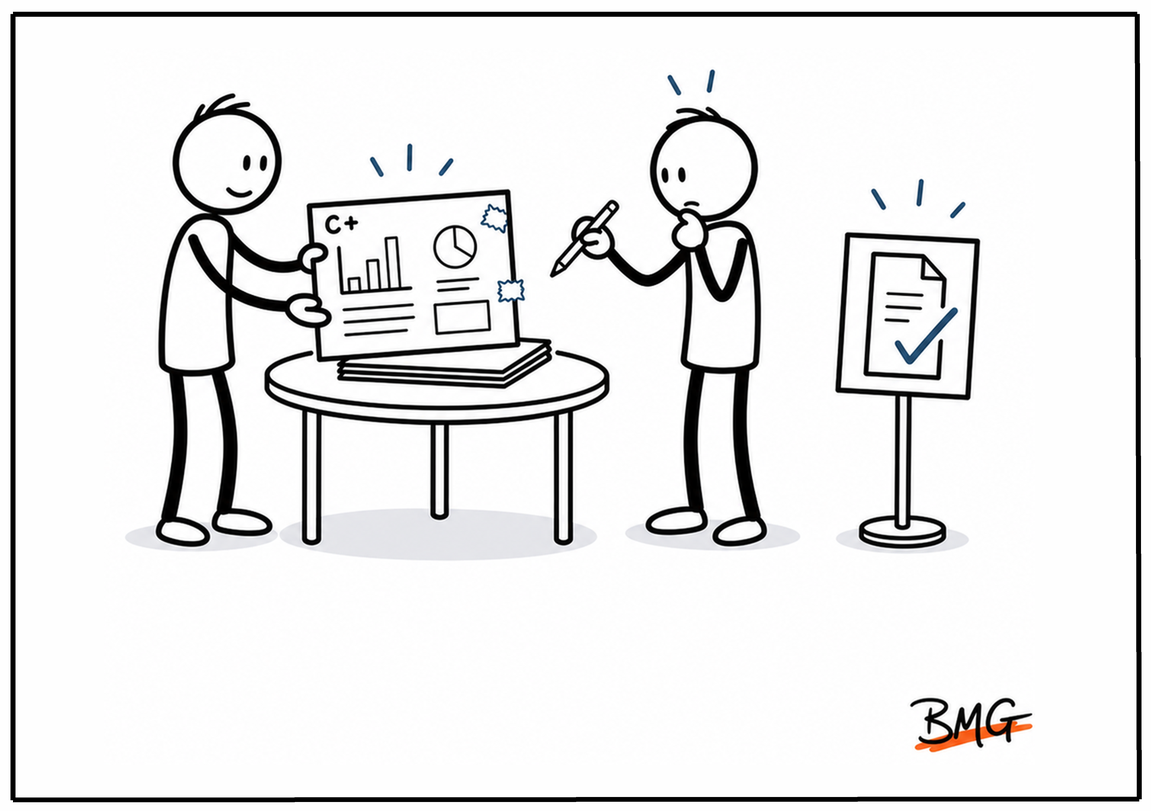
The more dangerous slip is the C+ deck.
It is good enough to pass if everyone is tired. It has the right sections. The numbers are nearly current. The recommendation is present, but vague. The formatting is not awful, just slightly off. The risk section says enough to look responsible and not enough to be useful. You can probably fix it in twenty minutes.
So you do.
You make the data current. You sharpen the recommendation. You move two slides around. You rewrite the summary so it says something a client could actually act on. Then you send it back with a note: I made a few tweaks, but we are good to go.
That sentence feels efficient.
It may also be the moment the standard starts to move.
The Problem
C+ work is seductive because it almost works.
It does not create enough pain to force an immediate reset. It is not embarrassing enough to trigger a crisis. It gives the leader a tempting choice: spend the emotional energy correcting the person, or spend the practical energy fixing the work.
Fixing the work often feels easier.
The problem is that the person who produced the work may not know they missed the standard. They may believe they did a solid job. The team may believe the leader is happy because the output landed. The leader may believe the issue is too small to mention because the client never saw the weakness.
Nothing breaks.
That is precisely why the pattern continues.
Quality drift often enters through the gap between what the leader silently fixes and what the team explicitly learns. Every quiet fix protects the immediate deliverable and weakens the long-term standard. The work gets rescued, but the person does not get developed. The client sees quality, but the system does not learn how to produce it without hidden senior labour.
The C+ deck is not a document problem.
It is a leadership moment.
A Workplace Moment
It is 4:40 PM on Thursday. The client review is at 9:00 AM on Friday. You open the deck from a capable team member and feel the familiar small drop in your stomach.
Slide 4 uses last month’s data. Slide 7 has three bullet points that sound confident and mean very little. The risk slide mentions stakeholder alignment and timeline pressure without naming the actual risk. The design is close enough that nobody outside the team would complain, but the whole thing lacks the crispness you expect from someone at this level.
You look at the clock.
You could send it back. That would require a call. The person might say they thought it was what you wanted. You would need to explain what stronger synthesis looks like. You would need to risk a slightly awkward conversation with someone who is generally good and clearly busy.
Or you could fix it.
Your fingers are already on the keyboard.
Twenty-five minutes later, the deck is better. The review will be fine. You feel mild relief and a little irritation. You send the polished version and move to the next task. The person replies with a thumbs-up. They may even feel grateful.
From their perspective, the work was accepted.
From your perspective, you have just absorbed the gap.
This is where standards slip quietly. People are usually not malicious, and leaders often care deeply. The slippage happens because rescuing the work feels cleaner than naming the standard.
The Reframe
Good enough is not always good enough when the person is capable of better.
That sentence needs care. It can sound harsh if used without context. People have off days. Capacity fluctuates. Perfect is not the standard. Leaders who treat every imperfect output as a moral failure create brittle teams and performative work.
The issue is not perfection.
The issue is repeated avoidable slippage from someone who has the capability to meet the standard and the responsibility to own the output. If the gap is due to unclear expectations, fix the expectation. If it is capacity, renegotiate. If it is development, coach. But if the person can do better and keeps learning that you will quietly close the gap, you have created a compensation loop.
That loop is expensive.
It trains the team to submit work that is close enough for the leader to finish. It trains the leader to become the quality control department. It trains high performers to expect uneven standards. It turns feedback into a future crisis because the early corrections were hidden inside tracked changes.
The reframe is simple: correcting the work is not the same as correcting the standard.
Sometimes you must do both. The client deck still needs to be right. The meeting still matters. But after the immediate rescue, the leadership work remains. The person needs to understand the gap, the expected standard, and what will change next time.
If they do not, the C+ deck becomes a permission slip.
A quick pause
If this is helpful, my free guide goes deeper, and the newsletter brings ideas like this twice a week.
My book, High-Fidelity Leadership, explores these same themes in more depth, with practical frameworks for standards, clarity, and the conversations that leaders avoid for too long.
What Leaders Get Wrong
The first mistake is assuming the person knows the gap.
They often do not. Leaders forget how much invisible judgement sits inside senior quality. A stronger recommendation, a cleaner risk, a sharper executive summary, a more useful distinction between facts and implications. These things feel obvious after years of pattern recognition. They are not obvious to everyone.
If you only say I made a few tweaks, you may be hiding the most useful coaching.
The second mistake is turning a quality conversation into a taste conversation. This needs to be better is vague. The recommendation needs to tell the client what decision we want from them and why it matters now is useful. The more specific the standard, the less personal the feedback feels.
The third mistake is correcting too much inside the document and too little in the relationship. Tracked changes can improve the output, but they do not always improve judgement. If the person does not understand why you changed what you changed, they may learn the wrong lesson: Barry likes different wording, the client is fussy, the format changed, or senior people always tinker.
The fourth mistake is waiting until you are annoyed. If you quietly fix three decks, the fourth conversation will carry the irritation of all four. The person may only experience the first real feedback, while you are emotionally presenting the whole private history.
That is not fair.
It is also avoidable.
A Better Quality Reset
The reset does not need to be long.
It should be specific, respectful, and tied to future ownership. You might say:
I made the deck client-ready because of the timing. I want to talk through the gap, though, because the first version was not at the standard I need from you. The main issue was not formatting. It was that the recommendation and risk section did not give the client a clear decision. Next time, I need you to land that before it comes to me.
That is clear. It names the rescue, the gap, and the future standard. It does not attack the person. It does not pretend the issue was only a few tweaks.
Then ask a question:
What would help you judge that standard before you send it?
That question matters because the goal is not simply compliance. The goal is judgement. You want the person to build the internal quality filter that reduces the need for senior rescue. Sometimes they need examples. Sometimes they need a checklist. Sometimes they need to slow down. Sometimes they need to stop treating completion as the same thing as readiness.
The distinction between complete and ready is one of the most important quality conversations in leadership.
Complete means all the parts exist.
Ready means the work can carry the responsibility it is being given.
C+ work is often complete.
It is not ready.
Personal Reflection
I have fixed more C+ decks than I care to admit.
Sometimes that was the right call in the moment. The meeting was too close, the risk too high, the client too important. Leadership is practical, and sometimes the work simply needs to be made safe.
The part I have had to learn is that rescue is not the end of the leadership act. It is the beginning of the next conversation. If I save the work and never name the gap, I have protected the deliverable while leaving the person’s judgement exactly where it was.
I also know the ego trap in senior editing. It is easy to believe the work is better because I touched it. That may be true, and it may also be taste. The discipline is to separate preference from standard. A standard must be explainable in terms of outcome, risk, clarity, audience, or decision quality. If I cannot explain the difference beyond I would have done it differently, I need to be careful.
The best quality conversations make the next piece of work better without making the person smaller.
That is the bar.
Reflection Prompts
Where am I quietly fixing C+ work instead of naming the standard?
What quality gap is the person unlikely to see unless I explain it?
Am I correcting a real standard or imposing a personal preference?
Where has complete been mistaken for ready?
What hidden senior labour is making the team’s output look better than the system can produce?
What would help this person build a stronger quality filter next time?
Final Thought
The C+ deck is tempting because the short-term fix is obvious and the leadership conversation is awkward.
But every quiet fix teaches. It teaches the person what passed, the team what is tolerated, and the leader that rescue is faster than development. Do the practical fix when you must. Then have the quality conversation while the moment is still fresh and small.
The path to extraordinary is walked with a thousand small steps, you’re doing great!
Your Small Steps
What is C+ work?
C+ work is work that is technically present but not genuinely ready. It has the parts, but not the clarity, judgement, usefulness, or finish required for the context.
Small Step: Choose one current deliverable and ask: Is this complete, or is it ready?
When should I fix the work myself?
Fix it when the immediate risk is high and time is short. But do not confuse the rescue with development. If you fix it, plan the follow-up conversation.
Small Step: After making a rescue edit, book ten minutes to talk through the gap within two working days.
How do I stop sounding picky?
Tie the feedback to outcome, risk, audience, or decision quality. If you cannot explain the standard beyond personal preference, rethink the feedback.
Small Step: Complete this sentence: This matters because the reader needs to...
What if the person is generally strong?
That is exactly why the conversation matters. Capable people often respond well to precise standards when they are delivered respectfully and early.
Small Step: Open with: This is why I am raising it now, because I know you are capable of this standard.
How do I make the standard specific?
Describe the features of ready work. For a client deck, that might include current data, a clear recommendation, named risks, and a decision the client can make.
Small Step: Create a three-point readiness check for the next repeated deliverable.
What if I have already fixed it several times?
Name your part honestly. The person may not know how much you have been absorbing.
Small Step: Say: I have been correcting this quietly, and that has probably hidden the standard from you. I want to reset it clearly now.
How do I avoid demoralising them?
Separate their capability from the current output. Be clear that the work missed the standard, not that they are inadequate.
Small Step: Use: This version is not there yet rather than you are not good enough at this.
What is the goal of the quality conversation?
The goal is better judgement next time, not just a better version this time. If the person understands why the work was not ready, the system improves.
Small Step: Ask: What will you check differently before sending the next version?

Barry Marshall-Graham
Executive coach and leadership advisor
Get the Difficult Conversations Guide
A practical resource for leaders who want to say the thing that needs saying, without burning bridges or avoiding the moment.
Keep reading
31 August 2026
The Sentence They Nearly Said
A pause or changed expression may lead to the useful part of a conversation, but noticing it doesn't give the coach permission to decode it.
24 August 2026
You Cannot Coach Someone You Are Secretly Judging
Second-hand information may be useful, but once it becomes a character verdict it changes the leader’s listening, questions and tone.
17 August 2026
A Good Question Can Be Badly Timed
The wording may be excellent, but a coaching question can still arrive before the relationship or the moment is ready to carry it.
10 August 2026
Whose Goal Is It Anyway?
A goal can be strategically sensible and still feel unowned. The answer is honest internalisation, not coaching somebody into believing it was their idea.
3 August 2026
The Leader Who Uses Coaching to Avoid Leading
Coaching can create room for another person to think, but it can also help a leader postpone the feedback, standard or decision that belongs to them.
27 July 2026
Advice Wearing a Hat
A coaching question can sound wonderfully curious while quietly steering somebody towards the answer their leader already prefers.
20 July 2026
The Emotional Cost of Being the Reliable One
Reliability earns trust, but it can also turn one capable leader into the place where unfinished work, uncertainty, and organisational risk accumulate.
13 July 2026
The Relief of Finally Saying the Thing
An overdue conversation occupies far more space than the words themselves. Relief begins when reality is finally allowed back into the room.
6 July 2026
The Sideways Shove
Peer conflict cannot be solved with the Manager Card. Influence begins when leaders stop pushing across borders and repair the working relationship.
29 June 2026
Clarity Under Pressure
Authority is tested when the room tightens. Clear leaders make reality, uncertainty, and the next decision visible without adding drama.