How to Live Without Drama
23 June 2025
Understanding The Roles in Any Drama to Choose a Healthier Way to Live
He who controls others may be powerful, but he who has mastered himself is mightier still.”
Lao Tzu
Not all conflict is loud, clear or obvious.
Some of it plays out in much subtler scripts … resentment, over-functioning, blame, withdrawal and many more besides. What we often experience as tension or dysfunction is, in fact, drama.
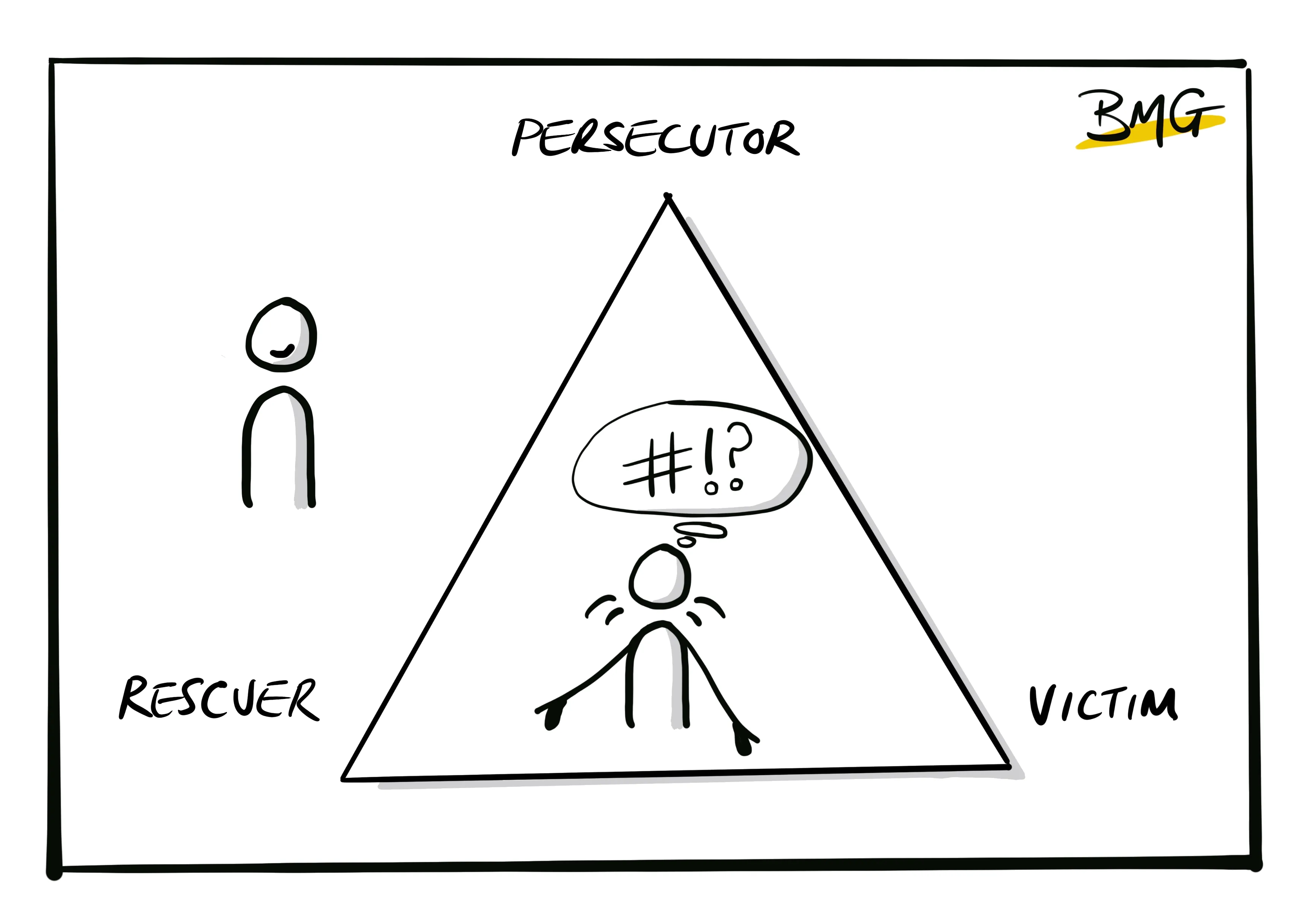
The Karpman Drama Triangle, a model developed in the late 1960s by psychologist Stephen Karpman, offers a lens through which to view these unhealthy patterns.
It names three roles (Victim, Rescuer, and Persecutor) and shows how we unconsciously move between them in moments of stress, conflict, or poor communication.
In coaching, leadership, and everyday relationships, learning to spot this triangle is a game changer, because once you learn how to see it, you see it everywhere.
The good news is, you can step out of it.
Quite easily as it happens.
Understanding the Triangle
Each role in the drama triangle has its own story, emotional hook, and unintended consequence:
Victim
The mindset: “Why does this always happen to me?”
The victim feels powerless, helpless, and overwhelmed.
But the trap is this: by remaining in this role, they outsource agency,and reinforce the belief that they cannot change their circumstances.
Rescuer
The mindset: “Let me fix it for you.”
The rescuer swoops in to save the victim, often with good intentions.
But the trap? They create dependency, erode boundaries, and burn out in the process.
Persecutor
The mindset: “This is your fault.”
The persecutor blames, criticises, or controls … often from frustration or fear.
The trap is that it breeds defensiveness and disconnection, and perpetuates a toxic cycle.
A Word of Caution
It’s important that you remember this:
You can shift between roles rapidly.
You can start as the rescuer and end up the victim.
You can feel persecuted and lash out as the persecutor.
It’s dynamic, sticky, and entirely human.
How the Triangle Shows Up
The Drama Triangle shows up everywhere. In families, friendships, and most interactions.
A parent constantly steps in to shield their child from discomfort (rescuer), but over time feels exhausted and unappreciated (victim), eventually lashing out with controlling rules or guilt (persecutor).
A friend complains that no one ever helps them (victim), then ignores offers of support, only to later accuse others of being unreliable (persecutor), prompting another friend to overextend themselves to “fix” the situation (rescuer).
A partner feels unacknowledged (victim), begins criticising their spouse’s habits (persecutor), then overcompensates by doing everything themselves to keep the peace (rescuer).
These are cycles dysfunctional moments. Familiar, human, and often invisible until we name them.
And it doesn’t stop at home.
This triangle plays out in offices, boardrooms, and Teams/Slack channels all over the business world.
A leader over-functions to fix a struggling team (rescuer), then resents being overburdened (victim), and finally snaps at a colleague (persecutor).
A team member avoids accountability (victim), relies too heavily on their manager (rescuer), then accuses them of micromanagement (persecutor).
Two peers locked in cycles of subtle blame, reluctant help, and unmet needs … each convinced they’re the one being reasonable.
In high-pressure environments, the triangle thrives on stress, urgency, and unspoken expectations.
And the more intense the atmosphere, the easier it is to fall into the roles without even realising it.
A quick pause
If this is helpful, my free guide goes deeper, and the newsletter brings ideas like this twice a week.
My book, High-Fidelity Leadership, explores these same themes in more depth, with practical frameworks for standards, clarity, and the conversations that leaders avoid for too long.
Shifting from Drama to Empowerment
The antidote to drama is consciousness and awareness.
Here’s how we flip the script:
From Victim to Creator
Ask: What do I want out of this?
The creator takes ownership. They recognise constraints but focus on possibilities and action.
From Rescuer to Coach
Ask: How can I support this person/situation without taking over?
The coach empowers. They listen, ask questions, and trust others to find their own solutions.
From Persecutor to Challenger
Ask: What needs to be addressed here with respect and clarity?
The challenger brings honesty. They hold the line, give feedback, and challenge growth … without blame.
This shift is beautifully captured in David Emerald’s follow-up model, The Empowerment Dynamic, which reframes the triangle with healthier alternatives.
The key? Awareness & intention.
You can’t avoid getting pulled in sometimes … but you can choose how you respond to get out again.
When I’ve Played All Three
There have been days, weeks even, where I’ve unknowingly played every role on the triangle.
I’ve tried to rescue - stepping in too soon, trying to shield someone from discomfort instead of letting them grow.
I’ve felt like the victim - stuck, unheard, burdened by expectations to have all the answers.
And yes, I’ve been the persecutor - short-tempered, sharp, convinced that everyone but me was the problem.
But what shifted things was this realisation:
You don’t need to be perfect to escape the triangle. You just need to own your current role within it and choose again - wisely.
Each time I notice the triangle, I see an invitation. Not to get sucked in, to blame or spiral, but to pause, reflect, and return to what matters.
The insight to notice and recognise the roles in the triangle are like having a superpower - if you know, you know - and when you know, the exit is far easier to find, leaving those trapped behind confused and wondering what just happened.
You see, I’ve found that those stuck in the triangle, want you in there. They can’t help themselves.
The triangle must be fed to survive.
Reflection Prompts
Which of the roles do you most often default to under pressure?
What does that role give you, and what does it cost you?
How would it feel to shift from fixing to coaching? From blame to challenge?
Where do you need to reclaim agency in your own life or leadership?
What would a drama-free response have looked like in a recent situation?
Final Thought
I think we can use The Karpman Drama Triangle as a pocket mirror.
We can take it with us anywhere and every glance in it shows us how we avoid responsibility, seek control, or bypass discomfort.
I hope that reading this today leads you to further research and understanding on the triangle, because drama doesn’t have to be our destiny.
We can choose differently. Pause. Shift. Recognise. Move.
We can live with awareness instead of reaction, because as I am sure you’ve come to understand, even the very best informed people can’t avoid conflict.
That would be impossible.
Those that know step through it - clearly, courageously, and without the costume.
Leave the drama to the actors, because life isn’t about performing, it’s about owning your presence.
The most powerful move you can make is to step out of the triangle, into the truth.
Take the first step with that knowing smile and an internal thought lighting your path to the exit …
“I see what you did there, I’m choosing not to engage, the exit is this way, are you coming?”
Remember, the path to extraordinary is walked with a thousand small steps, you’re doing great!
Your Small Steps
How do I know if I’m in the drama triangle?
If you feel stuck, resentful, overly responsible, or reactive, you’re likely playing one of the roles.
Action: Reflect on a recent tense situation. Which role were you in? What role were others playing?
Can these roles be unconscious?
Absolutely. Most people don’t intend to play victim, rescuer, or persecutor. These are learned responses - coping mechanisms, not character flaws.
Action: Bring awareness without blame. Use notes or journaling to spot patterns in your responses.
What’s the fastest way to step out of the triangle?
Pause and shift the question. Instead of “Who’s to blame?”, ask “What’s my responsibility?” or “What’s possible from here?”
Action: In your next moment of tension, try using the creator, coach, or challenger lens. Speak from clarity, not emotion.
What if someone else keeps pulling me into drama?
You can’t control others but you can choose how you engage. Stay grounded in your chosen role, and don’t take the bait.
Action: Practise “empathetic boundaries” … be kind, but clear. Refuse the role without rejecting the person.
How can I teach this model to others, or my team?
It makes a great conversation point, workshop or team session. Use stickman visuals, stories, or even role play. In my experience, people often find it eye-opening and oddly familiar (to those that don’t know).

Barry Marshall-Graham
Executive coach and leadership advisor
Get the Difficult Conversations Guide
A practical resource for leaders who want to say the thing that needs saying, without burning bridges or avoiding the moment.
Keep reading
31 August 2026
The Sentence They Nearly Said
A pause or changed expression may lead to the useful part of a conversation, but noticing it doesn't give the coach permission to decode it.
24 August 2026
You Cannot Coach Someone You Are Secretly Judging
Second-hand information may be useful, but once it becomes a character verdict it changes the leader’s listening, questions and tone.
17 August 2026
A Good Question Can Be Badly Timed
The wording may be excellent, but a coaching question can still arrive before the relationship or the moment is ready to carry it.
10 August 2026
Whose Goal Is It Anyway?
A goal can be strategically sensible and still feel unowned. The answer is honest internalisation, not coaching somebody into believing it was their idea.
3 August 2026
The Leader Who Uses Coaching to Avoid Leading
Coaching can create room for another person to think, but it can also help a leader postpone the feedback, standard or decision that belongs to them.
27 July 2026
Advice Wearing a Hat
A coaching question can sound wonderfully curious while quietly steering somebody towards the answer their leader already prefers.
20 July 2026
The Emotional Cost of Being the Reliable One
Reliability earns trust, but it can also turn one capable leader into the place where unfinished work, uncertainty, and organisational risk accumulate.
13 July 2026
The Relief of Finally Saying the Thing
An overdue conversation occupies far more space than the words themselves. Relief begins when reality is finally allowed back into the room.
6 July 2026
The Sideways Shove
Peer conflict cannot be solved with the Manager Card. Influence begins when leaders stop pushing across borders and repair the working relationship.
29 June 2026
Clarity Under Pressure
Authority is tested when the room tightens. Clear leaders make reality, uncertainty, and the next decision visible without adding drama.