Lead People, Manage Things
8 December 2025
Why great leadership begins the moment you stop treating people like tasks.
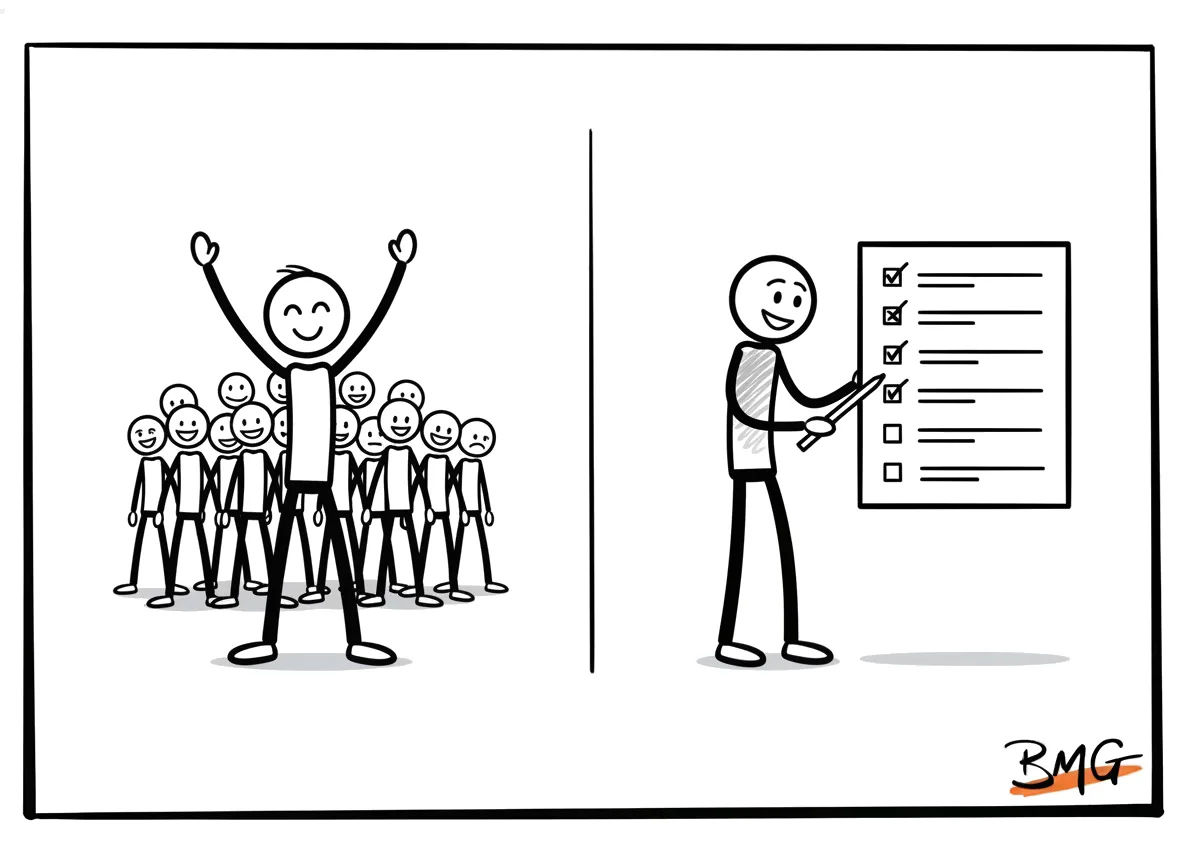
There’s a quiet change that happens to leaders under pressure.
It’s not deliberate (or malicious), but in my experience it’s quite common.
People slowly turn into tasks.
Conversations become updates.
1:1s become status checks - “What have you been up to?” vs “What are your goals?”.
Coaching becomes troubleshooting - “I know the answer you need” vs “I can help you discover the answer within yourself”.
And leadership becomes … management.
It’s subtle, but the effect is profound, because when we start managing people the way we manage processes or spreadsheets, something essential breaks.
We might still get compliance (but lose commitment).
We might get progress (but lose meaning).
We might get activity (but lose trust).
This unveils a simple truth:
Things need managing. People need leading.
From Control to Connection
Processes, systems, budgets, projects … these need managing.
They require structure, predictability, checklists, and KPIs.
People are different.
People require connection, understanding, motivation, trust, autonomy, belonging …. and many more besides
We cannot spreadsheet our way to a high-performing team (although many have tried - I’ve seen it).
People don’t grow when handled like tasks.
They grow when they feel seen, heard, valued, and supported.
This is why great leaders consistently separate the two worlds:
Manage the work - Lead the human.
Don’t collapse them into one and the same.
When we manage everything and everyone equally, we end up tightening the system for sure, but we also lose the people and the community.
What Leading People Actually Looks Like
Leading people means:
Asking what they need, not what they’re doing.
Helping them see their strengths, not their gaps.
Giving them space to decide, not tasks to complete.
Listening more deeply than is felt necessary.
Understanding their context, not their output.
Coaching their potential, not policing their performance.
Think about this … we can easily assign tasks to a calendar, but we can’t easily assign belief to a person.
Real leadership recognises the human behind the responsibility - the hopes, fears, values, gifts, challenges, and inner stories that shape how they show up.
Reflection Prompts
Where do you catch yourself managing people rather than leading them?
Which conversations lately felt more like checklists than connections?
What does your team truly need from you that a task list can’t provide?
How would your leadership change if you focused on developing people rather than organising them?
What would it look like to lead with curiosity instead of control this week?
Final Thought: Lead the Human First
You can automate processes.
You can optimise workflows.
You can refine systems endlessly.
But people?
People require presence, patience, and understanding.
The leaders who forget this become efficient, but never inspiring. Perhaps they deliver efficiency, but rarely greatness.
Leaders who operate in this way manage, but never lead.
So never forget:
The spreadsheets and plans don’t need your empathy.
The processes don’t need your belief.
The systems don’t need your courage.
But your people do.
Lead them first.
Manage the rest.
Remember, the path to extraordinary is walked with a thousand small steps, you’re doing great!
Your Small Steps
How do I know if I’m treating people like tasks?
If conversations centre only on deadlines, updates, and output, you’ve slipped into management mode.
Action: In your next 1:1, ask, “What’s one thing you need from me this week?”
What’s the biggest risk of managing people instead of leading them?
You lose trust, psychological safety, and long-term performance.
Can I lead and manage at the same time?
Yes … but only if you keep them distinct. Lead the person; manage the work.
Action: Before each meeting, decide: “Is this a leadership conversation or a management one?”
What if someone just wants to be managed, not led?
People rarely want less support, they want appropriate support.
Action: Ask them directly: “How would you like me to support you?”
How do I shift from control to empowerment?
Start by giving ownership, not just tasks.
Action: Let one team member make a decision this week without your approval.
What’s one simple behaviour that makes me a better leader?
Listen longer than feels comfortable.
Action: In your next conversation, wait two full seconds before responding.
How can I teach this mindset to my team?
Model it. People learn leadership by experience, not instruction.
Action: Choose one person this week to intentionally lead, not manage.

Barry Marshall-Graham
Executive coach and leadership advisor
Get the Difficult Conversations Guide
A practical resource for leaders who want to say the thing that needs saying, without burning bridges or avoiding the moment.
Keep reading
31 August 2026
The Sentence They Nearly Said
A pause or changed expression may lead to the useful part of a conversation, but noticing it doesn't give the coach permission to decode it.
24 August 2026
You Cannot Coach Someone You Are Secretly Judging
Second-hand information may be useful, but once it becomes a character verdict it changes the leader’s listening, questions and tone.
17 August 2026
A Good Question Can Be Badly Timed
The wording may be excellent, but a coaching question can still arrive before the relationship or the moment is ready to carry it.
10 August 2026
Whose Goal Is It Anyway?
A goal can be strategically sensible and still feel unowned. The answer is honest internalisation, not coaching somebody into believing it was their idea.
3 August 2026
The Leader Who Uses Coaching to Avoid Leading
Coaching can create room for another person to think, but it can also help a leader postpone the feedback, standard or decision that belongs to them.
27 July 2026
Advice Wearing a Hat
A coaching question can sound wonderfully curious while quietly steering somebody towards the answer their leader already prefers.
20 July 2026
The Emotional Cost of Being the Reliable One
Reliability earns trust, but it can also turn one capable leader into the place where unfinished work, uncertainty, and organisational risk accumulate.
13 July 2026
The Relief of Finally Saying the Thing
An overdue conversation occupies far more space than the words themselves. Relief begins when reality is finally allowed back into the room.
6 July 2026
The Sideways Shove
Peer conflict cannot be solved with the Manager Card. Influence begins when leaders stop pushing across borders and repair the working relationship.
29 June 2026
Clarity Under Pressure
Authority is tested when the room tightens. Clear leaders make reality, uncertainty, and the next decision visible without adding drama.