Spend Your Attention Wisely
2 June 2025
Reclaim Your Focus in an Ever More Distracting World
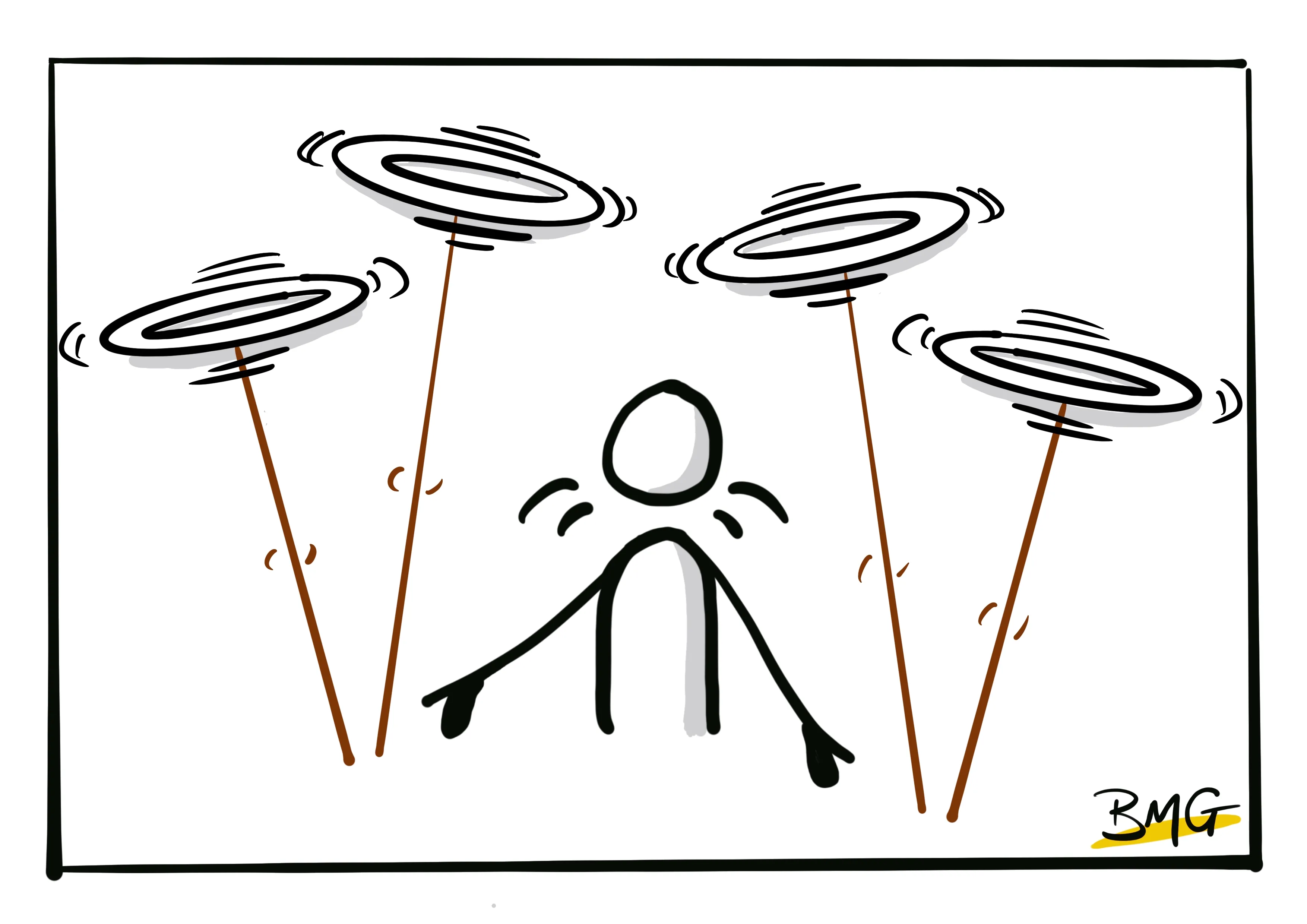
“The truth is, you are not failing to focus. Your focus is being stolen.”
- Johann Hari
We’re all familiar with time management. But how often do we speak about attention management?
In Johann Hari’s Stolen Focus, he makes a compelling case: the real scarcity we face isn’t time … its capacity.
Think of a “normal” day for us, filled with endless pings, shifting priorities, and dopamine-triggering digital distractions
Our ability to focus has been hijacked.
Hijacked by the systems, technologies, and cultural norms we’ve built around us.
For leaders, creatives, professionals, and parents alike, this isn’t just a productivity issue - it’s an existential one.
Because how we use our attention shapes who we become.
Learning to Spend Wisely
As you have read in previous articles, for a very (VERY) long time, I wore busyness as a badge.
Back-to-back meetings. Constant inbox checking. Jumping between tools, platforms, channels … trying to keep up, to stay ahead, to be involved in the detail, and to have it all when it was requested.
But I noticed something:
The more I did, the less I thought.
The more I responded, the less I reflected.
I was confusing motion with momentum; noise with importance.
Reading Stolen Focus by Johann Hari, reminded me that being present isn’t indulgent. It’s essential.
As their leader, my teams do not want me to simply react. They trust me to think.
And that requires space.
So now, I protect that space more fiercely.
Not perfectly. But intentionally.
What follows are some of my thoughts and reflections on Stolen Focus.
Focus Isn’t Just a Skill. It’s an Environment
Hari draws attention to something most of us feel but struggle to name: that focus is less about personal discipline and more about environmental design.
We live in a culture engineered to fragment our minds.
Algorithms thrive on outrage. Notifications demand urgency. Tasks are stacked on tasks, layered with meetings, messages, and more messages about the meetings.
Our focus, therefore is not lost … it’s stolen from us.
The more we pretend this is a personal failing, the more we allow the true culprits to escape scrutiny.
Leadership insight: Instead of asking, “How can my team focus more?”, ask, “What’s stealing their focus … and how can I resolve it?”
The Myth of Infinite Capacity
Hari reminds us of an uncomfortable truth: we are finite.
Our attention has a limit.
Our energy has a ceiling.
Our minds cannot multitask effectively, no matter how much we believe otherwise.
Trying to keep up with everything (every update, every demand, every change in priority) isn’t at all noble.
It’s absolutely unsustainable.
The brain fatigues, our mind scatters, and slowly, so does our sense of self.
If we treat our attention like an unlimited resource, we’ll spend it on everything … and invest it in nothing.
Coaching prompt: Where are you leaking attention? What would it look like to spend it like it mattered?
Technology Isn’t Neutral
One of Hari’s most striking assertions is that technology isn’t passive, it’s persuasive.
Most platforms don’t exist to serve your focus. They exist to monetise your distraction. Every swipe, like, ping, and scroll is carefully engineered to keep you on platform, in loop, out of depth.
You become a Doom Scroller.
This doesn’t mean we should go off-grid completely.
It means we need to become conscious of designing our tools - not being designed by them.
Do your tools support deep work, or fast reactions?
Do they facilitate meaningful connection, or just constant availability?
Does that email you are reading need your attention, or is someone making the basic declaration that “look, I too am busy”
Leadership reflection: What digital norms exist in your team? Do you celebrate responsiveness over reflection? Activity over focus?
A quick pause
If this is helpful, my free guide goes deeper, and the newsletter brings ideas like this twice a week.
My book, High-Fidelity Leadership, explores these same themes in more depth, with practical frameworks for standards, clarity, and the conversations that leaders avoid for too long.
The Loss of Deep Thinking
At the heart of Stolen Focus is a loss we don’t talk about enough: the ability to think deeply.
When our attention is shattered, so is our capacity to reflect, to imagine, to make sense of complexity.
We skim. We scroll. We react.
But depth?
Depth takes stillness. Spaciousness. Time without interruption.
People today need depth more than ever. In a world of speed, wisdom becomes the differentiator.
And wisdom cannot be rushed.
Team insight: What rhythms in your culture promote surface over substance? Where might you make room for slow, uninterrupted thought?
The Path Back to Attention
Hari doesn’t just diagnose the problem. He offers a path forward.
Reclaiming our focus is possible, but it isn’t found doing more.
It’s found doing less, better.
Create spaces for deep work. At least a few hours a week.
Normalise digital hygiene … like email-free periods (in my own case sometimes days) or meeting-free mornings.
Protect time for rest, because cognitive renewal isn’t optional.
Encourage mono-tasking … it’s where true quality lives.
Shift cultural norms - from “always on” to “thoughtfully present.”
And most of all: treat your attention like it’s sacred.
Because it is.
Reflection Prompts
Where is your attention most often pulled … and is it aligned with your values?
What systems or habits are stealing focus from you, and/or the people around you?
What does “enough” look like when it comes to work, screen time, or availability?
How would your life change if you prioritised depth over speed?
What boundaries or rhythms could you reintroduce to protect your capacity?
Final Thought
We protect what we value.
We lock away our money, insure our homes, and safeguard our passwords.
But what about the one thing we spend every minute of our lives using?
Attention is not just a tool … it’s the foundation of choice, presence, and power.
You can’t work well if your mind is somewhere else.
You can’t live fully if your focus is always stolen.
So take it back.
Bit by bit.
Not with guilt, with grace.
Because what you attend to intentionally, becomes what you become.
Remember, the path to extraordinary is walked with a thousand small steps, you’re doing great!
Want to learn more? Let's grow together!
Your Small Steps
How do I know if I’m overwhelmed or just busy?
Overwhelm tends to feel like fragmentation. A sense that you’re reacting more than thinking, that nothing is ever quite finished, and everything feels urgent.
Action: Try a focus audit: for two days, track your attention in 30-minute blocks. See what’s reactive vs. intentional.
Can I improve my focus without cutting tech entirely?
Absolutely. It’s not about rejection, it’s about intention. Use tech that serves your goals, not the platform’s metrics.
Action: Choose one app or platform to use more consciously this week. Set time limits or use it only during specific hours.
How can I support my team’s focus?
Model it. Create meeting-free zones. Honour focus time. Celebrate outcomes, not just activities.
Action: Run a team retrospective like meeting titled “What’s Stealing Our Focus?” Capture opinions and create actions together.
What if I don’t have time for deep work?
You don’t have time for distraction. Even one protected hour per week of uninterrupted thought is better than none.
Action: Book a weekly “thinking hour” into your diary. Honour it like a client meeting.
How can I rebuild my ability to focus long-term?
Like any muscle, attention can be trained. Start small. Remove distractions. Increase intervals. Celebrate stillness.
Action: Try 10 minutes of mono-tasking today. Do one thing with full attention. Reflect on how it felt. I’m willing to bet you like it.

Barry Marshall-Graham
Executive coach and leadership advisor
Get the Difficult Conversations Guide
A practical resource for leaders who want to say the thing that needs saying, without burning bridges or avoiding the moment.
Keep reading
31 August 2026
The Sentence They Nearly Said
A pause or changed expression may lead to the useful part of a conversation, but noticing it doesn't give the coach permission to decode it.
24 August 2026
You Cannot Coach Someone You Are Secretly Judging
Second-hand information may be useful, but once it becomes a character verdict it changes the leader’s listening, questions and tone.
17 August 2026
A Good Question Can Be Badly Timed
The wording may be excellent, but a coaching question can still arrive before the relationship or the moment is ready to carry it.
10 August 2026
Whose Goal Is It Anyway?
A goal can be strategically sensible and still feel unowned. The answer is honest internalisation, not coaching somebody into believing it was their idea.
3 August 2026
The Leader Who Uses Coaching to Avoid Leading
Coaching can create room for another person to think, but it can also help a leader postpone the feedback, standard or decision that belongs to them.
27 July 2026
Advice Wearing a Hat
A coaching question can sound wonderfully curious while quietly steering somebody towards the answer their leader already prefers.
20 July 2026
The Emotional Cost of Being the Reliable One
Reliability earns trust, but it can also turn one capable leader into the place where unfinished work, uncertainty, and organisational risk accumulate.

13 July 2026
The Relief of Finally Saying the Thing
An overdue conversation occupies far more space than the words themselves. Relief begins when reality is finally allowed back into the room.
6 July 2026
The Sideways Shove
Peer conflict cannot be solved with the Manager Card. Influence begins when leaders stop pushing across borders and repair the working relationship.
29 June 2026
Clarity Under Pressure
Authority is tested when the room tightens. Clear leaders make reality, uncertainty, and the next decision visible without adding drama.