The Beliefs That Hold You Back
10 November 2025
How the stories we tell ourselves quietly shape what we think we’re capable of
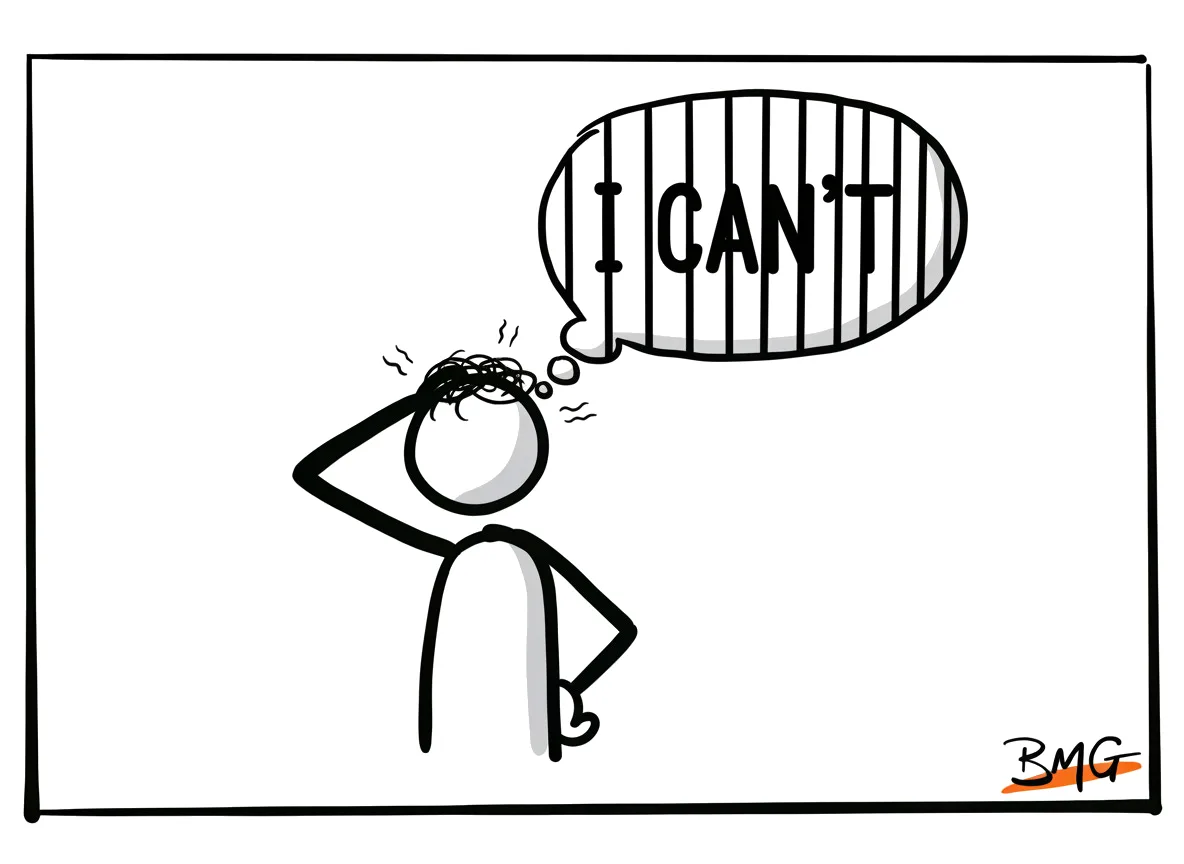
Beliefs are just thoughts that are taken seriously for a long time.
Stop for a second and think about that.
It’s such a simple idea, and yet, most of us underestimate its power because the thoughts we repeat eventually become the stories we live by.
Of course, those stories, once embedded, begin to shape everything: what we attempt, what we avoid, how we lead, and how we respond to challenge.
In leadership, this is our silent saboteur.
Even the most capable people are not always held back by skill, they are held back by beliefs they themselves have quietly built over years:
“I’m not ready.”
“I’m not as smart as they are.”
“I always mess up under pressure.”
“This team doesn’t listen to me.”
Each one of those started as a thought … perhaps fleeting, momentary, easy to dismiss.
However, taken seriously for long enough, those thoughts become self-fulfilling truths.
How Beliefs Form (And Why They Stick)
Beliefs are efficiency tools for the brain. They simplify the world, filter information, and save us from overthinking every moment.
The trouble is, once a belief forms, the mind looks for evidence to confirm its truth. Psychologists call this confirmation bias.
We ignore data that contradicts the story and overvalue data that supports it.
If you believe you’re bad at public speaking, every stutter reinforces that story, while every confident sentence goes unnoticed.
If you believe your team doesn’t respect you, every silence feels like proof.
Over time, these beliefs harden into identity. They stop being ideas you have and start becoming truths you live by.
And that’s when your leadership gets smaller and much more difficult to manage mentally.
Question the Story, Not the Situation
The good news is that even the most hardened beliefs can be changed.
They are not facts … they are narratives we have told ourselves over and over.
The shift begins by catching the thought before it hardens.
Ask:
“Is this really true, or am I trying to convince myself its true?”
“What evidence am I ignoring?”
“If someone I respect held this belief, what would I tell them?”
In coaching, one of the most powerful moments comes when a leader realises: the problem isn’t the circumstance … it’s the story they are telling themselves about it.
When that story changes, new options appear.
Confidence returns.
Capabilities expand.
The external world didn’t shift … the internal one did.
A quick pause
If this is helpful, my free guide goes deeper, and the newsletter brings ideas like this twice a week.
My book, High-Fidelity Leadership, explores these same themes in more depth, with practical frameworks for standards, clarity, and the conversations that leaders avoid for too long.
A Personal Reflection
One of many I can think of used to be that if I wasn’t in constant motion, I wasn’t adding value. It made me busy, visible, productive … and, eventually (even recently), exhausted.
This is the one limiting belief that I continue to have to catch time and time again. As soon as I do catch myself and reframe the belief from “movement equals value” to “impact equals value”, everything changes.
My leadership gets calmer. My decisions become sharper. The right path appears - as if from nowhere.
This belief, that to be effective I have to be visibly active, has not been protecting me … it has been quietly running me.
I now very often realise that the most powerful move isn’t to act - but to hold presence.
Be still. Say nothing. Find clarity in calm.
Reflection Prompts
What belief about yourself or your leadership feels heavy or limiting?
When did you first start believing it, and what might have reinforced it?
What would it look like if you stopped taking that thought seriously?
What new story could you tell yourself instead?
How might your leadership expand if you believed something different?
Final Thought
Our mind’s greatest trick is convincing us that the stories it tells us are the truth.
But beliefs are optional. They are malleable. They are thoughts on repeat … not laws of physics.
When we stop treating them as fixed, we reclaim our freedom to choose new ones.
To choose rewrite the script.
To lead from awareness, not autopilot.
My challenge for you this week: catch one of your long-held thoughts and look at it through fresh eyes.
Ask yourself: Is this really true, or have I just believed it for too long?
The leaders who grow are the ones who stop worshipping their beliefs … and start editing them.
Remember, the path to extraordinary is walked with a thousand small steps, and you’re doing great!
Your Small Steps
How do I recognise a limiting belief?
Look for absolutes: “I always,” “I never,” “I can’t.”
These are clues to rigid thinking.
Action: Write down one of these statements and reframe it to include possibility (“Sometimes I struggle with…”).
Can beliefs really change that easily?
Yes, but they need evidence. Change the behaviour first, and the belief will follow.
Action: Choose one small action that contradicts your limiting belief today.
Why do we hold on to beliefs that hurt us?
Because they create predictability. Familiar discomfort feels safer than the unknown.
Action: Ask yourself, “What would I gain by letting this belief go?”
How can I help my team with their limiting beliefs?
Reflect what you see without judgement. Use coaching questions like “What else could be true here?”
Action: Introduce a 10-minute belief reflection in your next 1:1 conversation.
What’s the danger of unchecked beliefs in leadership?
They create blind spots. Teams inherit what leaders believe.
Action: Audit your leadership statements this week. Are they open, or fixed?
How can I build new, empowering beliefs?
By repetition and evidence. Speak them, write them, act on them. The brain learns through proof.
Action: Write one belief you want to embody and read it daily for 21 days.

Barry Marshall-Graham
Executive coach and leadership advisor
Get the Difficult Conversations Guide
A practical resource for leaders who want to say the thing that needs saying, without burning bridges or avoiding the moment.
Keep reading
31 August 2026
The Sentence They Nearly Said
A pause or changed expression may lead to the useful part of a conversation, but noticing it doesn't give the coach permission to decode it.
24 August 2026
You Cannot Coach Someone You Are Secretly Judging
Second-hand information may be useful, but once it becomes a character verdict it changes the leader’s listening, questions and tone.
17 August 2026
A Good Question Can Be Badly Timed
The wording may be excellent, but a coaching question can still arrive before the relationship or the moment is ready to carry it.
10 August 2026
Whose Goal Is It Anyway?
A goal can be strategically sensible and still feel unowned. The answer is honest internalisation, not coaching somebody into believing it was their idea.
3 August 2026
The Leader Who Uses Coaching to Avoid Leading
Coaching can create room for another person to think, but it can also help a leader postpone the feedback, standard or decision that belongs to them.
27 July 2026
Advice Wearing a Hat
A coaching question can sound wonderfully curious while quietly steering somebody towards the answer their leader already prefers.
20 July 2026
The Emotional Cost of Being the Reliable One
Reliability earns trust, but it can also turn one capable leader into the place where unfinished work, uncertainty, and organisational risk accumulate.
13 July 2026
The Relief of Finally Saying the Thing
An overdue conversation occupies far more space than the words themselves. Relief begins when reality is finally allowed back into the room.
6 July 2026
The Sideways Shove
Peer conflict cannot be solved with the Manager Card. Influence begins when leaders stop pushing across borders and repair the working relationship.
29 June 2026
Clarity Under Pressure
Authority is tested when the room tightens. Clear leaders make reality, uncertainty, and the next decision visible without adding drama.