The Climb Within
19 May 2025
The Psychology of What People Need - And How We Can Respond
“What a man can be, he must be.” , Abraham Maslow
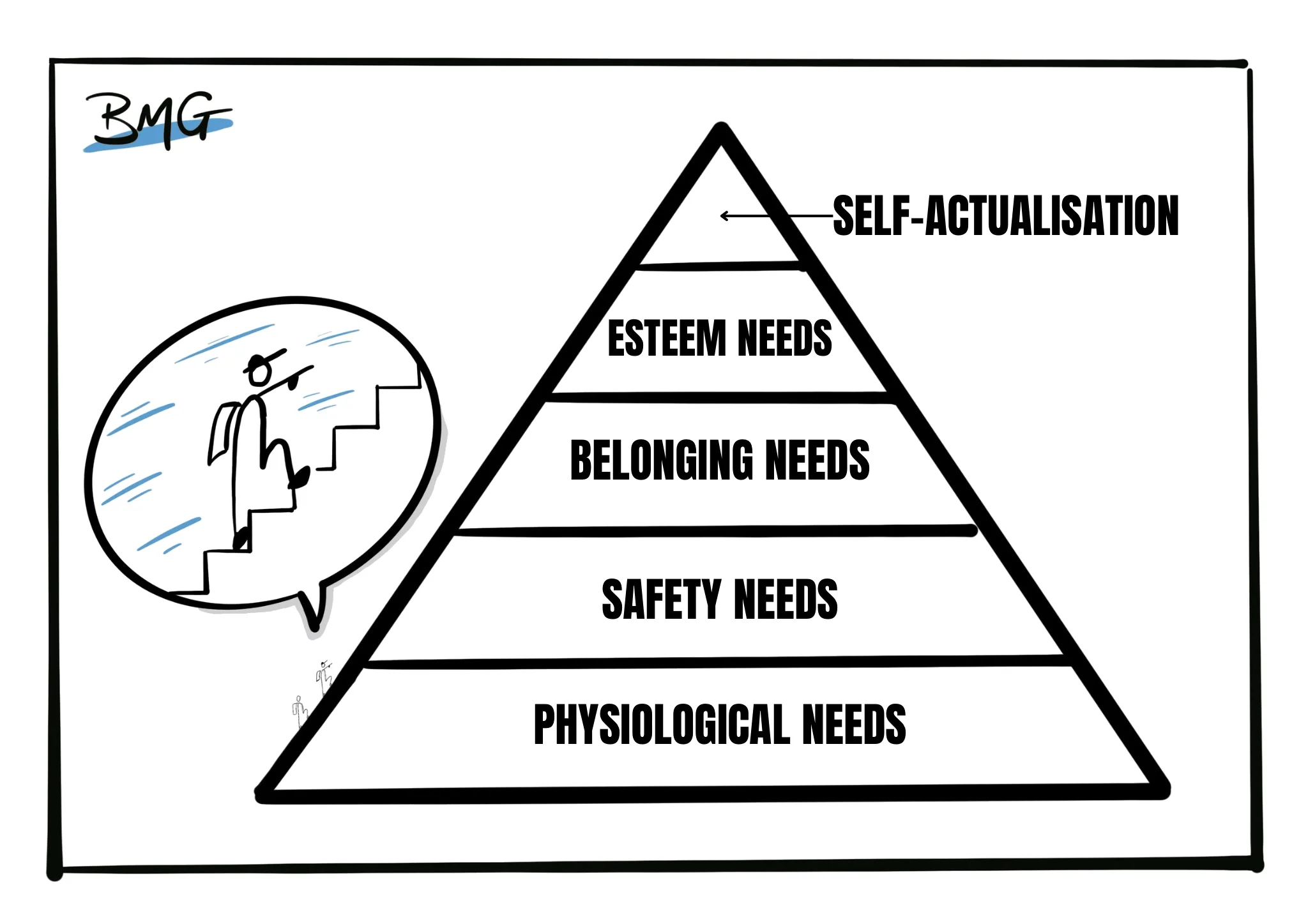
Abraham Maslow’s Hierarchy of Needs remains one of the most enduring and intuitive frameworks in psychology and leadership development. Far from being just an academic model, Maslow’s pyramid captures something deeply human: our layered journey from survival to significance.
Understanding this journey isn’t just a matter of theory, it’s a practical guide for fostering environments where people truly flourish.
Maslow proposed that we move through five key levels of human need: physiological survival, safety, belonging, esteem, and self-actualisation and that at each level, we seek different forms of stability, recognition, and growth.
What’s profound is that we rarely leave one level behind entirely. We cycle through them as life evolves, as pressure shifts, and as leadership challenges emerge.
In the workplace, these needs don’t disappear … they disguise themselves. Our role is to watch for the clues:
A request for flexible hours may be a physiological or safety need.
A drive for inclusion could reflect a need for belonging.
An unspoken tension around feedback might stem from unfulfilled esteem.
And at the top of the pyramid (the space Maslow called self-actualisation) lives the true magic of leadership: helping others reach their full potential while still striving to realise your own.
So whether you’re coaching a team, leading a business, or navigating your own personal development, Maslow’s framework is a leadership compass.
Let’s walk through the pyramid again but this time, through the lens of practical, human-centred leadership.
Physiological Needs
Supporting Energy and Capacity
At the base of Maslow’s pyramid are the foundational physiological needs: rest, food, hydration, air, and recovery. In a workplace context, these needs translate into energy, sustainability, and access to basic wellbeing.
Leadership in action:
We can’t expect peak performance from a tired, overstretched team. Creating space for breaks, encouraging healthy routines, and modelling balance ourselves is part of responsible leadership.
Subtle signs:
Consistent lateness or fatigue
Short fuses or disengagement
Productivity spikes followed by crashes
When leaders acknowledge these human needs without judgement, they foster trust. When they ignore them, they risk burnout disguised as busyness.
Safety Needs
Building Psychological and Professional Security
Safety goes beyond physical conditions. It includes financial stability, role clarity, consistency, and (perhaps most crucially) psychological safety.
Leadership in action:
We create safety through transparency, follow-through, and empathy. When people feel safe, they take risks, speak up, and stretch.
Subtle signs:
Reluctance to speak in meetings
Withholding ideas or concerns
Resistance to change due to fear of judgement
Safety isn’t the absence of challenge. It’s the presence of trust.
Belonging Needs
Fostering Connection and Inclusion
We are wired for connection. At this level, people seek community, inclusion, shared purpose, and relationships that make them feel seen.
Leadership in action:
Belonging doesn’t happen by accident. It’s created through rituals, relational leadership, and a culture where people feel invited, not just expected to show up.
Subtle signs:
Silence in group settings
“Checking out” behaviour
Division between teams or cliques
Connection fuels commitment. People don’t give their best to organisations …they give their best to relationships within them.
Esteem Needs
Recognising Worth and Contribution
This level reflects our desire to be valued, to be respected, and to know that our work matters. It includes both self-esteem and the esteem we receive from others.
Leadership in action:
Effective leaders recognise effort, celebrate wins, and offer feedback that uplifts without diluting the truth. They help people see the difference they make.
Subtle signs:
Low confidence or hesitancy
Overachievement driven by fear
Withdrawal after criticism
Recognition isn’t indulgence; it’s reinforcement of impact. When people feel seen, they rise.
A quick pause
If this is helpful, my free guide goes deeper, and the newsletter brings ideas like this twice a week.
My book, High-Fidelity Leadership, explores these same themes in more depth, with practical frameworks for standards, clarity, and the conversations that leaders avoid for too long.
Self-Actualisation
Unlocking Purpose and Potential
At the top of the pyramid lies the need for fulfilment - for becoming who we are capable of becoming. This is about meaningful growth and contribution rather than achievement for the sake of it.
Leadership in action:
Great leaders create stretch, autonomy, and alignment. They don’t just manage work - they help shape purpose. They ask questions like:
“Where do you want to grow?”
“What’s lighting you up lately?”
“How can we help you thrive?”
Subtle signs:
Boredom despite competence
Plateauing growth
Subtle disengagement from meaningful work
Actualisation isn’t reserved for the few. With the right support, it’s available to all.
A Journey, Not a Ladder
It’s tempting to imagine the pyramid as a simple to-do list: satisfy one layer, then move on.
In reality, life is messier. We often oscillate between levels.
A sudden crisis can send someone tumbling from self-actualisation back to a focus on basic safety. A new relationship might pull belonging needs sharply into focus. The journey is dynamic, not static.
We must recognise this movement:
A high performer struggling with change might not need more goals - they might need reassurance (safety).
A disengaged employee might not need another KPI - they might crave connection (belonging).
Understanding where someone is operating allows you to meet them there, rather than pushing them up the pyramid prematurely.
Personal Reflection
Maslow’s framework, once you’ve seen it in action, becomes impossible to unsee.
I’ve seen really high performers start to unravel … and this was in no way because they lacked skill, but because they lacked rest.
I’ve seen bright ideas wither because the person behind them didn’t feel safe enough to speak up and fight for their cause.
I’ve seen teams thrive because someone took the time to say, “You made a difference today.”
I firmly believe that Maslow’s framework remains highly relevant in the modern workplace, despite it being over 80 years old:
Remote work has amplified safety and belonging challenges.
Economic uncertainty makes financial safety a sharper concern.
Social media has inflated esteem needs in terms of healthy validation and unhealthy comparison.
Younger generations increasingly seek purpose (self-actualisation and even transcendence) … much earlier in their careers.
The hierarchy isn’t linear in real life. People move between levels every day.
Our role is to notice … and to respond.
And to remember: helping someone rise through those levels is meaningful, human work.
Reflection Prompts
Which level of Maslow’s pyramid feels most dominant for you right now?
Are there areas where you’re trying to operate at a higher level without securing a lower one first?
How often do you pause to consider the needs beneath someone’s behaviour rather than judging it?
What could you do to support belonging and esteem more intentionally in your team or network?
Where might self-actualisation be calling you forward, and what might you need to strengthen first?
Final Thoughts
I think Maslow’s work endures because it’s human, not perfect.
It reminds us that people aren’t just assets.
They are layered, living systems of needs, potential, and purpose.
And leadership, at its best, is the quiet, daily work of helping others climb that pyramid … one level, one moment, one conversation at a time.
Because when people feel safe, seen, and stretched …
They don’t just work.
They come alive.
Remember, the path to extraordinary is walked with a thousand small steps, you’re doing great!
Your Small Steps
Is Maslow’s hierarchy still relevant in modern leadership?
Absolutely. While life and work have evolved, the human needs Maslow identified remain foundational. Understanding them deepens empathy and improves decision-making.
Action:
Choose one person you lead and ask yourself: What level of the pyramid are they operating from right now? Adjust your next conversation accordingly.
Do people move through the pyramid in order?
Not always. Life isn’t linear, and neither are our needs. People often revisit lower levels when circumstances shift. That’s why consistent check-ins and flexibility matter.
Action:
In your next 1:1, ask an open question like: “What’s feeling most supportive for you right now … and what’s missing?”
How can I apply this with a large, diverse team?
Lead with principles, not one-size-fits-all tactics. Create a culture that respects safety, celebrates contributions, and encourages growth. Then personalise where you can.
Action:
Review your team rituals or culture touchpoints. Which level of Maslow’s hierarchy do they most support? What could you introduce to reach another?
Can self-actualisation be a leadership goal?
Yes - and it should be. Leaders who help others reach self-actualisation often build the highest-performing, most fulfilled teams. It’s about nurturing potential, not just managing outcomes.
Action:
Pick one person with high potential and ask: “What would growth look like for you this quarter, beyond just hitting targets?”
What if someone’s needs are clearly unmet but they don’t express it?
Not all needs are verbalised. Observe behaviour, energy, and engagement. Compassionate curiosity often reveals more than direct questioning.
Action:
Check in privately. Say, “I’ve noticed [behaviour], and I want to make sure you’re feeling supported. Is there something we could adjust together?”
How do I use this model for myself as a leader?
Use it as a mirror. Where are you thriving? Where are you stretched thin? Strong leadership starts with self-awareness and groundedness.
Action:
Draw Maslow’s pyramid and write one sentence in each level reflecting how you’re doing right now. Where’s the tension? Where’s the energy?

Barry Marshall-Graham
Executive coach and leadership advisor
Get the Difficult Conversations Guide
A practical resource for leaders who want to say the thing that needs saying, without burning bridges or avoiding the moment.
Keep reading
31 August 2026
The Sentence They Nearly Said
A pause or changed expression may lead to the useful part of a conversation, but noticing it doesn't give the coach permission to decode it.
24 August 2026
You Cannot Coach Someone You Are Secretly Judging
Second-hand information may be useful, but once it becomes a character verdict it changes the leader’s listening, questions and tone.
17 August 2026
A Good Question Can Be Badly Timed
The wording may be excellent, but a coaching question can still arrive before the relationship or the moment is ready to carry it.
10 August 2026
Whose Goal Is It Anyway?
A goal can be strategically sensible and still feel unowned. The answer is honest internalisation, not coaching somebody into believing it was their idea.
3 August 2026
The Leader Who Uses Coaching to Avoid Leading
Coaching can create room for another person to think, but it can also help a leader postpone the feedback, standard or decision that belongs to them.
27 July 2026
Advice Wearing a Hat
A coaching question can sound wonderfully curious while quietly steering somebody towards the answer their leader already prefers.
20 July 2026
The Emotional Cost of Being the Reliable One
Reliability earns trust, but it can also turn one capable leader into the place where unfinished work, uncertainty, and organisational risk accumulate.
13 July 2026
The Relief of Finally Saying the Thing
An overdue conversation occupies far more space than the words themselves. Relief begins when reality is finally allowed back into the room.
6 July 2026
The Sideways Shove
Peer conflict cannot be solved with the Manager Card. Influence begins when leaders stop pushing across borders and repair the working relationship.
29 June 2026
Clarity Under Pressure
Authority is tested when the room tightens. Clear leaders make reality, uncertainty, and the next decision visible without adding drama.