What Your Team Learns When You Fix It Quietly
26 October 2026
When you quietly improve someone's work, they may never see the judgement behind your changes. What would help them do it differently next time?
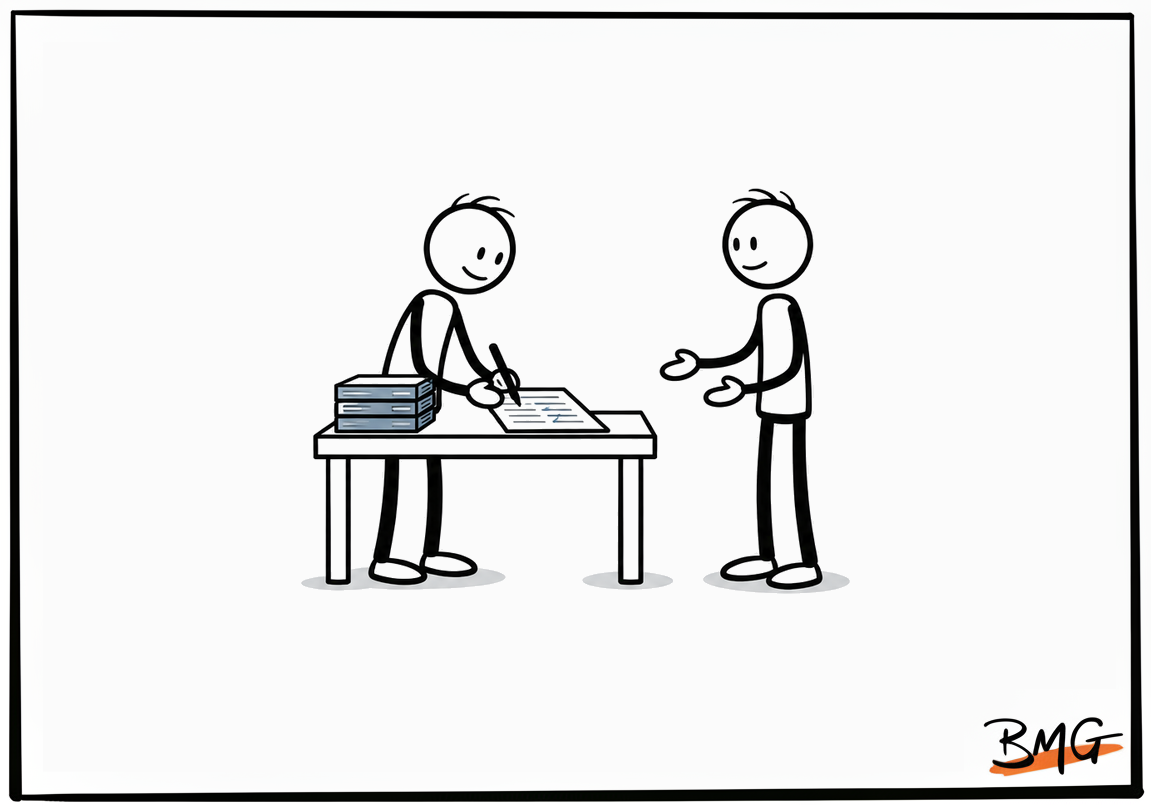
Consider a familiar sort of handover. Someone sends you a paper to check before it goes to a senior meeting. The information is there, but the recommendation needs work. It's difficult to tell what decision the reader is being asked to make.
You could send it back. You could explain where you got lost, ask what they wanted the reader to understand and leave them to have another go. But the meeting is tomorrow, your calendar is full and you already know how you'd fix it.
So you do. You move the recommendation, remove a paragraph and make the choice clearer. Then you send it on, perhaps with a quick message to say you've made a few tweaks.
The paper is better. The deadline is met. Everyone can get on with something else.
Except that your colleague may have missed the most useful part of the work.
They saw the version they gave you. They may see the version that went out. What they haven't necessarily seen is why you changed it, what you noticed or how you decided which parts mattered. A finished document can hide quite a lot of thinking.
What Was In Those Few Tweaks?
Leaders can be surprisingly modest about their editing. ‘Just tidied it up.’ ‘Made it a bit sharper.’ ‘Nothing major.’
Sometimes that's accurate. You corrected a date or removed a repeated sentence, and nobody needs a development conversation about a repeated sentence. But sometimes you've changed the argument or spotted an unsupported assumption. Describing that as a tidy-up makes a substantial piece of judgement sound like you've straightened the stationery.
If the same gap appears next time, it's easy to become irritated. Surely they can see what good looks like by now?
Perhaps they can. Perhaps they've studied the final version and understood your reasoning. It's also possible they've concluded that this is simply how the process works: they produce a draft, you make it ready for the meeting. From their side, that might look like a perfectly reasonable division of labour.
Before deciding they've failed to learn, it's worth asking what we've actually made available for them to learn from.
Michael Bungay Stanier's The Advice Trap explores the urge to supply answers before we've stayed curious long enough. His Advice Monster is recognisable here, even when we're barely speaking. We can take over with a keyboard just as efficiently as we can take over a conversation.
The awkward part is that the answer may be good. Your edit may genuinely improve the work. That doesn't settle whether making it yourself was the most useful contribution you could have made, or whether something still needs to happen afterwards.
A quick pause
If this is helpful, my free guide goes deeper, and the newsletter brings ideas like this twice a week.
My book, High-Fidelity Leadership, explores these same themes in more depth, with practical frameworks for standards, clarity, and the conversations that leaders avoid for too long.
There May Be A Good Reason To Step In
I don't think the answer is to stand beside an urgent problem and offer beautifully open questions while everyone waits for the work to be finished. Sometimes you need to help directly. The consequences matter, the deadline is real, and developing someone doesn't require leaving them exposed when you can prevent it.
The opportunity may come after the immediate pressure has passed.
You can return to one meaningful change and explain it. The original paper's recommendation was buried beneath the three options. You brought it forward because that meeting needed to make a choice. Now there's something concrete to discuss: what did your colleague believe the paper was meant to do? Were they unsure how much background the reader needed, or worried that leading with their recommendation would look presumptuous?
Those are different problems. Quietly rewriting the paper would produce a cleaner document in either case, while leaving you none the wiser about which problem you were solving.
You don't have to conduct a forensic examination of every tracked change. Pick the one that made a difference. Let them explain their thinking as well as listening to yours. There may be information in the original approach that your improvement has accidentally removed.
Then agree what they'll do with the next piece of work, and what help they need from you to do it. A useful conversation should leave them with more than a better understanding of why you're good at editing.
And Sometimes It's Your Preference
There's another possibility that deserves a little honesty. The work was good enough, and you changed it because you like it better your way.
Most leaders have preferences. A particular opening. A preferred order. A phrase they'd never use, although apparently the rest of the English-speaking world is managing quite well with it. After enough rounds of this, a colleague can spend more effort predicting your edits than thinking about the reader.
The distinction matters. If you're asking someone to meet a standard, you should be able to explain what the standard protects or enables. Accuracy. A decision the reader can understand. An assumption that needs checking. If the reason is simply that you'd have written it differently, it's worth noticing that before turning your taste into their performance problem.
Some preferences are useful to share. A senior audience may expect a particular structure, and helping someone understand that is part of the job. But calling everything a standard makes it very hard for another person to exercise their own judgement. They can never quite finish because the final test lives in your head.
This is where a little curiosity can be uncomfortable for the leader too. You may discover that the brief wasn't clear, the permission was missing, or the extra polish you've been providing isn't needed. The conversation needs enough room for those answers.
If one of these situations has been following you around, I've made a short companion to High-Fidelity Leadership called The Conversation You Keep Carrying. You can sign up for book updates and download it free. It's a place to separate what happened from what you've decided it means before choosing your next step; your written answers stay with you.
For now, think of the last substantial correction you made to someone else's work. Could they explain why you made it? Could they use that understanding without you next time?
If you're not sure, you already have somewhere to begin. Open the two versions together and look at the change that mattered.
The path to extraordinary is walked with a thousand small steps, you’re doing great!

Barry Marshall-Graham
Executive coach and leadership advisor
Get the Difficult Conversations Guide
A practical resource for leaders who want to say the thing that needs saying, without burning bridges or avoiding the moment.
Keep reading
2 November 2026
A Book for the Conversation You Keep Putting Off
High-Fidelity Leadership is a book to read and return to when a conversation needs to happen. Here's how I hope you'll make it useful to you.
14 September 2026
Rest Is Not a Reward for Finishing Everything
A proper break doesn't solve every leadership problem, but it can reveal the habits, dependencies and noise that constant availability keeps hidden.
31 August 2026
The Sentence They Nearly Said
A pause or changed expression may lead to the useful part of a conversation, but noticing it doesn't give the coach permission to decode it.
24 August 2026
You Cannot Coach Someone You Are Secretly Judging
Second-hand information may be useful, but once it becomes a character verdict it changes the leader’s listening, questions and tone.
17 August 2026
A Good Question Can Be Badly Timed
The wording may be excellent, but a coaching question can still arrive before the relationship or the moment is ready to carry it.
10 August 2026
Whose Goal Is It Anyway?
A goal can be strategically sensible and still feel unowned. The answer is honest internalisation, not coaching somebody into believing it was their idea.
3 August 2026
The Leader Who Uses Coaching to Avoid Leading
Coaching can create room for another person to think, but it can also help a leader postpone the feedback, standard or decision that belongs to them.
27 July 2026
Advice Wearing a Hat
A coaching question can sound wonderfully curious while quietly steering somebody towards the answer their leader already prefers.
20 July 2026
The Emotional Cost of Being the Reliable One
Reliability earns trust, but it can also turn one capable leader into the place where unfinished work, uncertainty, and organisational risk accumulate.
13 July 2026
The Relief of Finally Saying the Thing
An overdue conversation occupies far more space than the words themselves. Relief begins when reality is finally allowed back into the room.